
Licensing Opportunity: VLP Vaccine Technology for Universal Influenza Virus Vaccine
National Institute of Allergy and Infectious Diseases sent this bulletin at 07/13/2021 01:52 PM EDT

Leading Research to Understand, Treat, and Prevent Infectious, Immunologic, and Allergic Diseases |
    Visit us on the Web |
VLP Vaccine Technology for Universal Influenza Virus Vaccine
Licensing Opportunity
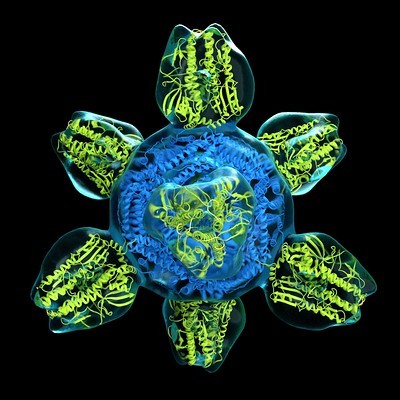
A colorized structure of a prototype for a universal flu vaccine, known as H1ssF_3928, which is being evaluated as part of a Phase 1 clinical trial at the NIH Clinical Center in Bethesda, MD. The vaccine nanoparticle, designed by Jeffrey Boyington (VRC), is a hybrid of a protein scaffold (blue) and eight influenza hemagglutinin proteins arrayed on the surface (yellow). The hemagglutinin protein was specifically engineered to display antibody binding sites common to all human influenza subtypes. The 3D structure of the particle was determined by cryo-electron microscopy by John Gallagher and Audray Harris (Laboratory of Infectious Diseases). Credit: NIAID
Influenza virus is a major public health concern, and the current strategy of reformulating vaccines annually against dominant circulating strains leads to variable protective efficacy and is unlikely to protect against novel influenza viruses with pandemic potential. Thus, there is a great need for a vaccine that provides “universal” protection against influenza viruses.
This is a virus-like particle (VLP) vaccine technology for influenza viruses, based on a mixture of VLPs expressing the hemagglutinin protein or the neuraminidase protein from influenza virus strains belonging to different virus subtypes. The technology has demonstrated broad protection against lethal challenge in mice with various influenza virus strains and virus subtypes. Results from ferret and mouse studies demonstrate broad heterosubtypic protection against various influenza virus subtypes, further supporting and strengthening the proposed application of this technology as a universal influenza virus vaccine.
Read more about this exciting collaboration opportunity at : https://bit.ly/3xD2UQ3
or contact Elizabeth Pitts, Ph.D. at 240-669-5299 or elizabeth.pitts@nih.gov.