|
|
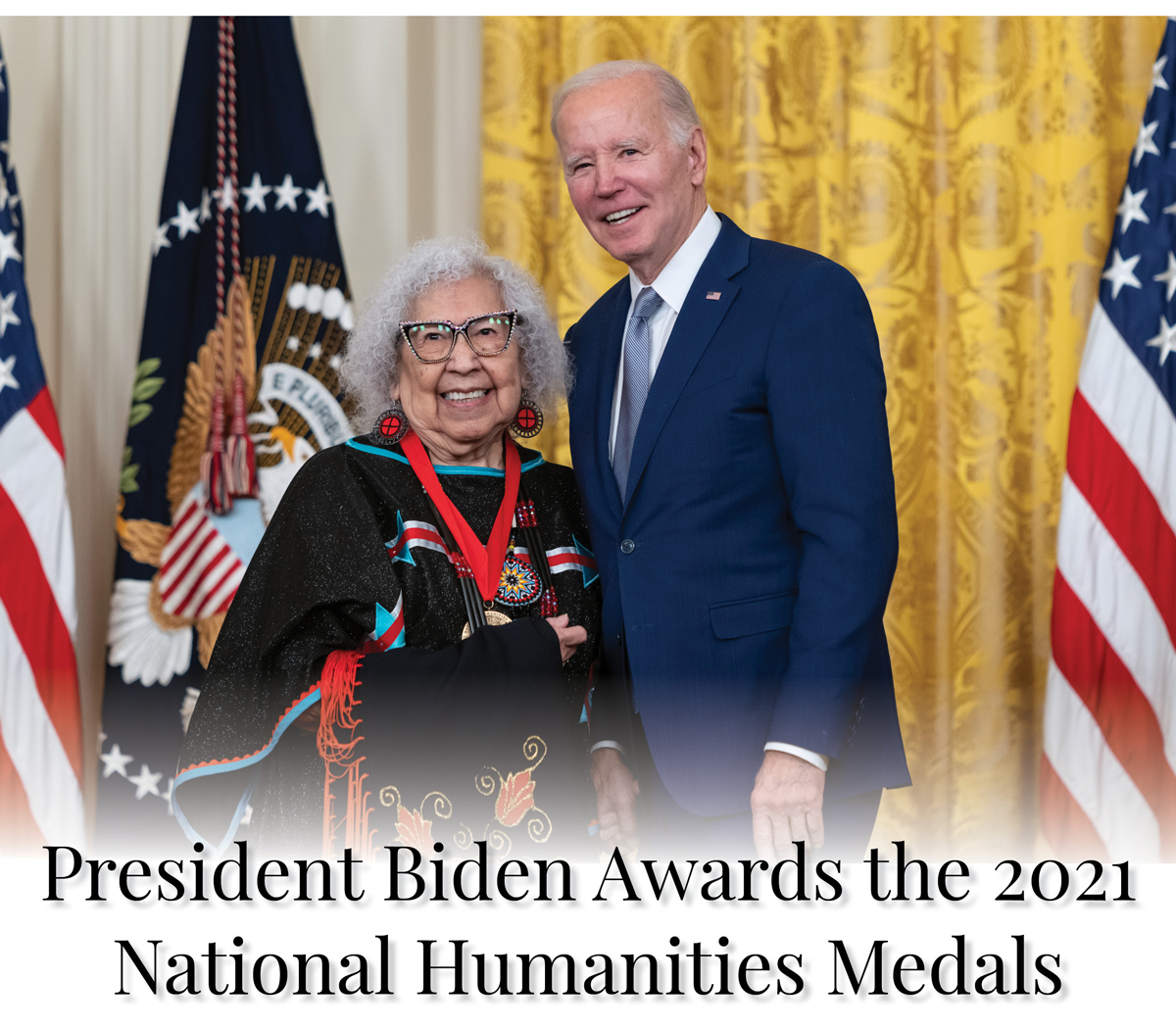
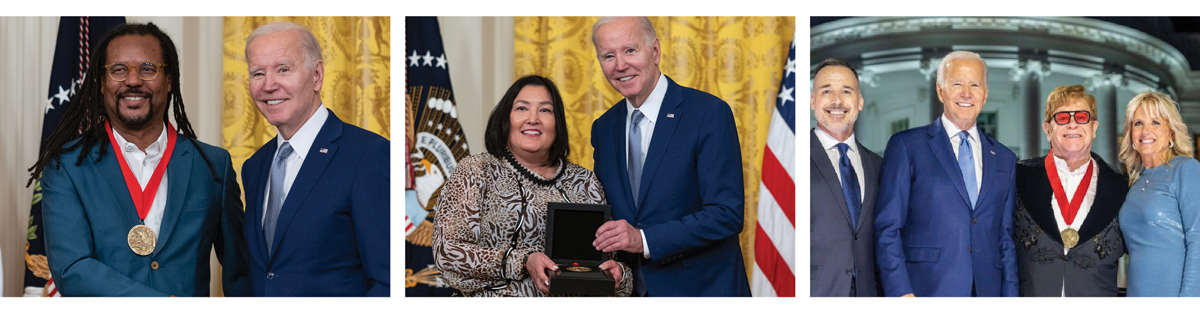
On Tuesday, March 21, 2023, President Joseph R. Biden presented the 2021 National Humanities Medals, honoring a group of 12 distinguished recipients that includes writers, historians, educators, activists, and the first Native American organization to receive the award.
The National Humanities Medal was awarded in conjunction with the National Medal of Arts in a ceremony hosted by President Biden and First Lady Jill Biden and attended by Vice President Kamala Harris and Second Gentleman Doug Emhoff, alongside representatives of the National Endowment for the Humanities (NEH) and National Endowment for the Arts (NEA).
“The work of our honorees is as diverse as the nation that celebrates with them today. But common threads weave them together in many ways in the very fabric of America—the pursuit of excellence, the drive to create, the yearning to connect and the boldness to be truth tellers, bridge builders, and change seekers,” said President Biden during the ceremony, which is now streaming here. These are the 2021 National Humanities Medalists, with excerpts from their profiles:
|
|
|
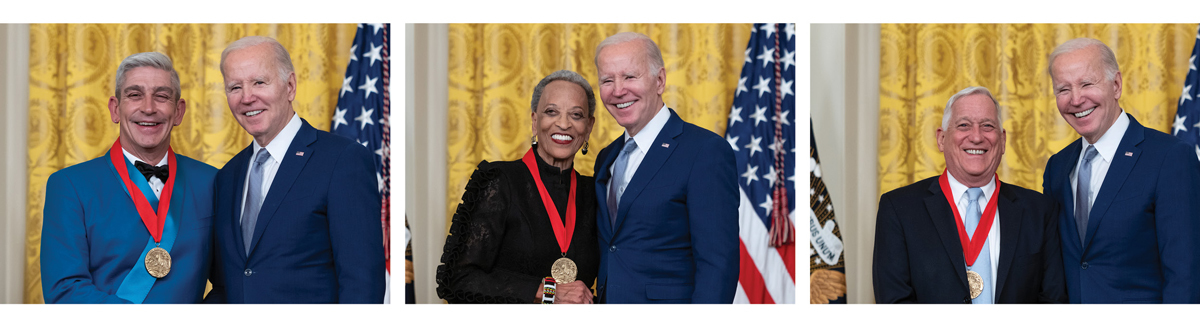
Richard Blanco
“Personal experience anchors the poetry and prose of Richard Blanco, but he also somehow includes us all, as he did in ‘One Today,’ which after summing up the myriad activities occurring every day in America under one sun, concludes with the image of one moon and of ‘Hope—a new constellation / waiting for us to map it, / waiting for us to name it—together.’”
Johnnetta B. Cole
“Asked to imagine a world without the humanities, Cole furrows her brow. ‘What would the world be like if there was no literature?’ Cole asks, looking over the floor-to-ceiling books to her left. ‘That’s a frightening notion. You’re asking me to imagine a nightmare.’ Her books, her art, are proof of a life lived and of Cole’s central belief: People, however different, are worth knowing.”
Walter Isaacson
“He thought the gritty experience might help him write The Great American Novel. Isaacson still keeps an unfinished manuscript of his novel in his desk as a reminder that fiction writing probably isn’t his gift. ‘Walker Percy told me that two types of people come out of Louisiana: preachers and storytellers,’ Isaacson said. ‘I think of myself as a storyteller, even in my nonfiction.’”
|
|
|
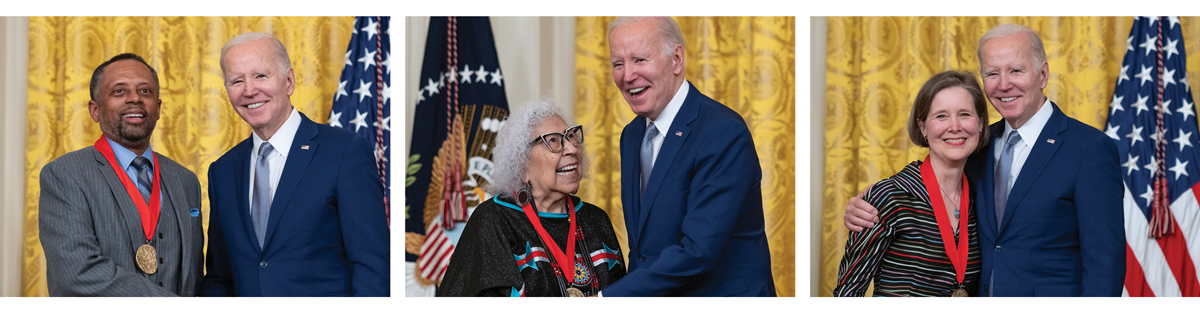
Earl Lewis
“I learned from my grandparents, who never went to college, that there are many kinds of ways to achieve immortality, but one sure way is to have it written down, because once it’s written down it’s there for all time. So my goal has been to work hard to produce as much as can be produced and to help others do so.”
Henrietta Mann
“She is also a widely acclaimed speaker on Native American education. But when she speaks about her own life, her family, and Cheyenne history, including such tragic episodes as the Sand Creek Massacre, you realize that, along the way, Henrietta Mann has been educating all of us, Native and non-Native alike.”
Ann Patchett
“For Patchett, however, the connection between her stories is simple: ‘A group of strangers are thrown together by circumstance and form a society,’ Patchett said in a recent telephone conversation. ‘That’s it.’”
|
|
|
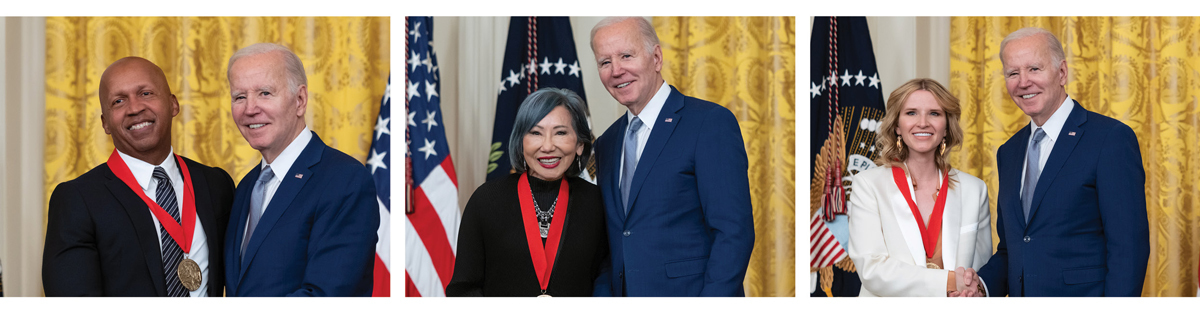
Bryan Stevenson
“The fight for equality isn’t only legal but cultural; it’s about the stories people tell and believe. In 2013, Stevenson’s organization erected three markers about the Montgomery slave trade, ‘and I was blown away by the intensity of the community’s response, and I began to understand the power of public history.’”
Amy Tan
“Tan believes her success is partly because she offers stories that resonate with contemporary readers’ experiences—stories that incorporate generational tension, world conflicts, trauma, and forgiveness. ‘Writers naturally embed the details of what is going on out in the world,’ she says.”
Tara Westover
“‘Studying the humanities showed me that there are other ways of being—that the life I was living at that moment was just one of many possible lives, and that there could be others. . . To be educated is not to know more than another person, but simply to know that other person as kindly and as curiously as you can.’”
|
|
|
Colson Whitehead
“For his part, he says, his best contribution is to simply continue making art. His next book, the forthcoming Crook Manifesto, is a sequel to Harlem Shuffle, moving the story into the ’70s. Whether a story about race in the past can change the future is out of his hands. ‘My work is my engagement,’ he says. ‘And I’m pretty busy enough with that.’”
Native America Calling
“The program has been dubbed ‘the nation’s largest electronic talking circle,’ and it is exactly what it sounds like, a safe, shared space where listeners speak with noted experts and guests over the airwaves. For one hour, community is fostered through the reciprocal exchange of words, ideas, and information; and Native voices have agency.”
Elton John
“Although John’s over-the-top stage costumes of platform shoes, sequins, and feathers won attention, it is the universal appeal of his extraordinary music and his example of compassionate activism that have endured.”
|
|
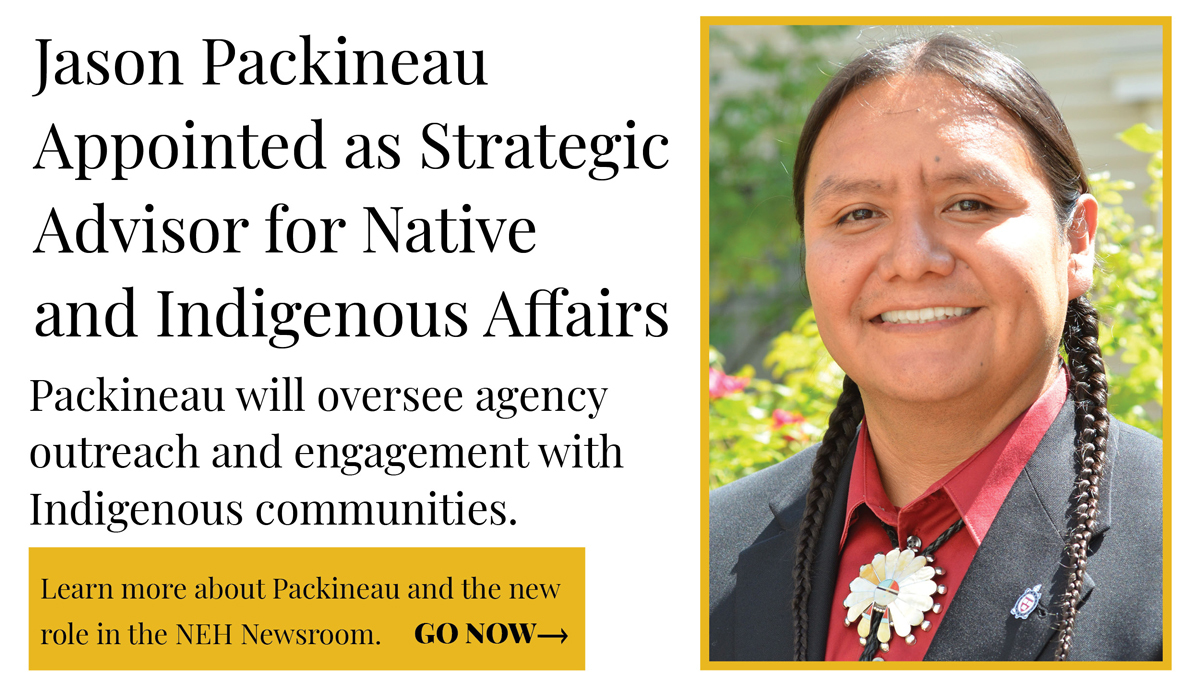
On March 8, 2023, NEH announced the appointment of Jason Packineau (Mandan, Hidatsa, Arikara, Pueblo of Jemez, Pueblo of Laguna) as NEH’s first Strategic Advisor for Native and Indigenous Affairs.
In this new position, Packineau will serve as the lead policy and strategy advisor for NEH’s outreach and engagement with Tribal Nations and Native American, Alaska Native, Native Hawaiian, and Pacific Islander communities. He will also coordinate NEH’s Tribal consultation policy, develop partnerships that enhance the agency’s support of Indigenous communities, and support convenings, listening sessions, capacity-building, and information sharing among state and jurisdictional Indigenous networks.
“We are thrilled to have Jason Packineau join NEH in this important and historic role,” said NEH Chair Shelly C. Lowe (Navajo). “Packineau brings with him wide-ranging expertise in K–12 and higher education and deep ties to Indigenous communities throughout the country. We are excited to have him spearhead NEH’s outreach to Tribal Nations and communities to expand access to humanities resources and help bring the hidden histories of Native American peoples to light.”
|
|
As part of NEH’s “American Tapestry: Weaving Together Past, Present, and Future” initiative— which leverages the humanities to strengthen our democracy, advance equity for all, and address our changing climate—NEH has committed $1.7 million in a cooperative agreement with the nonprofit iCivics toward the creation of pilot programs at elementary schools serving urban, rural, and tribal communities based on the Educating for American Democracy Roadmap.
This two-year cooperative agreement is an extension of the “Educating for American Democracy” initiative, funded by NEH and the U.S. Department of Education. New NEH funding will support the implementation of the EAD Roadmap in pilot programs at elementary schools in underserved communities. The implementation project includes the creation of an advisory team to provide teacher training and assist schools in developing curricula, as well as the establishment of a task force to evaluate the pilot programs’ progress and identify best practices that can guide other educators. This new funding from NEH will support the widespread adoption of high quality, inquiry-based K–12 civic and history education, with the goal of reaching 60 million students and one million teachers by 2030.
|
|
|
|
|