What's New
Modification to Fiscal Year 2020 Service Area Competition Funding Opportunity
HRSA added an additional Las Vegas, NV, service area to fiscal year (FY) 2020 Service Area Competition (SAC) funding opportunity HRSA-20-100. Refer to the Service Area Announcement Table (Service Area Identification Number 526) for service area details.
|
Focusing on Health Centers
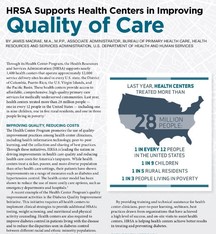
BPHC Associate Administrator Jim Macrae recently published an article (see page 10) in the Independence Blue Cross Foundation’s “Reaching Communities” edition of the Journal of Change.
The issue’s theme is the history and impact of the Health Center Program, and the article describes HRSA’s work to improve quality of care at health centers through efforts such as the Diabetes Quality Improvement Initiative and the Quality Improvement Awards.
|
|
 |
340B Recertification Due by February 24
About three weeks remain for covered entities, including HRSA-funded health centers and look-alikes, to recertify and retain their 340B participant status. All covered entities who do not recertify by the deadline of Monday, February 24, will be terminated from the HRSA 340B Program starting on Wednesday, April 1. Terminated entities will require a new registration and not be eligible to participate in the 340B Program until July.
To recertify, Authorizing Officials (AOs) and Primary Contacts (PCs) must first set up user accounts by visiting the HRSA 340B Office of Pharmacy Affairs Information System (340B OPAIS) and choosing “I am a participant.” It is the covered entity’s responsibility to ensure they have created their accounts before recertification to allow successful completion of the process.
For questions or assistance, email the 340B call center or call 888-340-2787 (Monday-Friday, 9:00 a.m.-6:00 p.m. ET).
FY 2020 Health Center Controlled Networks Non-Competing Continuation Progress Report
The FY 2020 Health Center Controlled Networks (HCCN) Non-Competing Continuation (NCC) Progress Report is now available. The NCC Progress Report must be submitted in HRSA’s Electronic Handbooks by 5:00 p.m. ET on Tuesday, March 24.
Join a technical assistance (TA) webinar:
Thursday, February 6
2:00-3:00 p.m. ET
Join the webcast the day of the session
Call-in: 888-989-9714
Passcode: 7744452
TA materials are available on the HCCN TA webpage. Contact the HCCN TA Response Team with questions using the BPHC Contact Form.
CMS Data Highlight: Reporting of Social Determinants of Health Among Medicare Fee-for-Service Beneficiaries
A new Data Highlight from CMS provides insight into the reporting of social determinants of health (SDOH) for Medicare fee-for-service beneficiaries using data from the ICD-10 codes. These codes identify individuals with potential health hazards related to socioeconomic and psychosocial circumstances. The analysis shows that in the future, with an increase in data collection, ICD-10 Z codes offer great opportunity to standardize the capture of SDOH in medical practice and billing.
Substance Use Disorder & Mental Health
New Communities of Practice Available for Health Centers
The HRSA Center of Excellence for Behavioral Health TA invites you to join new Communities of Practice (CoP).
Pharmacotherapy for Depression and Anxiety in Patients with Opioid Use Disorder
Mood and anxiety symptoms burden patients entering into treatment for opioid use disorder (OUD). Medications such as buprenorphine and methadone can improve comorbid psychiatric pathology, but residual and resistant symptoms often persist. First line treatment options are often inadequate, leaving clinicians frustrated and patients at high risk for relapse.
HRSA and the National Clinician Consultation Center offer an interactive office hour session aimed at helping health center clinicians make vital medication treatment decisions. Participants will learn to:
- Describe the relationship between OUD and comorbid mood and anxiety disorders.
- Identify the available evidence for treatment of depression and anxiety in patients with OUD.
- Design a medication regimen for patients with comorbid OUD and depression or anxiety disorders.
Wednesday, February 19
3:00-4:00 p.m. ET
Register here
Nurse Corps Loan Repayment Program Application Cycle is Open
See announcement below.
Strong African American Families: an Evidence-based Prevention Program for Rural Youth and Families
The NIH-funded Strong African American Families Program is a culturally tailored study and prevention program focusing on rural African American youths aged 10-14 years old and their families. Learn how the program addresses risk factors common in rural communities and supports improved health outcomes in youth and parents.
HIV
Exploring Cultural Competence and Humility in the Care of HIV Patients
The National Center for Health in Public Housing, a HRSA-funded National Cooperative Agreement (NCA), presents a learning collaborative designed to help move organizations past cultural stereotypes and biases (e.g., based on race, sexual orientation, gender identity) to offer HIV patients preventive and health care services with cultural humility. Learn more or register before the first of four sessions on Monday, February 10.
Diabetes
Advancing Partnerships with Schools to Address Diabetes Risk Factors in Elementary School Children
A new learning collaborative from The National Nurse-Led Care Consortium and the School-Based Health Alliance, both HRSA-funded NCAs, will provide targeted interventions for students with pre-diabetic indicators or school-wide interventions to prevent diabetes. The target audience for this learning collaborative is:
- Health centers with an established collaboration with an elementary school(s).
- Primary Care Association staff who provide assistance to health centers that seek to collaborate with elementary schools in preventing diabetes.
Register here for the collaborative, which commences in March.
Workforce
Nurse Corps Loan Repayment Program Application Cycle is Open
HRSA’s Nurse Corps Loan Repayment Program is accepting applications until 7:30 p.m. ET, on Thursday, March 12. As part of HRSA's efforts to combat the nation's opioid crisis, there is special funding this year for psychiatric nurse practitioners. The goal is to increase the nursing workforce at critical shortage facilities and provide evidence-based care to patients in need of OUD and behavioral health treatment.
SDOH Academy
The SDOH Academy announces the 2020 Learning Collaborative Series and the launch of the SDOH Academy website. (Note: The SDOH Academy was founded by a HRSA-funded NCA.) The latest learning collaboratives will help health centers (1) humanize enabling services data; (2) build a workforce to care for sexual and gender minority patients; (3) reduce disparities through community partnerships; and (4) create equitable emergency and disaster preparedness. Register for sessions and check out other virtual trainings. You can also find additional SDOH resources in the Health Center Clearinghouse.
 |
|
American Heart Month
February is American Heart Month. We’ll feature resources and learning opportunities throughout the month.
|

Participate in an Interactive Virtual Town Hall on Resistant Hypertension
Resistant hypertension is high blood pressure that does not respond well to aggressive medical treatment. It substantially increases the risk of heart attack, stroke and kidney failure.
Join HRSA for an interactive Virtual Town Hall on this topic. Oscar H. Cingolani, M.D., Director of the Center for Resistant Hypertension at the Johns Hopkins University School of Medicine, will explore contributing factors such as gender, race, genetic disparities, and social determinants associated with resistant hypertension. He will share evidence-based promising practices for treatment and control. You can join other health centers in the interactive portion to share your experiences and ask questions about treating patients with this condition.
Addressing Hard-to-Control Hypertension: Let Us Count the Ways
Tuesday, February 25
2:00-3:30 p.m. ET
Register here
|
Additional Resources
Optimizing EHRs for Tracking Referrals and Test Results
ECRI Institute (on HRSA’s behalf) presents a webinar on using electronic health records (EHRs) and health information technology (HIT) to improve tracking and follow-up for patient referrals and test results. Jennifer Fabre, Chief Health Information Officer and Director of Quality and Risk Management at Teche Action Clinic (Louisiana), will share her organization’s efforts to improve referral tracking processes, including challenges encountered, lessons learned, and practical tips for other health centers and free clinics. ECRI Institute will also share results from work with health centers.
ECRI Institute’s Partnership for HIT Patient Safety provides resources on safe practices, including a closing-the-loop toolkit and implementation guide. Speakers will share resources during the webinar. ECRI Institute will offer the webinar at two times:
Tuesday, February 18
Noon-1:00 p.m. ET
Register here
OR
Wednesday, February 19
3:00-4:00 p.m. ET
Register here
Food is Medicine: How Food Banks and Health Centers Can Provide Healthy Food to Food Insecure Patients
Food insecurity affects more than 37 million individuals in the United States. HRSA’s San Francisco Office of Regional Operations presents a webinar highlighting how providers who care for vulnerable populations can assist food insecure patients. Presenters will discuss how community health centers can partner with local hunger relief organizations and food banks. Strategies include referring patients to food banks, connecting with mobile food pantries, or hosting a food pantry on site at the health center.
Tuesday, February 18
3:00-4:00 p.m. ET
Register here
For more information, contact CAPT Nidhi Jain.
New Module: SOAR for Native Communities
HHS’ Administration for Children and Families recently launched the SOAR for Native Communities online module through the National Human Trafficking Training and Technical Assistance Center. Using a public health approach, this online module helps those serving indigenous populations gain more understanding of human trafficking and its impact on Native communities. It helps professionals build trauma-informed and culturally responsive strategies to address human trafficking in American Indian, Alaska Native, Native Hawaiian, and Pacific Islander communities.
Training for New Clinical Directors
New Chief Medical or Nursing Officers, Dental Directors, and Behavioral Health Directors should consider this training opportunity for continuing education and networking presented by the National Association of Community Health Centers (NACHC, a HRSA-funded NCA). This is a pre-conference activity that will take place on March 14-15, in conjunction with NACHC’s annual Policy and Issues Forum in Washington, DC. It will provide core knowledge and competencies that health center Clinical Directors need to function as effective managers, leaders, and advocates for their health centers and communities. Find out more.
2020 Western Forum for Migrant and Community Health
The Northwest Regional Primary Care Association announces registration for the 2020 Western Forum for Migrant and Community Health, February 19-21, in Sacramento, CA. Join your colleagues in sessions focused on HHS priority topics, including chronic disease prevention and management, childhood obesity, mental health, substance use disorder, health workforce, emergency preparedness, SDOH, and policy and environmental updates related to the health of agricultural workers and their families. Learn more or register by Wednesday, February 12.
U.S. Surgeon General Releases New Smoking Cessation Report
U.S. Surgeon General VADM Jerome M. Adams has released Smoking Cessation: A Report of the Surgeon General. Accompanying resources include The Key Findings Fact Sheet, which provides highlights from the report, and a consumer’s guide, which provides an overview of the report and smoking cessation resources. This is the first Surgeon General’s report since 1990 to focus solely on smoking cessation.
In case you missed it:
Visit the Primary Health Care Digest archive.
Do you forward the Digest to others?
Encourage them to subscribe.
|







 Sign up for eNews

 Connect with HRSA


