What's New
Expanded Authority for Carryover of Unobligated Balances
-
What is Expanded Authority (EA) for Unobligated Balances?
Health centers will not have to request prior approval from HRSA to carry over unobligated balances of less than 25% of the amount awarded for that budget period.
-
When does this take effect?
EA will be in place starting with the submission of fiscal year 2019 Federal Financial Reports.
-
To which awards does EA apply?
It applies to base and supplemental awards (e.g., Oral Health Infrastructure, New Access Point, and Integrated Behavioral Health Services).
-
When does EA not apply?
EA does not apply for unobligated balances:
- Carried over from one project period to the next.
- Equal to or in excess of 25% of the awarded funds for that budget period.
- Under other Health Center Program awards (e.g., Primary Care Associations, National Cooperative Agreements (NCAs), and Health Center Controlled Networks).
FAQs are coming soon! Contact your Grants Management Specialist with questions.
2019 Uniform Data System Preliminary Reporting Environment Training
Participants will learn about the reporting functionalities for calendar year (CY) 2019 Uniform Data System (UDS). This session will cover the Preliminary Reporting Environment for early access to UDS reporting and two offline UDS reporting features: an Excel and an offline HTML feature. These features, first introduced with CY 2018 UDS reporting, support HRSA’s UDS Modernization Initiative focused on reducing reporting burden and improving the quality of data.
Wednesday, December 11
1:30-3:30 p.m. ET
Register here
Deadline Approaching for Ending the HIV Epidemic Primary Care HIV Prevention
Next Monday, December 16, is the application deadline for the Ending the HIV Epidemic-Primary Care HIV Prevention (PCHP) funding opportunity. It will support expanding HIV prevention services that decrease the risk of transmission, focusing on supporting access to and use of PrEP. Health centers with service delivery sites in the identified geographic locations are eligible to apply in HRSA’s Electronic Handbooks by 5:00 p.m. ET next Monday.
Sickle Cell Disease Training and Mentoring Program
Many adults living with sickle cell disease (SCD) have challenges accessing care due to a national shortage of SCD-trained hematologists. To help address this gap, HRSA is collaborating with the HHS Office of Minority Health to deliver the SCD Training And Mentoring Program (STAMP), a new telehealth series for primary care providers. This free series, taught by hematologists using a case study-based, tele-mentoring approach, will cover the basics of SCD care, such as pain management, hydroxyurea, and preventive services. Participating providers will be able to request real-time consultations from hematologists to further support patient care. The first STAMP session will be in January 2020. Learn more and register.
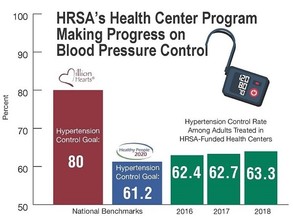
HRSA's Health Center Program Making Progress on Blood Pressure Control
AHRQ and HRSA released a Data Spotlight illustrating that HRSA-funded health centers met the Healthy People goal for blood pressure control in 2016-2018. AHRQ and HRSA will continue to support efforts by health centers to reach the CDC Million Hearts® goal of 80% blood pressure control among hypertensive patients aged 18-85 years. |
|
 |
 |
|
Contacted Health Center Program Support? Rate Our Service
Whether you've had a pleasant experience or feel we could do better, the Health Center Program Support team would like to hear from you. Please take a moment to fill out the customer service survey embedded in the auto-generated email you receive after we resolve your issue or complete your request. |
Don’t Miss Out!
Through your feedback, we’ve learned that you love learning about upcoming webinars in the Digest, but want to make sure you don’t miss any. There are two places where you can find information about webinars:
- The Technical Assistance and Training section of the Digest (in the sidebar on the right, if you’re on a desktop, or at the bottom if you’re on a mobile device) has two sections.
- The top section lists ALL webinars that will take place within a week of when we send out the Digest (including the following Tuesday). For example, today’s issue includes everything taking place before Wednesday, December 18.
- The bottom section (“Upcoming”) lists select webinars scheduled further out.
But what if you want to see all the webinars we know about?
We hope this was helpful! If you still have questions, please let us know.
Final Week: HHS Request for Information on Chronic Disease Prevention
HHS recognizes a need for new approaches to prevention and, as a first step, requests input from the public to better understand:
- The barriers to effective chronic disease prevention in the U.S.;
- Highlights of effective chronic disease prevention strategies; and
- The potential of scientific and technological advancements, innovative partnerships, and human-centered design to create and scale new models of chronic disease prevention.
Help advance chronic disease prevention in the U.S. by sharing your input. HHS will accept responses to this request for information until Friday, December 13.
Substance Use Disorder & Mental Health
Introducing HRSA’s Center of Excellence for Behavioral Health Technical Assistance
We are excited to announce the new HRSA Center of Excellence for Behavioral Health Technical Assistance (TA). The Center will provide training and TA on evidence-based interventions and promising practices to support the integration of behavioral health and substance use disorder services in primary care settings. Learn more at a webinar TODAY:
Tuesday, December 10
3:00-4:00 p.m. ET
Register here
Funding Opportunities for Implementation Research at Ryan White HIV/AIDS Program Sites
NIH invites applications to enhance screening and treatment for mental and substance use disorders in HRSA Ryan White HIV/AIDS Program-funded sites in order to advance the goals of the Ending the HIV Epidemic Initiative.
-
RFA-MH-20-521 will support pilot or feasibility implementation studies to enhance screening and treatment of substance use or mental health disorders.
-
RFA-MH-20-520 will support definitive studies on implementation approaches to enhance screening and treatment of substance use or mental health disorders.
Applications are due by 5:00 p.m. local time on Friday, January 31, 2020.
Assessing Alcohol Problems: A Guide for Clinicians and Researchers
The National Institute on Alcohol Abuse and Alcoholism developed a guide on alcohol screening and treatment for clinicians and researchers. The guide includes information on screening and diagnostic tools and resources for planning treatment for alcohol-dependent patients.
HIV
The 2020 National Ryan White Conference on HIV Care & Treatment
Save the date for The 2020 National Ryan White Conference on HIV Care & Treatment, which will take place on August 11-14, 2020. This is the largest national conference for HIV care and treatment providers, Ryan White HIV/AIDS Program recipients, local, national and federal stakeholders, and people with HIV. Abstracts are due on Friday, December 20. Learn more.

Risk and Safety Resource Spotlight: Help for Patients Living with HIV/AIDS
ECRI Institute’s Clinical Risk Management Program includes checklists, tools, and other resources to assist those who play a role in HIV diagnosis and treatment. Health centers and free clinics can:
All resources are free for health centers, look-alikes, free clinics, and PCAs. Contact ECRI Institute for access or assistance.
|
Funding Opportunities for Implementation Research at Ryan White HIV/AIDS Program Sites
See announcement above.
Workforce
Addiction Medicine Fellowship Program Notice of Funding Opportunity
HRSA plans to invest approximately $20 million through the Addiction Medicine Fellowship (AMF) program to increase access to board certified addiction professionals who are practicing in underserved, community-based settings that integrate behavioral health with primary care services.
HRSA plans to fund an estimated 25 eligible grantees. AMF award recipients will receive up to $800,000 annually, over a five-year period of performance, to foster robust community-based clinical training of addiction medicine or addiction psychiatry physicians to provide opioid and other substance use prevention, treatment, and recovery services.
Additional Resources
TODAY: Building the Case for Implementing Nurse Practitioner and Postdoctoral Clinical Psychology Residency Programs
This session will provide background and details on why your health center should consider developing a postgraduate residency-training program, including the return on investment to your organization and the community health center system as a whole. Learn more about the free learning collaborative opportunity offered through Community Health Center, Inc., a HRSA-funded NCA.
Tuesday, December 10
1:00-2:00 p.m. ET
Register here
Health Educator's Nutrition Toolkit
FDA recently released the Health Educator’s Nutrition Toolkit. It is designed to help health educators, clinicians, and other health professionals teach consumers about the Nutrition Facts label and how to use the information it provides to make healthier food choices.
Youth Outreach Materials on Nutrition
FDA’s “Read the Label” outreach campaign encourages kids ages 9 to 13 to look for and use the Nutrition Facts label on food and beverage packages. Campaign materials include information and activities for kids, parents, and community health educators.
Online Health Library Available to Veterans
Does your health center serve veterans? If so, consider introducing them to the VA’s online health library. It provides information and education about treatments and conditions offered by VA, including more than 1,500 health sheets and 150 videos.
Patient-Centered Medical Home Teleconferences
HRSA contracts with The National Committee for Quality Assurance (NCQA) to provide TA and training to health centers on the NCQA Patient-Centered Medical Home (PCMH) recognition process. This is the final session for 2019 hosted by NCQA’s Government PCMH Recognition Programs (GRIP), which will address questions related to NCQA’s PCMH standards concepts and documentation requirements. Speakers will cover the second part of this presentation (Concepts 4-6) during the call:
PCMH Standards, Part 2
Tuesday, December 17
2:00-4:00 p.m. ET
Call-in: 844-676-8471
Conference ID: 1362694
In case you missed it:
Visit the Primary Health Care Digest archive.
Do you forward the Digest to others?
Encourage them to subscribe.
|





 Sign up for eNews

 Connect with HRSA


