47 billion. That’s how many gallons of water Federal civilian agencies use annually. Water demand is increasing, as supply is decreasing. But “off the shelf” conservation measures, such as replacing existing toilets, faucets, and showerheads with more efficient versions, could help reduce water use by up to 26%, saving $35–$50 million annually in water and sewer expenses.
Based on building research, we offer evidence-based strategies to help you identify cost-effective water conservation options. Some examples include:
- To ensure that sensor-operated faucets don’t use more water than manually-operated ones, carefully consider both the flow rate (we recommend 0.5 gpm) and the timing of the automatic shut-off (we recommend 15 seconds).
- A successful upgrade requires more than just replacing old fixtures. First check for leaks, understand the existing drain lines in your building and consider the length of plumbing lines. Even the type of toilet paper can affect performance.
- The age of your current fixtures affects your potential savings, but even with relatively new fixtures a payback of one year or less can be found by replacing faucets and showerheads with high-efficiency models.
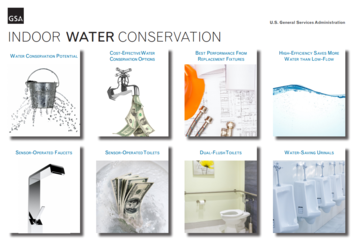
Download and share our interactive Indoor Water Conservation document for more tips covering eight categories.
Take the Indoor Water Conservation Quiz to check your knowledge and find additional tips!
Posted by Don Horn, Deputy Director of GSA’s Office of Federal High-Performance Green Buildings. |