|
The USDA Food and Nutrition Service's Food Distribution Division launched new "USDA Foods from Farm to Plate" e-letters in February 2015! We will be sharing resources, news, and best practices for all of our programs, including this special "FDPIR Connection" focusing on the Food Distribution Program on Indian Reservations. Other editions will feature the Commodity Supplemental Food Program (CSFP), The Emergency Food Assistance Program (TEFAP), and the National School Lunch Program and other child nutrition programs. Visit the FNS website to sign up to receive these e-letters via GovDelivery or modify your subscription preferences (see instructions below). We welcome your input on topics for future letters, and you may contact us through our USDA Foods mailbox at USDAFoods@fns.usda.gov.
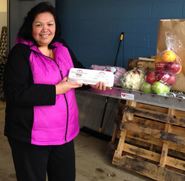 Seneca Nation of Indians has served as the host for a shell egg pilot that began in October 2014. FDPIR staff order and receive eggs on a weekly basis through their DoD Fresh vendor. The program has two distribution methods: home delivery to the Cattaraugus and Allegheny Territories in Western New York and a warehouse where clients may pick up their foods. Seneca FDPIR is preparing to move into a new facility, with a ribbon cutting scheduled for late May. Staff and participants have reported positive experiences with the shell egg pilot, and FNS is currently exploring options to expand the pilot to additional tribes.
|
New produce items are being added to the FDPIR food package! Beginning in June, programs will be able to order lemons through DoD Fresh, in 40 pound cases containing 140 lemons each. More seasonal produce is in the works, with fresh cranberries and clementines being anticipated additions to the food package in fall 2015.
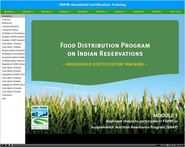
An updated Online
FDPIR Household Certification Training course went live on the FNS website
in June 2014. In the year since the re-launch, over 90 FDPIR staff either
have completed or are working towards completing the training. FNS
developed the FDPIR Household Certification Training course to help Indian
Tribal Organization (ITO) and State agency certification workers and their
supervisors successfully administer the program. This update reflects the
changes made to the certification process as a result of the FDPIR: Income
Deductions and Resource Eligibility Final Rule. The training course
is comprised of nine modules and a post test, designed to be taken in any
order. Because the training is online, certification staff can access the
modules 24 hours a day, seven days a week, and revisit them to refresh their
knowledge at any time. If you haven’t already, check
it out!
|
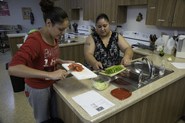
The USDA blog has featured the nutrition education activities of two of the recipients of 2014 Food Distribution Program Nutrition Education (FDPNE) grants, the Mississippi Band of Choctaw Indians and the Menominee Indian Tribe of Wisconsin. Read excerpts of USDA staff site visits below, and click the links for the full story.
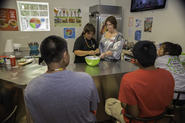 Reap What You Sow: Choctaw Children Learn About Gardening and Cooking
“How many of you like vegetables?” The question posed to a gathering of Choctaw children in a garden in rural Mississippi elicits skeptical responses. But upon sampling the fresh produce harvested with their own hands, however, the children’s stereotypes of disgust turn to surprises of delight. A young boy taking a giant bite out of a juicy tomato could be the poster child for the vibrant red fruit. A pair of sisters declares cucumbers as their favorite. The newly adventurous children are even willing to taste raw eggplant…Now that’s impressive. Read more
|
In conjunction with an FDPIR Food Package Review Work Group meeting in December, FNS staff visited the Pueblo of Acoma and the Eight Northern Pueblos FDPIR programs near Albuquerque, New Mexico. Both programs are located in remote areas with limited access to other grocery options, emphasizing the need for the program as an alternative to the Supplemental Nutrition Assistance Program (SNAP) in rural communities.
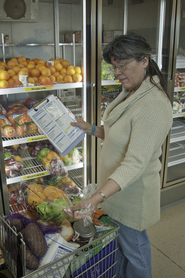 The Pueblo of Acoma Food Distribution Program staff take pride in the efficacy and organization of their operation. Their warehouse is set up in a “store” concept so that the 275 monthly participants can select the foods they want and check out like they would at a grocery store. Acoma also offers home delivery services for participants who are unable to come to the warehouse. Fresh produce is available through USDA’s partnership with the Department of Defense Fresh Fruit and Vegetable Program. Connie Martinez, director of the program, and her staff showed us how they manage inventory, certify program participants, schedule food deliveries, assist participants in the store, and provide food demonstrations and nutrition education. Their focus is on customer service, which ensures that every client has a positive experience.
|
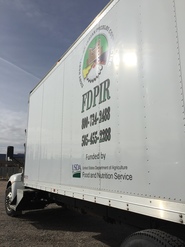 Perry Martinez, director of the Eight Northern Pueblos Food Distribution Program, has worked with FDPIR for over 30 years. The program serves eight distinct Pueblo tribes in New Mexico, covering 1,430 participants per month over a large geographical area. Due to the large service area, “tailgating” and home delivery are the program’s primary food distribution methods. When tailgating, program staff take foods out to communities in temperature-controlled trucks at scheduled dates and times for each service location. Clients travel a relatively shorter distance to the site to select their foods.
The opportunity to tour the Acoma and Eight Northern facilities, learn about their client services, and meet the dedicated staff members who make the program a success was truly inspirational.
|
Several FDPIR programs have opened new facilities. Here, we spotlight the San Carlos Apache Reservation and the Choctaw Nation of Oklahoma, who held ribbon cutting ceremonies in 2014.
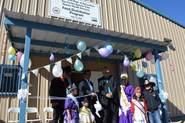
The San Carlos Food Distribution Program held a grand
opening and ribbon cutting ceremony at their new location in downtown San
Carlos, Arizona. The new Food Distribution facility, which was tribally funded
and is located in the heart of the San Carlos Apache Reservation, provides a
centralized location, a wider space, room for nutrition courses, and new security
and sprinkler systems. Howard Hooke Jr., Manager of the San Carlos Food Distribution
Program, shares that the new building is the same size as the old Food
Distribution Program building located in Skill Center but has a much roomier
layout that includes the lobby, kitchen, several workspaces, freezer room,
cheese and produce storage rooms, an electrical room, a loading dock, and
warehouse. Mr. Hooke also comments that there will be more opportunities for
educating the community with nutrition and food preparation classes in the
new facility noting that the new location increases accessibility for FDPIR
clients.
The
San Carlos Food Distribution Program first opened its FDPIR doors in 1983 and
has been successfully running the program for over 30 years.
|
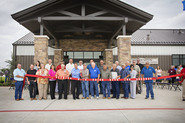
The Choctaw Nation of Oklahoma opened a new
food distribution center in Durant, Oklahoma. The new FDPIR
site provides services to eligible households by implementing the self-service
store concept, similar to Choctaw Nation’s Antlers, McAlester, and Poteau
Food Distribution Centers.
The self-service store concept means the
center is set up like a grocery store with shelving, reach-in coolers and
freezers, grocery carts, and check-out counters. In the new center,
instead of a household picking up its full month’s food benefits in one trip
to the center, a participating household can visit the new 7,500 square foot
center as frequently as needed. While there are monthly limits to the
amount of food provided to a household, now participants have the freedom to
choose when, how often, and what to pick up during each shopping trip to the
center.
The Choctaw Nation has been administering
FDPIR successfully since 1984. They currently operate the program from four
permanent sites and four tailgate sites located throughout the Choctaw Nation’s
10 ½ county jurisdictional area. A new building for the McAlester site
will be completed this fiscal year, and a new permanent site in the Broken Bow
area will be completed next year.
|
 Historically the DoD Fresh Fruit and Vegetable Program web application (FFAVORS) used by schools, school districts, and tribal organizations has had the feature of an ‘Automatic Goods Receipt.’ This feature automatically receipts an order 5 business days past its scheduled delivery date. DoD is now requiring that any automatic receipting process be removed, and each order must be manually receipted.
In June, the system will prevent a user with an outstanding receipt from placing a new order; in other words, if there is an order with a delivery date more than 5 business days in the past, the ‘Place New Order’ function will not be active. Once the user has completed the receipt, the new order can be placed. If you need help with manually receipting orders, please contact your FNS regional office staff.
|

A decade has passed since the 2005 NAFDPIR
conference in Rapid City. We appreciate the dialogue and fellowship we
find at each year’s conference and look forward to seeing many of you again
this year.
 Here's how to sign up for these updates via GovDelivery:
1. Go to the FNS website: http://www.fns.usda.gov/fdd/food-distribution-programs
2. Click on the red envelope on the row of social media icons on the top right of the page.
3. Enter your email address and click "Submit."
4. Check the boxes to select your topics of interest. For these e-letters, scroll down to the Food Distribution category and click the plus sign to the left of the check box to expand the list and view all the sub-categories. Check these sub-categories to receive the corresponding e-letters:
*USDA Foods --> receive all "USDA Foods from Farm to Plate" general + program-specific e-letters
*Commodity Supplemental Food Program (CSFP) --> receive "Household Highlights" e-letter
*The Emergency Food Assistance Program (TEFAP) --> receive "Household Highlights" e-letter
*Food Distribution Program on Indian Reservations (FDPIR) --> receive "FDPIR Connection" e-letter
*Schools/Child Nutrition Commodity Programs --> receive "Spotlight on Schools" e-letter
5. Update your subscription preferences any time by following the above steps or clicking on the Subscriber Preferences Page link at the bottom of any of the e-letter email messages you receive from GovDelivery. Questions? Contact us at USDAFoods@fns.usda.gov
|
|