|
|
Volume 12, Issue 1, Fall 2025
Local School Food Markets: Turning Excitement into Action
|
|
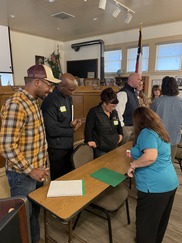
If you listen, you can hear a buzz around school food markets that is getting louder: excitement about local foods and the many benefits they offer students, producers, and communities. The USDA Food and Nutrition Service (USDA FNS) hears it, and we want to harness this energy to propel us to a future with local food in every school. Through cooperative agreements with the National Center for Appropriate Technology (NCAT) and the Urban School Food Alliance (USFA), USDA is helping to make this vision a reality by closing the gap between producers and schools.
For years, NCAT and USFA have been actively working in this space. NCAT has been educating farmers in communities across the United States about how to sell to schools through the "Bringing the Farm to School" curricula and training, a project funded through a previous USDA FNS cooperative agreement. USFA has been working with America’s largest school districts to share best practices, develop procurement strategies, and advance student health and wellness through meal quality. While these contributions are making important changes, USDA recognized that producers and schools needed specialized support to maximize the use of fresh, healthy local foods in schools.
To build on this momentum, USDA formed a new cooperative agreement with NCAT to expand Bringing the Farm to School curricula and events. The events now include in-person networking between school buyers and producers to kickstart new buyer-seller relationships. NCAT is also writing a best practices guide for state and local organizations interested in holding their own event. With USFA, USDA formed a cooperative agreement to improve procurement practices for schools of all sizes through easy-to-use procurement tools, including those supporting local sourcing. USFA created a variety of resources, ranging from a report on procurement opportunities and challenges to a self-assessment tool for school food procurement, including local sourcing related questions, to a specification guide for writing school food solicitations. USFA also hosted webinars for local producers and producer organizations on understanding school food procurement processes and needs and crafted resources for schools on buying from local farmers.
We sat down with Tammy Howard of NCAT, and Dottie Arnold of USFA, respectively, to learn more about how each of these projects bring two sides of this marketplace closer together for the benefit of students across the country.
|
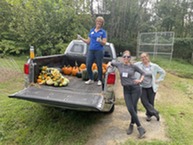
When reflecting on these projects, both shared how happy they were to see such enthusiasm for local foods. “In collaborating with both state and regional producer organizations,” says Howard, “I was really struck by the incredible work that’s being done at the local level and on the part of State agencies … especially their efforts to problem solve.” Arnold reflected that, "We have seen so much engagement from SNAs [school nutrition associations], SFAs [School Food Authorities], and local producers. It is clear that there is a desire to serve students local foods, and it is a value that is showing up in procurement processes across the country."
The reason for much of this enthusiasm is clear to Howard. As school buyers become more aware of and comfortable working with entities like food hubs and other mission-centric product aggregators, they are gaining more exposure to the producers themselves, and ultimately, they can see their purchases making a difference in the producers’ businesses and lives. Schools want to understand that connection, which is why direct purchases and indirect purchases from vendors that retain brand identity are important. This amplifies the importance of NCAT’s networking events, which enable schools to meet multiple producers and identify those that produce the products they need.
|

USFA’s work has revealed that schools are enthusiastic about serving high-quality foods but need help overcoming procurement challenges. USFA is continuing to develop tools to simplify and standardize school food procurement. “One of the largest components of this project is developing content for a universal [solicitation] template,” explains Arnold, sharing that during 2026, USFA will pilot the template in five districts across the country. The template will include considerations for procuring local foods.
NCAT and USFA are each working to channel the growing enthusiasm for local foods into meaningful action, preparing different actors, schools and producers, so they can successfully meet in the middle and local sourcing can flourish. If you’d like more information on how resources from these projects can support your farm to school projects, visit our Cooperative Agreement page. To learn about how USDA is increasing support for small farmers, check out our Farmers First: Small Family Farms policy agenda.
|
 |
Just in time for Farm to School Month, the Patrick Leahy Farm to School Program invites the farm to school community to apply for the fiscal year (FY) 2026 Farm to School Grant Program (Grant Program).
The FY 2026 Grant Program offers more funding than ever before — up to $500,000 per applicant! It’s also easier than ever for interested organizations to apply thanks to streamlined application templates, a consolidated program objective, and additional instructions for completing Federal forms.
USDA Food and Nutrition Service’s (FNS) Farm to School Team encourages interested applicants to view the full opportunity on Grants.gov. Remember to start your registration process early to prepare to apply through Grants.gov. Complete applications must be submitted by 11:59 PM Eastern Time on Friday, December 5, 2025.
For additional resources, continue checking the Resources for Grant Applicants webpage throughout the application window. The recorded 2026 RFA webinar is now available online. Resources will also be highlighted in The Dirt.
Have you read the RFA and still have questions? Reach out to the FNS Farm to School Team at SM.FN.FarmToSchool@usda.gov!
|
|
Farm to School Month is always an exciting time for kids and adults alike and we are excited to see all the great activities that were scheduled for October. Here is a sampling of what's going on:
-
Virginia: Virginia has designated the first full week in October as "Virginia Farm to School Week," which ran October 6-10, 2025, with the "Crunch Heard Round the Commonwealth" on Thursday, October 9.
-
Maine: Governor Janet Mills issued a proclamation in September that designated October as "Maine Farm to Sea and School Month," recognizing the work of all 215 school food authorities that purchased $968,163 in food products from Maine's farmers, fishers, and other producers.
-
North Carolina: North Carolina held its statewide "North Carolina Crunch" at noon on Wednesday, October 22, 2025.
-
Nevada: Nevada Department of Agriculture hosted their very first Crunch Day on October 2 and has made a guide for in-state partners planning to hold their own Crunch events in October
-
Washington: Taste Washington Day and the Washington Apple Crunch were both held October 8. The event took place alongside a proclamation from Governor Bob Ferguson. Congratulations to Washington on 16 years of "Tates of Washington Day"!
|
|
 |
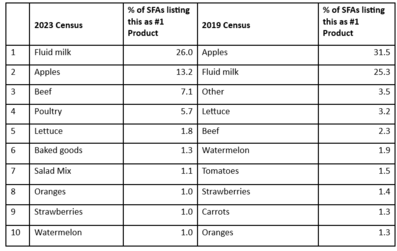
Today, USDA FNS continues to mine the data gathered from the 2023 Farm to School Census (Census) and learn new insights. One question that USDA FNS pondered is whether there were changes in the top local items purchased between the 2019 and 2023 Censuses. By comparing Top Local items by spending, asked on question 42, we see some interesting shifts among SFAs that reported participating in farm to school activities.
Taking a quick glance at the top five items for 2023, we see that fluid milk and apples remain top items, with lettuce in top-five, but we also see a significant increase in meat and poultry items with nearly 13 percent of SFAs reporting their “top local item” was beef or poultry.
Additionally, we see salad mix and Baked Goods both appearing in the top ten items for the first time.
We hope you take time to dig into the Census and see what is going on near you. Check out the Farm to School Census Data Explorer to learn more!
|
The Make America Healthy Again Commission released the "Make Our Children Healthy Again Strategy," a sweeping plan with more than 120 initiatives designed to tackle America's chronic childhood diseases. The strategy outlines targeted executive actions to advance gold-standard science, realign incentives, increase public awareness, and strengthen private-sector collaboration.
The report highlights several key focus areas for action, including:
- Restoring Science and Research
- Historic Executive Actions
- Process Reform and Deregulation
- Public Awareness and Education
- Private Sector Collaboration
|

|
|
The U.S. Department of Agriculture (USDA) today announced $3.38 million in grant funding awarded to three organizations through the Bison Production and Marketing Grant Program (BPMGP).
The program will strengthen and enhance the production and marketing of bison and bison products in the United States through business and resource development, and the advancement of innovative approaches to solving long-term needs in the bison sector. Awards will go to Mad Agriculture, National Bison Association, and Flower Hill Institute.
BPMGP award recipients will implement a competitive subaward program, which will fund and support projects that address unique problems and challenges across the bison industry. BPMGP is administered by USDA’s Agricultural Marketing Service (AMS).
|


Vermont FEED's Farm to School Institute is accepting applications for its 2026 program through January 13. 2026. Offered through Shelburne Farms, the Vermont FEED Farm to School Institute is a proven professional learning model for growing robust and enduring farm to school programs. Through action planning, coaching, peer networking, and skill building, the program establishes sustainable farm to school and early childhood programs that connect the dots between classrooms, cafeterias, and communities. This program is open to leaders across the country seeking to adapt this successful model for their region and grow integrated farm to school programs in their own states.
|
|
|
USDA FNS new study finds that child care providers who participate in the USDA, Food and Nutrition Service’s Child and Adult Care Food Program (CACFP) serve healthy meals and snacks to the children in their care. Children have better overall diets on days when they are in child care than on days when they are not. Check out the full report and appendicies to learn other key findings from the study!
|
 |
|
The Rural Development Innovation Center is hard-wired into USDA’s customer-driven approach in helping communities achieve prosperity across rural America. The Center applies cutting-edge techniques to provide innovative products and services to its rural customers. The Center works to improve prosperity for rural communities through its three divisions: Strategic Engagement, Data Analytics and Regulations Management. |
|
|
|
|
|