|
|
Volume 11, Issue 4, Spring 2025
'Beefing Up' Education: Farm to School at Gibson County High School
|
|
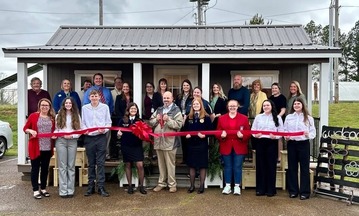
In the rolling fields of western Tennessee, Gibson County High School (GCHS) is reshaping agricultural education with an innovative, hands-on program in beef production and marketing for future leaders in agriculture. Known for its career technical education (CTE) programs, GCHS has long focused on raising cattle through its cow-calf breeder program. Recently, the school has taken on a new challenge, elevating its commitment to promoting agricultural careers and local foods through an innovative farm to school beef production project.
The GCHS Beef Production Program equips students with a comprehensive understanding of beef production and marketing processes. Annually, the program includes about 150 students responsible for decision-making and hands-on aspects of daily livestock care, herd management, transportation for processing, and, ultimately, beef sales. Derek Norman, CTE Director for the Gibson County School District, emphasizes the value of real-world practice, stating, “Students are not only seeing the importance of growing their own food, but they are also witnessing firsthand the challenges that livestock producers face daily. From calculating processing costs to marketing the final product, students walk the full farm-to-beef production journey.”
According to the 2023 Farm to School Census, local beef was the third most purchased local item by spending among farm to school participants or School Food Authorities (SFAs) engaging in at least one of over 30 possible farm to school activities surveyed in School Year (SY) 2022 – 2023. In that same period, 23 percent of all SFAs nationwide purchased local proteins, and 32 percent want to buy local proteins in the future. Local proteins are in demand! Why not make it an educational opportunity, too?
The program works, thanks to strong partnerships that connect students to key stakeholders across the beef supply chain. The University of Tennessee Extension Office worked closely with GCHS to broaden its CTE course, Large Animal Science, by adding a beef production concentration. GCHS also sources steers from local ranchers and partners with local farmers to grind and prepare the feed. A nearby USDA-inspected facility handles beef processing, giving students practical experience with the variety of cuts a steer can yield, from steaks and roasts to specialty cuts, an often-overlooked aspect of the process. The students pick up the processed beef from the facility and evaluate the yield from each steer.
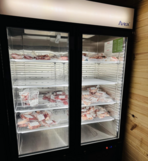
Once the meat is processed, GCHS students sell their products to the school district for inclusion in school meals. They also leverage two additional avenues for sales: Pioneer Market and the Beef Production Mobile Lab. The Pioneer Market is the high school’s onsite, student-run retail store, where the community can buy beef to prepare at home, and the Beef Production Mobile Lab enables students to sell their locally raised and locally processed product in nearby towns after school, expanding their marketing reach. Today, students continue using these sales channels, gaining valuable agricultural marketing skills and making locally sourced food available to the community.
Mr. Norman finds the most rewarding part of the program is equipping students with essential business and agricultural production skills they can carry into careers in agriculture or other professions. He regards this program as “one of the best learning tools” GCHS has introduced, profoundly impacting student development and producing a product of much demand, as the 2023 Farm to School Census reveals.
From pastures to plates, the Farm to School Beef Production Project builds future agricultural leaders while fostering local partnerships and supporting the local community. This comprehensive program shows how farm to school programming can foster a deeper connection to local foods, agriculture, and the community it serves.
Are you inspired to start a beef to school program? Check out the resources section of this newsletter for more information on local meat in schools. The USDA Patrick Leahy Farm to School Team, in alignment with U.S. Secretary of Agriculture Brooke Rollins’ vision, stands ready to serve you through technical assistance to connect America’s current and future farmers to federal child nutrition programs.
|


Secretary Rollins’ Vision for the U.S. Department of Agriculture’s 16 Nutrition Programs
On February 13, Secretary Rollins wrote to State, Tribal, Territory, and Local Government Partners to share her guiding principles for nutrition programs and encourage states to partner with the USDA as innovative collaborators and policy incubators.
|
New Memo: SP11-2025, CACFP 09-2025, SFSP 05-2025: Using Federal Funds to Purchase Local Foods
The purpose of this memorandum is to remind schools, sponsors, and institutions participating in any U.S. Department of Agriculture (USDA) Child Nutrition Program (CNP), including the National School Lunch Program (NSLP), School Breakfast Program (SBP), Fresh Fruit and Vegetable Program (FFVP), Special Milk Program for Children (SMP), Child and Adult Care Food Program (CACFP), Summer Food Service Program (SFSP), and the Seamless Summer Option (SSO), of the many ways they can purchase local foods to serve in Program meals. Sourcing and serving locally grown foods, and other farm to school activities, such as taste testing, gardening, and agriculture education, can infuse new energy and vision into CNP operations, support community health, create new opportunities for American farmers, invest Federal dollars in local economies, and strengthen strategies to encourage healthy choices.
Census Infographics and Individual Graphics Offer a Tool for Illustrating Your Farm to School Story
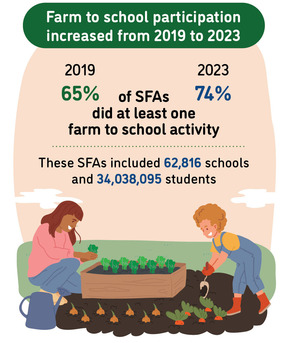
The 2023 Farm to School Census tells an exciting story— farm to school is going strong across the nation! USDA’s Food and Nutrition Service is excited to share resources to help states and other partners illustrate their farm to school story: the 2023 Census Infographics and Individual Graphics. These colorful and engaging Infographics and Individual Graphics highlight key Census data points at the national and state levels.
USDA Expediting $10 Billion in Direct Economic Assistance to Agricultural Producers
On March 18, National Agriculture Day, Secretary Rollins announced that USDA will directly issue up to $10 billion to agriculture producers through the Emergency Commodity Assistance Program for the 2024 crop year. Administered by USDA’s Farm Service Agency, this program will help agricultural producers mitigate the impacts of increased input costs and falling commodity prices.
USDA Announces New FPAC Leadership to Better Serve Farmers and Ranchers
On March 21, the USDA announced key presidential appointments to the Farm Production and Conservation (FPAC) mission area. “FPAC is the most farmer-facing mission area at USDA, housing the Farm Service Agency, the Risk Management Agency, and the Natural Resources Conservation Service—agencies producers rely on every day,” said USDA Secretary Brooke Rollins. The FPAC mission area is vital in delivering USDA programs directly to farmers and ranchers across the country, from disaster assistance and risk management to conservation efforts that protect and enhance working lands.
|
|

USDA Community Facilities Direct Loan and Grant Program
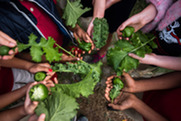
USDA's Rural Development Community Facilities Direct Loan and Grant Program provides affordable funding to develop essential community facilities in rural areas. Essential community facilities include, but are not limited to, community gardens, food pantries, community kitchens, food banks, food hubs, and greenhouses. Read the fact sheet for more information. The program is limited to areas with no more than 20,000 residents.
|
|
|

Local Meat in Schools Fact Sheet
Local meats, poultry, and seafood are becoming staples on school meal trays across the country. Sourcing locally supports local farmers and producers and can help schools serve fresher and more nutritious meals. This USDA fact sheet gives examples, tips, and information for putting local meat on school menus.
|
Selling Local Food to Schools Fact Sheet
Schools are sourcing locally grown foods for their meals and snacks and providing complementary educational activities that emphasize food, farming, and nutrition. As a farmer, rancher, fisherman, or other food producer – large or small – there are market opportunities in your own backyard. Learn about the four paths to selling to schools and how to prepare for conversations with school nutrition directors in this USDA fact sheet.
Beginning Farmers and Ranchers Resources
Are you new to farming? Want to learn how to start a farm? USDA offers assistance to beginning farmers and ranchers. USDA considers anyone who has operated a farm or ranch for less than 10 years to be a beginning farmer or rancher. From farm loans to crop insurance, USDA is here to support you and your operation.
Bringing the Farm to School Training Program: Producer Resources
Developed through a cooperative agreement between USDA, National Center for Appropriate Technology, and National Farm to School Network, the Bringing the Farm to School training program offers producer resources to help prepare farmers and ranchers to market and sell products to child nutrition program operators. The program also offers a producer workbook and a beef to school case study.
USDA Alternative Farming Systems Information Center
The USDA's National Agricultural Library Alternative Farming Systems Information Center (AFSIC) provides research-based resources for non-traditional food production and crop management practices to support a sustainable future and agricultural economic viability for farmers. Featured topics include hydroponics, aquaculture and aquaponics, irrigation techniques, and more.
Bureau of Indian Education’s Harvest of the Month Program
The U.S. Department of Interior Bureau of Indian Education (BIE), through their Indigenous Food Hubs, has recently developed a Harvest of The Month Program. The program teaches students about nutrition, agriculture, Indigenous food culture, and cooking. Each monthly packet will contain a recipe, a fact sheet with nutrition information, and an activity page focusing on culturally relevant food in season. Check out the January packet that highlighted deer and elk meats. View the full 2025 Indigenous Food Hubs Harvest of the Month poster.
USDA Disaster Assistance Fact Sheet
USDA’s Food and Nutrition Service plays a vital role in providing supplemental nutrition assistance in response to disasters in the U.S. and its territories. FNS is ready to provide emergency nutrition assistance to people in need. You can read about USDA’s overall response efforts to communities and agricultural producers affected by recent storms.
|
|
|
USDA is an equal opportunity provider and employer. To file a complaint of discrimination, write: USDA, Office of the Assistant Secretary for Civil Rights, Office of Adjudication, 1400 Independence Ave., SW, Washington, DC 20250-9410 or call (866) 632-9992 (Toll-free Customer Service), (800) 877-8339 (Local or Federal relay), (866) 377-8642 (Relay voice users).
|
|
|
|
|