FNS Celebrates Native American Heritage Month
USDA Food and Nutrition Service (FNS) celebrates Native American Heritage Month by taking time to reiterate our commitment to removing unique barriers for tribal access to our programs; promoting tribal self-determination, including tribal values and indigenous perspectives in our decision-making; and improving indigenous health through traditional foods. This month we highlight tribal food and nutrition stories that demonstrate these commitments.
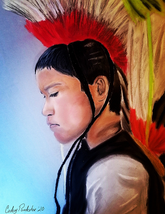
Artwork by Codey Poindexter of Cherokee Creek titled "Envision." Featured in Center for Native American Youth's (CNAY) Creative Native Call for Art competition. From the artist: "I titled this ‘Envision’ because I want the youth to envision where they want to be, what do they want to do when they grow up, and envision who they can be as a tribal leader. Native youth are medicine who carry on the next generation."
|
FDPIR Self-Determination Demonstration Projects Help Tribes Promote Traditional Foods and Support Native Producers
The Food Distribution Program on Indian Reservations (FDPIR) provides USDA Foods to income-eligible households living on Indian reservations and to Native American households residing in designated areas near reservations or in Oklahoma.
Under normal program operations, all USDA Foods provided in the FDPIR food package are purchased and provided by USDA. Through this demonstration project, participating Tribes are able to:
- select one or more foods that they would like to procure for inclusion in the food package,
- identify the food(s) in the food package that they would like to supplant with the tribally procured food(s),
- establish contract(s) with a vendor(s) to procure the selected food(s), and
- distribute the tribally procured food(s) alongside other USDA-provided foods in the FDPIR food packages distributed to their tribal citizens.
To date, USDA has awarded $5.7 million dollars to eight tribal organizations participating in the first round of the project. Project implementation began in October 2021 with some contracts expected to last up to three years, through 2024. Here are some highlights from the first year of the project.
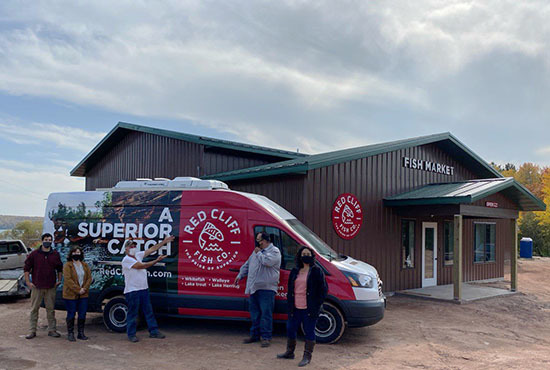
Photo: Red Cliff Fish Company, owned and operated by the Red Cliff Band of Lake Superior Chippewa. Red Cliff Fish Company provides fish to Oneida Nation and Menominee Indian Tribe of Wisconsin (joint project) as well as their own Red Cliff Band of Lake Superior Chippewa through the demonstration project. Photo by Dan Cornelius.
|
Lummi Nation
Located in the northwest corner of Washington, 10 minutes from the Canadian border, Lummi Nation has the largest tribal fishing fleet on the West coast. "We've always been a fishing community since time immemorial. If you drive through our reservation you'll see a fishing boat in the majority of our yards, similar to pre-contact where'd you see reef net fishing canoes in all our village sites," said Travis Brockie, General Manager for Lummi Indian Business Council.
Lummi Nation replaced walleye with salmon procured from local fish buyers who get their fish from Lummi fishermen. "Some of our locals didn't know what to do with walleye. They weren't into it. It's not something we grew up with," said Ray James, Assistant Director for Lummi's Food Distribution Program. "With the salmon, everybody is liking it. When they're calling to fill their order, they're making sure we add the local salmon."
"The local fishermen have a sense of pride knowing the traditional foods that they're catching is going to our commodities food program and that food is turned around and feeding our people. With some of the other foods, you don't know where it comes from, if it was freshly caught or what kind of preservatives were added," added Billy Metteba, Food Sovereignty Project Manager for Lummi Nation.
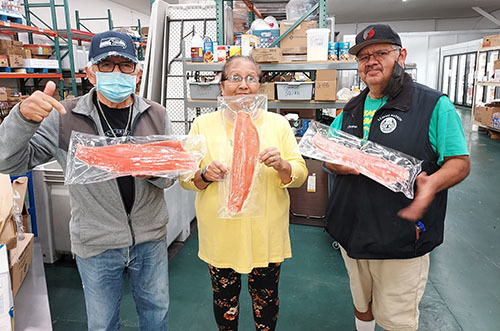
Photo: Lummi Nation Commodity Foods staff display frozen sockeye salmon fillets purchased with FDPIR self-determination contract funds. Lummi Nation manages several treaty-reserved fisheries off the Washington coast and will be providing a variety of local seafood items to FDPIR participants through the demonstration project. Photo by Lummi Nation Commodities.
|
Little Traverse Bay Bands of Odawa Indians
Located in Northern Michigan, the Little Traverse Bay Bands of Odawa Indian were known as the original traders with odawa meaning "to trade" in their language. They have a rich fishing tradition, including spearfishing walleye every spring as the walleye come from the lakes and up the rivers to spawn.
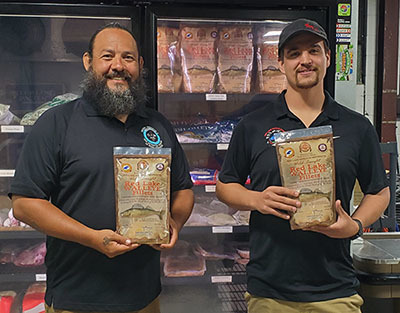
Under the demonstration project, the Tribe procured walleye from Red Lake Nation fisheries, which is owned and operated by Red Lake Band of Ojibwe, located in Minnesota. "Our tribal citizens love the walleye. Citizens can also request catfish or salmon in their food package, but the walleye, it's beautifully packaged and it comes from a tribal producer," said Joe Van Alstine, Program Director.
"One of the very last boarding schools that closed was on our reservation. We are trying to make sure our people are reconnected to the traditional foods that they once ate. The boarding schools took away the traditional foods that we had. So now some of our older citizens get a chance to taste that food again and reconnect with it. Hopefully, this is what we will achieve with the project, having more of our tribal people eating more traditional foods," added Van Alstine.
Photo: Program Director Van Alstine and Jake Robinson, General Manager from Red Lake Nation Fishery, display Red Lake walleye fillets at the Little Traverse Bay Bands Food Distribution Center, which is modeled like a grocery store, where tribal citizens can come in and place the food items they want into a grocery cart and check out.
|
Alaska Native Tribal Health Consortium (ANTHC)
ANTHC is a non-profit tribal health organization designed to meet the unique health needs of Alaska Native and American Indian people living in Alaska. ANTHC provides world-class health services, which include comprehensive medical services at the Alaska Native Medical Center, wellness programs, disease research and prevention, rural provider training and rural water and sanitation systems construction. ANTHC also operates a FDPIR program in partnership with 18 Tribes across Alaska. Many of the Tribes served through the FDPIR program are not connected to the main road system and can only be accessed by boat or airplane. "Because it costs a lot to ship things out to rural areas in Alaska, a gallon of milk can cost from $17 to $30 in some areas. Groceries can be extremely expensive and FDPIR addresses some of these issues," said Dana Diehl, ANTHC Wellness & Prevention Director. "The other thing FDPIR helps with is fresh produce. Because it takes more time to get things shipped out to our rural communities and they are often delayed due to weather and other challenges, rural residents often do not have access to fresh produce in their grocery stores."
For the project, ANTHC replaced catfish and walleye in their food package and procured Alaskan halibut and cod from tribally-owned vendors. "Catfish and walleye are not really traditional foods in Alaska. Our people were really not familiar with it. Providing traditional foods like halibut and cod provided relief to our elders. They really appreciated it," said Gregory Nothstine, FDPIR Program Manager. "Halibut is a really healthy and versatile fish that can be prepared in many ways, everything from tacos to making seafood chowder, baked or grilled," added Dana Diehl, ANTHC Wellness & Prevention Director.
"It remains important for ANTHC to participate in the self-determination project because it provides an opportunity to work with tribally-owned vendors, supporting them and our local Alaskan economy. But the primary reason is because we know incorporating traditional foods into our diet supports our physical, mental, and spiritual health," said Diehl.
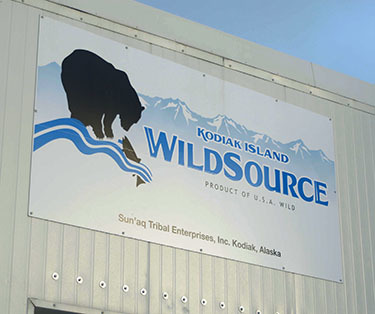
Photo: Kodiak Island WildSource is one of the tribally-owned vendors providing Alaskan fish to ANTHC as part of their demonstration project. Photo by Christopher Sannito.
|
Chickasaw Nation
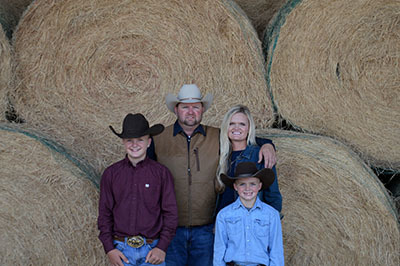
As part of the demonstration project, Chickasaw Nation's FDPIR Program is procuring roast beef, beef stew meat, and ground beef from Rolland Ranch Beef, which is owned and operated by Chickasaw citizen, Brynlee Rolland, and her husband. They operate a 4,500-acre ranch located in Checotah, Oklahoma and offer all-natural beef products free of antibiotics and steroids.
"We are so excited about the opportunity to offer beef products to our fellow Chickasaw citizens and other First Americans," said Rolland. "All in all, it's such a great process to think that the landowner to the caretaker to the processing facility and then on to the consumers, it's natives from start to finish.
Photo: The Rolland Ranch owned and operated by Chickasaw Citizen Brynlee Rolland, will now supply all of the ground beef, roast beef, and beef stew meat products used in the Chickasaw Nation’s food distribution program. From left: Cole Rolland, Chad Rolland, Brynlee Rolland, and Case Rolland.
|
Red Cliff Band of Lake Superior Chippewa
As part of the demonstration project, the Red Cliff Band is procuring a variety of fruits and vegetables from Mino Bimaadiziiwin Farm, a tribally-owned and operated farm located on the Band’s reservation in northern Wisconsin, along the shoreline of Lake Superior.
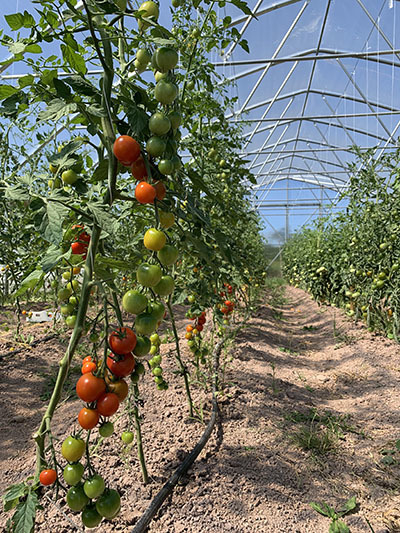
Mino Bimaadiziiwin (The Good Life) Tribal Farm is a diversified fruit and vegetable operation managed by the Red Cliff Band. The farm serves as a critical component of the tribe’s increasingly integrated food system and expanding food sovereignty initiatives. Through this demonstration project, Mino Bimaadiziiwin Farm is providing carrots, potatoes, cucumbers, head lettuce, salad mix, apples, slicing tomatoes, cherry tomatoes, onions, summer squash, radishes, winter squash, and frozen winter squash.
“It’s been rewarding to know that produce being distributed through this demonstration project was harvested just that same morning from the farm, just a few miles up the road,” says Allissa Stutte, Farm Manager. “Through this demonstration project we have an opportunity to provide fresh, nutritious, and culturally appropriate food and simultaneously support the food sovereignty goals of Red Cliff”.
In addition, Red Cliff is replacing salmon with whitefish from the Red Cliff Fish Company, and sourcing blueberries and wild rice from local and native producers.
Photo: Tomatoes growing up a string trellis in a high tunnel on Mino Bimaadiziiwin Farm. Photo by Alissa Stutte.
|
Round 2 Application Period Now Open For FDPIR Self-Determination Demonstration Project
USDA is currently soliciting proposals for tribal organization participation the FDPIR self-determination demonstration project through a Federal Register Notice that was published on Oct. 18, 2022. All proposals must be received by 11:59 p.m. ET on Jan. 31, 2023, in order to be considered for funding.
USDA Farm to School Grants Give Priority Consideration for Applications from Indian Tribal Organizations
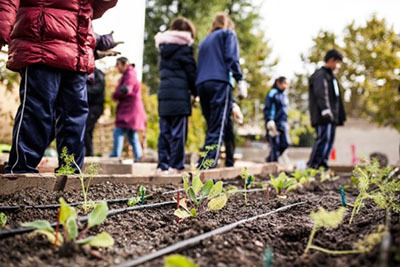
The Fiscal Year (FY) 2023 USDA Farm to School Grant Program will continue to take a comprehensive approach to advancing equitable food systems for people who have historically been underserved, marginalized, and adversely affected by persistent poverty and inequality. USDA Farm to School Grant Program applicants who meet certain criteria, including applicants from Indian Tribal Organizations (ITOs) and entities led and staffed by Native Americans and serving Native American communities, will continue to receive bonus points in the application review process.
The Request for Applications (RFA) for the FY 2023 Farm to School Grant Program opened on October 6, 2022, and will remain open through January 6, 2023 at 11:59 PM ET. The Farm to School Team held two webinars earlier this month to help prospective applicants learn more about the RFA and how to put together a competitive grant package. Recordings of the webinars and additional resources are available on the Farm to School Grant Applicant Resources Page. Contact the Farm to School team at farmtoschool@usda.gov with any questions about the RFA.
|
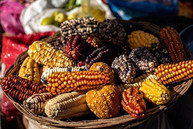
In FY 2022, USDA Farm to School Grants were awarded to four applicants from ITOs serving Native American communities. An additional three awardees stated that their projects will serve tribal communities.
The Sac and Fox Tribe of the Mississippi in Iowa Project will serve the Meskwaki Settlement School's Early Childhood through 12th grade students. Their implementation grant will help them expand the school's gardening and food storage capacity. They will also incorporate more local and tribal foods in the school's meals, conduct taste testing activities, and develop a tribal food sovereignty curriculum to support agricultural education.
In partnership with the Absentee Shawnee Tribe, Oklahoma Tribal Engagement Partners will use their turnkey grant to create and sustain an edible garden in the Absentee Shawnee Tribe Afterschool Program. The edible garden will support tribal food sovereignty, increase nutrition education through hands on learning, and improve fresh food access for students and community members.
The Cheyenne River Farm to School Implementation Project will provide locally sourced beef and buffalo to be served in school meals to the estimated 2,200 students attending schools on the Cheyenne River Sioux Reservation. Students will also learn about where the locally sourced protein comes from and its cultural importance. The project builds on the Cheyenne River Farm to School Action Plan the tribe and its partners developed as a FY 2020 Farm to School Planning Grant awardee.
The Knik Tribe will use their implementation grant to create tunnel houses and raised beds to grow leafy greens. The harvested greens will be served at the Benteh STEAM Academy to children in childcare and after school programs. Farmers from the Knik Tribe Farm and academy instructors of the Benteh STEAM Academy will collaborate to teach the children how the greens were grown.
|
Tribes Shine with Nutrition Education Efforts
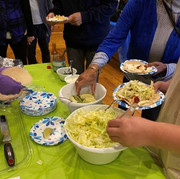
USDA FNS's Food Distribution Program on Indian Reservations Nutrition Education (FDPNE) grant program awards funding to tribal organizations and state agencies to provide nutrition education to FDPIR food package participants. The pandemic forced grantees to get creative in delivering nutrition education.
The Alaska Native Tribal Health Consortium (ANTHC) used their FDPNE grant funds to develop an online nutrition education learning series. Whole Grain Adventures, featuring Gordy the Grain and friends, provides an interactive learning experience focusing on whole grains and healthy snacking.
Project Manager Marcia Anderson explains, “By highlighting Alaska Native traditional foods alongside whole grains and other healthful food options available in FDPIR packages, we aim to show that incorporating whole grains is possible without disregarding traditional foods.” Whole Grain Adventures features interview with Alaska Native elders, cooking videos, and an interactive online learning curriculum.
Photo: Making halibut tacos in Metlakatla Indian Community in Alaska, in partnership with the ANTHC Health Promotion program. Photo by ANTHC.
|
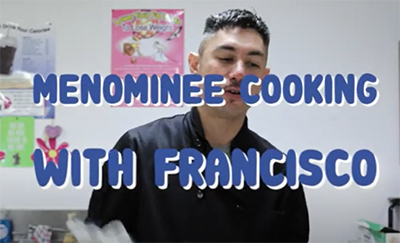
The Menominee Indian Tribe of Wisconsin produced an updated series of cooking demonstration videos featuring a local native chef using foods found in the FDPIR food package. Chef Francisco who grew up on the Menominee Indian Reservation in Wisconsin and incorporates traditional methods and equipment into his recipes. Video links can be found on the FDPIR Sharing Gallery. Chef Francisco was also featured on a fabulous Facebook Live event with Cooking Matters by Share Our Strength.
|
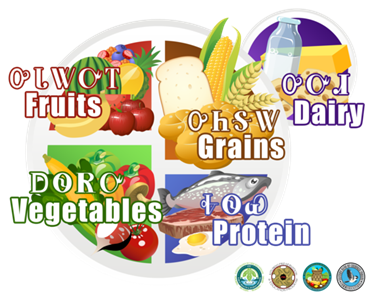
The Eastern Band of Cherokee Indians (EBCI) decided to take nutrition education virtual by creating a new food distribution program website emphasizing the Cherokee language and culture. The pronunciation of Cherokee words on the website can be heard by hovering the cursor on the word. The website inspires FDPIR participants to make their food package part of a healthy diet by including recipes, cooking demonstration videos, factsheets, and a beautiful explanation of the Cherokee traditional foodways. All pictures included on the website feature local and indigenous people so that community members see themselves reflected in the nutrition education materials.
One of the most important resources created is the “My Cherokee Plate” based on the USDA MyPlate nutrition guidelines. My Cherokee Plate includes local traditional foods, like berries and fish, as well as items commonly offered through FDPIR.
For more nutrition education resources check-out the FDPIR Sharing Gallery, and to stay up to date on the latest happenings in FDPIR subscribe to the USDA Foods from Farm to Plate: FDPIR Connection e-letter.
|
Northern Arapaho Tribe's WIC Program Receives WIC Breastfeeding Performance Bonus Award
The Northern Arapaho Women, Infants, and Children (WIC) Program is one of only three WIC agencies in the country that received a WIC Breastfeeding Performance Bonus Award in 2022. This year’s awards recognize the Puerto Rico, Northern Arapaho Tribe, and California WIC agencies’ outstanding achievements in sustaining high breastfeeding rates among WIC participants during FY 2021.
The Healthy, Hunger-Free Kids Act of 2010, established the WIC Breastfeeding Performance Bonus Awards for state agencies that demonstrate the greatest improvement or the highest rates in the proportion of breastfed infants.
Northern Arapaho Breastfeeding Coordinator Lacey Brown’s job is to support WIC moms' journeys in breastfeeding. She feels that more moms have come into the WIC clinic wanting information on breastfeeding since the infant formula recall. Lacey has taken advantage of this opportunity to use her knowledge to encourage more moms to breastfeed by providing them with education and support. She just passed her Certified Lactation Consultant (CLC) exam, making her an authority on breastfeeding. She also has personal experience; she has two children that she breastfed.
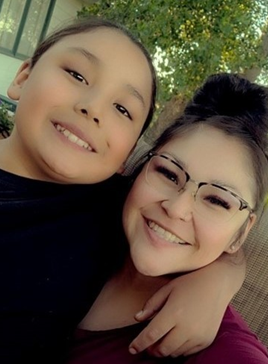
Photo: Northern Arapaho Breastfeeding Coordinator Lacey Brown with Dredyn, her 11-year-old son.
|
Blog: FNS Honors Traditions and Supports the Sovereignty of Tribal Nations
By Ali Hard, FNS Senior Policy Advisor
Tribal nations across what we now consider the Great Plains relied for millennia on their buffalo relatives for food, medicine, clothing, tools, and shelter. Yet today it is hard to find buffalo meat on school meal trays in the very areas where they once sustained Native communities. FNS is working with tribal partners to figure out why and to remove the barriers we can.
The Biden-Harris Administration and Secretary Vilsack have made it a priority to better meet our federal trust and treaty responsibilities. Historically, the U.S. government played a significant role in the decimation of the buffalo population in the North American continent, with a policy of destroying buffalo in order to starve Native Americans into submission. We recognize the weight of these actions and our obligation to better support tribes in restoring buffalo across their lands.
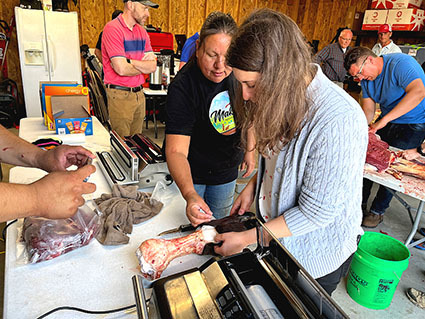
On Monday, June 6, my colleagues at FNS, Food Safety and Inspection Service, Rural Development, Agricultural Marketing Service, and the USDA Office of Tribal Relations, and I were honored to be invited by the InterTribal Buffalo Council and members of the Oglala Sioux Tribe on the Pine Ridge Indian Reservation to participate in a traditional buffalo slaughter and field harvest. Click here to read more.
|
|