| |
Navigating the Future
FAA's 19th annual controller workforce plan update
Federal law requires the FAA to submit an annual update to the Controller Workforce Plan to Congress. This is the FAA’s 19th annual update to the Controller Workforce Plan. The report reflects changes in air traffic forecasts, controller retirements and other factors.
The FAA is taking aggressive action to expand the controller pipeline to meet the nation’s air traffic demands. These programs include year-round hiring for experienced controllers from the military and private industry, enhancing the Air Traffic-Collegiate Training Initiative so that controller trainees completing the program can begin facility training immediately upon graduation, filling every seat at the FAA Academy and deploying upgraded tower simulator systems.
This year’s plan includes a discussion of the output of the Collaborative Resource Workgroup (CRWG) effort to determine Certified Professional Controller (CPC) staffing targets. These targets are higher than the Agency Staffing Standards (SS) targets. The CRWG and SS models take different approaches to determine the target number of controllers needed at each individual facility.
The staffing standards, updated annually, have been utilized to produce facility-specific staffing targets in the Controller Workforce Plan (CWP) since the CWP was first created in 2005. The FAA has contracted with the National Academy of Sciences to convene an expert committee in Fiscal Year 2024 to conduct a study to inform its efforts to develop repeatable and defensible methods for setting targets in the future. We expect results from the study in the summer of 2025.

Solar Storms in Forecast: Update from the #FAAWeatherSquad at the Command Center.
|
|
|
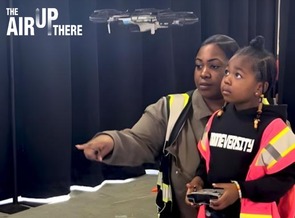
In the latest episode of the FAA’s podcast The Air Up There, Ashlee Cooper, an FAA certificated Remote Pilot and FAA Drone Pro in the Northeast Region, shares her insights into drones and innovative applications to advance STEM education. Through Droneversity, Cooper empowers students, educators and enthusiasts to explore their potential in the dynamic world of drones, coding, careers and technology, using immersive experiences like drone soccer. The organization also ensures all players pass The Recreational UAS Safety Test (TRUST), an FAA requirement that provides education and testing on important drone safety and regulatory information. “We’re just providing people with a lot of tools to be able to take advantage of everything that aerospace and STEM has to offer,” Cooper said. Share this episode to help raise awareness about careers in aerospace.
|
In a significant development for international aviation, Ethiopian Airlines and Kenya Airways successfully conducted their first trial User Preferred Routes (UPR) flights in November, backed by the FAA. This achievement further reinforces the FAA commitment to Africa, a key focus area championed by ATO Chief Operating Officer Tim Arel. It also highlights the FAA’s commitment to advancing the U.S. Strategy Toward Sub-Saharan Africa and marks a key step in establishing regional Free Route Airspace (FRA). UPRs allow airlines to propose the most efficient flight paths between two cities based on factors such as weather and traffic, which, upon approval by Air Navigation Service Providers (ANSPs), can lead to optimized flight efficiency, fuel savings and reduced emissions. This concept is pivotal for enhancing the flexibility and efficiency of air traffic management.
|
|
|
May 10, 1973: The Civil Aeronautics Board published the first rule regulating smoking on aircraft for reasons of consumer comfort and protection. The Board required airlines to provide separate sections for smokers and nonsmokers. Subsequent modifications to the rule included a 1981 requirement that airlines guarantee a seat in the nonsmoking section to every nonsmoker who met the check-in deadline. It would take another 27 years before smoking was completed banned on all domestic and international U.S. flagged flights. These regulations have been updated to include e-cigarettes and vaporizers. ICAO has recommended restrictions on smoking, but regulations vary by country and airline.
|
|
|
|
|