|
From Research to Reality
Systems Engineering blueprint for an info-centric NAS
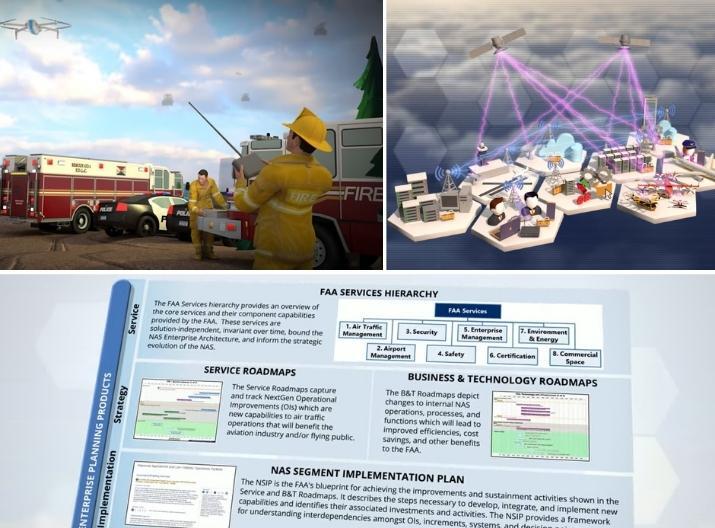
A new page on faa.gov provides technical information on the NAS Enterprise Architecture (EA) and the underlying contributions of Systems Engineering. Also known as “From Research to Reality,” the new page is the result of collaboration between the Office of NextGen (ANG), the Air Traffic Organization (ATO) and the Security and Hazardous Materials Safety (ASH) organization.
The NAS EA provides the blueprint to help move from today’s research toward the reality of an Info-Centric NAS. The EA contains a set of data and models that document the current and target states of the NAS, and establish the transition plans for achieving the target state.
The website will initially focus on the NAS EA roadmaps, which help communicate the NAS’s strategic evolution, support the allocation of resources, and provide a framework for programs as they introduce new capabilities and services. Establishing a process for evaluating technical information for release is in itself a valuable development in achieving an Info-Centric NAS.
All parties worked hard to strike the right balance between the availability of information and appropriate security precautions. Subject matter experts from ATO, ANG, and ASH reviewed and edited technical products multiple times. Making such detailed information publicly available encourages and enables private-public partnerships, improves cross-organizational collaboration across the FAA, and provides stakeholders with a better understanding of technical projects and programs currently under development and their end-state objectives.
Read more about the From Research to Reality page on FocusFAA.
|
|
AFN Efficiency Award
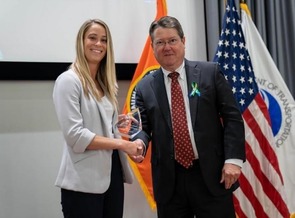
Stephanie Droussiotis was recognized for her work supporting AFN. Droussiotis developed a portal and automated tool to process contract pricing requests and procurement data - the tool has resulted in cost avoidance of about $1 million. Analysts are spending about one-quarter of the time they previously spent setting up a new procurement record. Phone calls between analysts and customers have dropped by 50 percent. Her efforts illustrate an undisputed commitment to AFN’s mission.
|
|
In this episode of the Pilot Minute, Federal Air Surgeon Dr. Susan Northrup outlines important desert survival strategies and provides information on free post-crash training offered by the FAA’s Civil Aerospace Medical Institute (CAMI). “Think of flying over a desert like flying over a large body of water. If you haven't packed it, don't expect nature to provide it,” Northrup said. “...Remember that rescue can take days, not hours. The goal of survival is to simply stay alive long enough to be rescued.”
|
|
 Join the final EIMxRPA Showcase today at noon ET to learn about FAA's latest Robotic Process Automation updates and Enterprise Information Management program efforts.
|
|
Passenger Blows Himself Out of Plane

|
July 25, 1957: A passenger boarded a Western Airlines Flight 39, a Convair 240, from Las Vegas to Burbank, locked himself in the lavatory at the rear of the plane and was sucked out in a mysterious explosion. The crew made an emergency landing with a 6ftx7ft hole in the fuselage, and no one else was injured. The passenger's body was found the next day, missing four fingers. The accident investigation later revealed that the passenger bought dynamite from a friend and two insurance policies before his flight and he was killed in an attempt to detonate his bomb onboard. |
|
|
|