Federal Aviation Administration Employees sent this bulletin at 03/30/2023 01:00 PM EDT
Summer Operational Summit Readout
ATO, airlines, GA meet with focus on NY airspace
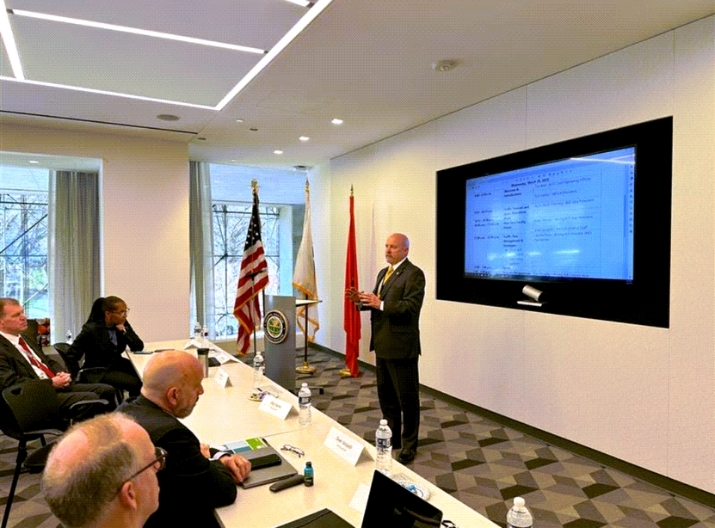
The FAA anticipates a busy summer air travel season to and from New York City, through some of the country’s most complex and congested airspace. To ensure safe and smooth operations, the Air Traffic Organization (ATO) held a productive meeting yesterday with airlines, general aviation representatives and associations and the National Air Traffic Controllers Association (NATCA) to discuss ways to minimize impacts to passengers.
Participants discussed traffic flow management strategies, system resiliency and facility staffing. Operators requested collaboration and communication with the FAA early and often to plan for circumstances that could result in delays, including weather events, space launches, and military operations. They discussed how closer collaboration and frequent air traffic updates would help them more effectively schedule crews.
They also requested increased coordination between facilities to take advantage of alternate routes, such as deep water routes. The FAA discussed efforts to reduce the air traffic controller training backlog at many air traffic facilities, but pointed out that staffing levels at the New York Terminal Radar Approach Control (N90) continue to be below targets. The agency stressed it will be more flexible to safely accommodate the projected increase in demand this summer. The agency will be more proactive regarding traffic management initiatives.
The agency is reviewing the feedback from participants and will identify actions to improve operations this summer in the New York area. The summit was similar to one hosted in Florida last year that resulted in measures to improve efficiency in a high-demand area.
Of the 1,074 women who completed the Women Airforce Service Pilots (WASP) program, only one pilot was Native American and she would go on to blaze a trail in aviation. Captain Ola Mildred Rexroat pursued her career undeterred even after WASP was disbanded, serving as an air traffic controller in the Air Force and with the Civil Aeronautics Administration, the FAA’s predecessor.
Meet AJI Human Factors Scientist Chandra Smith
Chandra Smith, human factors scientist in Safety and Technical Training (AJI), shares why her mother is the person she admires most and gives a look into what she does at work, including applying technical knowledge to human performance safety investigations, training standards, and safety culture to resolve complex problems and develop improved systems to safeguard the NAS.
March 30, 1994: President Clinton signed the Federal Workforce Restructuring Act of 1994, legislation offering buyouts of up to $25,000 to personnel willing to leave Federal service. The act also targeted a reduction of 272,900 federal employees between 1993 and 1999. The buyout was offered in conjunction with an early retirement option, authority for which had become available on March 14. FAA initially offered the buyout to its personnel between March 31 and May 3, 1994. Certain categories of employees received subsequent buyout offers, some with a deferred retirement option, during 1994 and 1995. More than 3,000 FAA employees eventually received buyouts. The buyouts were a major factor in the reduction of FAA’s full-time equivalent workforce, which fell from 52,352 in fiscal 1992 to 47,738 at the end of fiscal 1996.