|
Test Your School. Protect Your Health.
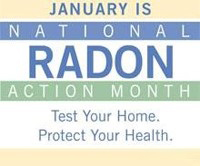
January is National Radon Action Month. The U.S. Environmental Protection Agency (EPA) encourages you to test your school facilities for radon.
 |
As a known human carcinogen, radon is one of the most hazardous indoor pollutants. It is the leading cause of lung cancer among non-smokers, causing almost 21,000 deaths a year. Radon is a naturally occurring radioactive gas that emanates from rock and soil and can enter school facilities through cracks and openings in building foundations. A nationwide survey of radon levels in schools estimates that nearly one in five has at least one schoolroom with a short-term radon level above the action level of 4 picocuries per liter (pCi/L)—the level at which EPA recommends that schools take action to reduce radon.
|
The only way to determine if your school building has elevated radon levels is to test. Testing for radon is simple and unobtrusive, and every school should have a plan to manage radon. Winter is a good time to test for radon because it is easier to maintain proper testing conditions, which require that doors and windows be closed except for normal entry and exit.

You can’t see or smell radon. The only way to know if radon levels are high is to test. Elevated levels of radon can occur anywhere, though radon concentrations may be higher in certain areas of the country. Testing each room within the school is important, as radon levels can vary even within the same building. Speak with your state radon office to learn if any schools have been previously tested and, if so, what the results were or if mitigating actions were taken. Your state radon program office can provide you with information and technical assistance to develop an action plan for radon education, testing and follow-up action. They also can help encourage a discussion of radon with stakeholders to ensure that all involved understand this important issue.

EPA recommends that all schools be tested for radon and retested after any renovations or changes to the building’s HVAC systems. Consider the following:
- If short-term testing is chosen, conduct testing on school days only (not holidays, vacations or weekends), in cold-weather months, using reliable short-term devices.
- Test all frequently occupied rooms, including rooms with ground contact and those immediately above unoccupied spaces that are in contact with the ground, such as crawlspaces and tunnels.
- Conduct follow-up testing and take corrective actions in all frequently occupied rooms that test at or above 4 pCi/L. The EPA radon guidelines for schools can be found here.
- Encourage residents in your community to test their homes for radon. If you find radon in your school, there is a greater chance that it will be present in homes in the area.
- Contact your state’s radon program for specific guidance and requirements.

It’s important to track and maintain a record of your facility’s radon tests. Check out EPA's resources and resources available in your state to help you address radon.
- Download EPA’s School IAQ Assessment Mobile App. This is our latest effort to provide updated, user-friendly guidance to help schools identify, resolve and prevent IAQ problems, using low- and no-cost measures. Use the comprehensive Walkthrough Checklist to assess your facility and track your radon testing dates and results. This app is a simple tool usable on a mobile device with internet access—whether it’s a smart phone or tablet. The app is available for both the Android and Apple platforms, free to download and free to use.
- Review the Framework for Effective School IAQ Management: Managing Radon in Schools. This tool provides a system to address radon risks as part of a comprehensive IAQ management process.
- Some areas of the country have more potential for radon than others. However, you should test your school wherever it’s situated. Radon can be a very localized phenomenon. Additionally, each state has specific resources and assistance they can provide. Locate your state resources here.
Get the Word Out—Be an Advocate for Radon Testing
Help spread the message and raise awareness about the importance of radon risk reduction. EPA has free online resources that can help you address this important public health issue at www.epa.gov/radon and at sosradon.org.
Spread the word! Forward this email to a colleague: 
Questions?
If you have any questions about the IAQ Tools for Schools guidance, please contact the IAQ Tools for Schools Connector Coordinator at iaqschools@epa.gov.
EPA offers free IAQ Tools for Schools resources—including the School IAQ Assessment Mobile App—to help schools maintain a healthy indoor environment by identifying, correcting and preventing IAQ problems. Learn more about the IAQ Tools for Schools guidance and access other valuable school environmental health resources at www.epa.gov/iaq-schools.
|