
November Monthly News Blast: BETO Releases Updated Multi-Year Program Plan
DOE Office of Critical Minerals and Energy Innovation sent this bulletin at 11/20/2014 03:10 PM EST
 |
||||
 |
||||
|
||||
BETO Releases Updated Multi-Year Program Plan
|
|
|||
Energy Department Announces New Grant Topics to Help Small Businesses Develop Clean Energy TechnologiesThe Energy Department’s Office of Energy Efficiency and Renewable Energy (EERE) recently announced three new bioenergy subtopics under its Small Business Innovation Research (SBIR) and Technology Transfer (STTR) programs. More details can be found on the EERE website, including a full list of topics and application instructions. Interested applicants who want to learn more about the SBIR/STTR application process can register for the EERE Cleantech SBIR webinar on December 8 from 11:30 a.m. to 1:00 p.m. Eastern Standard Time. Study Finds that Water Leads to a Chemical that “Gunks Up” the Biofuels Production Process
Report Evaluates Use of Biomass in Pulverized Coal PlantsA joint report from Idaho National Laboratory and Pacific Northwest National Laboratory presents the results of a BETO-funded evaluation examining the effects of substituting up to 20% renewable biomass for coal in electricity production. This research was the first to look at the impacts of co-firing biomass at concentrations greater than 10%, and expanded the methodology that communities and energy providers can use to evaluate the potential economic and environmental benefits of using biomass in their coal plants. Read more on the BETO website. Biomass 2014 Speaker Presentations Now Available
BETO Releases Webinar on Genetically Modified AlgaeAs the algae industry continues to invest in genetic modification research and development to optimize biofuels production, biocontainment systems and regulatory policies will play key roles in avoiding negative environmental impacts. Watch the webinar “Genetically Modified Algae: A Risk-Benefit Assessment” on demand to hear Dr. Richard Sayre of Los Alamos National Laboratory discuss these issues and explore the genetic modification of algal traits to enhance photosynthesis and biomass productivity. BioBlogsEnergy Department Blog: Pumpkin Power
EERE Blog: Cornstalks Aren’t Just for Scarecrows Anymore
Recent Events with BETO RepresentationF.O. Licht’s 17th Annual World Ethanol & Biofuels ConferenceValerie Sarisky-Reed, BETO Deputy Director, attended F.O. Licht's 17th Annual World Ethanol & Biofuels Conference, held in Budapest, Hungary, from November 3–6. Dr. Sarisky-Reed served on two panels: "Maintaining Next Generation Investments in the Years Ahead" and "Putting Together a Constant Supply of Feedstocks for Advanced and Cellulosic Biofuels, Biochemicals, and Aviation Fuels." BETO’s Waste-to-Energy WorkshopThe Waste-to-Energy Workshop hosted by BETO on November 5 was a great success, bringing together more than 80 industry stakeholders to discuss challenges and opportunities for creating biofuel from waste. The workshop concluded with a tour of DC Water’s Blue Plains Advanced Wastewater Treatment Plant. Advanced Bioeconomy Leadership ConferenceBETO’s Deployment & Market Transformation Program Manager James Spaeth attended the Advanced Bioeconomy Leadership Conference, which was co-sponsored by BETO and held in San Francisco from November 10–12. The conference welcomed leaders in the advanced biofuels and renewable chemicals industry to explore bioindustry-related topics—ranging from emerging markets to technologies, geographies, feedstocks, policies, and financing strategies. Green Lands Blue Water ConferenceOn November 19, Kristen Johnson, BETO’s Sustainability Program Technology Manager, delivered a presentation at the Green Lands Blue Water Conference, in Decatur, Illinois. Her presentation, “DOE Perspective on Sustainable Bioenergy Landscapes,” focused on BETO’s work with landscape design, including the workshops held earlier this year and the open funding opportunity. The two-day conference, which runs from November 19–20, concludes today. Upcoming Events with BETO Representation
|
||||
|
To view past Monthly News Blasts, visit the BETO Newsletter page. |
||||
|
Update your subscriptions, modify your password or email address, or stop subscriptions at any time on your Subscriber Preferences Page. You will need to use your e-mail address to log in. If you have questions or problems with the subscription service, please contact support@govdelivery.com.
This service is provided to you at no charge by DOE's Office of Energy Efficiency & Renewable Energy (EERE). Visit the website at http://www.eere.energy.gov. |
||||
 Learn how the Bioenergy Technologies Office’s (BETO’s) activities, mission, and goals are helping meet the nation’s energy challenges in the Office’s newly updated


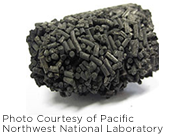 Researchers at Pacific Northwest National Laboratory have determined that water, which is prevalent in biofuel conversion processes, turns phenol, a common bio-oil byproduct, into an impurity that slows down key chemical reactions. These findings may lead to improved methods for refining biofuels. This research was conducted under BETO’s Computational Pyrolysis Consortium, a multi-lab effort to design processes and catalysts that speed up the development of hydrocarbon biofuels, helping BETO reach its conversion technology cost goals. Watch a 90-second video, “
 On July 29–30, 2014, BETO held its seventh annual conference, Biomass 2014: Growing the Future Bioeconomy. Speaker presentations are now available on the
 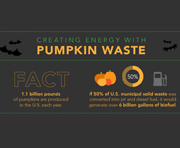 This Thanksgiving, BETO is giving new meaning to the familiar adage that one man’s waste is another man’s treasure. In fact, here at BETO, we think that one man’s waste should be another man’s bioenergy! Following your Thanksgiving feast, consider that your leftover pumpkins could be turned into energy. If 50% of municipal solid waste in the United States was converted into jet and diesel fuel, it would generate more than 6 billion gallons of biofuel each year. Now that’s something to be grateful for! Read more about the power of pumpkins and other forms of municipal solid waste on the
  For thousands of years, farmers have been using cornstalks to make scarecrows, preventing crows and other predators from destroying their crops. This fall, BETO is focusing on using cornstalks for a different purpose—bioenergy production. Our scientists have identified corn stover, which includes the corn plant’s stalks, husks, cobs, and leaves, as a plentiful and reliable feedstock for producing bioenergy. Read more about BETO’s work with corn stover on the