Innovation of the Month:
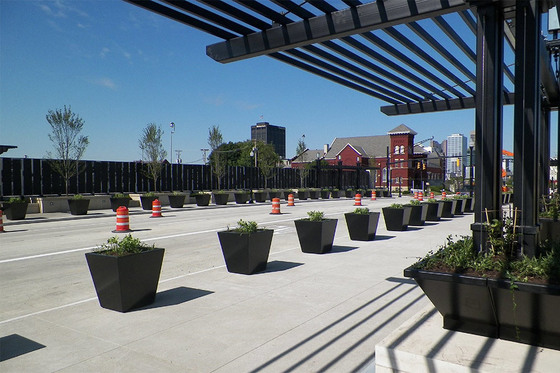
Community
Connections
The tools in the community connections
toolbox help transportation agencies ensure that all users have access to safe,
reliable, affordable, and multimodal transportation networks.
Project development and design
techniques such as the following encourage flexibility
to develop projects that meet community desires and users’ needs:
- Context-sensitive
solutions involve all stakeholders in planning transportation facilities that
fit their setting.
- Performance-based
practical design emphasizes thinking beyond cost-based choices on projects and
using performance data to make informed decisions in balance with community
needs.
- Road
diets reconfigure roadways to calm traffic, enhance safety, and provide space
for uses such as bicycle lanes and pedestrian pathways.
Operational improvements and programs
help agencies better connect communities:
- Expanded
access to transit for pedestrians and bicyclists helps agencies support
multimodal trips, improve safety, and increase public transportation use.
- Improved
transit service and transit infrastructure investment reduce dependence on cars
and enhance access to economic opportunities.
- Shared
mobility services such as bike-sharing, car-sharing, and demand-response bus
services provide flexible transportation options for communities.
To learn more, see the Federal
Highway Administration’s community connections toolbox
and watch the Overview of Community Connections
webinar.
Contact Corbin
Davis or Kenneth
Petty of the FHWA Office of Planning, Environment, and
Realty or Robert
Mooney of the FHWA Office of Infrastructure for
information and technical assistance.
Learn About
EDC-5 Innovations
FHWA’s webinar
series introducing the innovations in Every Day Counts round five (EDC-5) wraps
up next week. Go to the EDC-5 innovation orientation webinars
page to register for next week’s sessions:
- Safe Transportation for Every Pedestrian:
September 24, 1 to 2:30 p.m. and September 25, 1 to 2:30 p.m. ET
- Value Capture: Capitalizing on the Value Created
by Transportation: September 25, 10:30 a.m. to 12 noon, and September 26, 1 to
2:30 p.m. ET
- Advanced Geotechnical Exploration Methods:
September 26, 10:30 a.m. to 12 noon ET
Missed the EDC-5 orientation
webinars? Find the recordings here.
Texas Uses Pavement Preservation Treatment to Reduce Noise
After exploring several noise abatement
solutions, the Texas Department of Transportation (TxDOT)
constructed a Next Generation Concrete Surface
(NGCS) on Interstate 10 near Houston to address residents’ concerns about
tire-pavement noise. Developed by Purdue University and installed in 16 States,
NGCS is a pavement preservation treatment that combines grinding and grooving
to create a texture that improves ride quality and lessens the amount of noise
vehicles make on roads. Traditionally, transportation departments used just
grinding for concrete pavements. After the NGCS texture was installed, TxDOT
received positive feedback from the public and elected officials about tire-pavement
noise reduction. TxDOT expects to place several million square yards of NGCS in
the Houston area in the coming years to provide a smoother and quieter driving
experience. For information on pavement preservation,
contact Jason
Dietz of the FHWA Resource Center.
|



