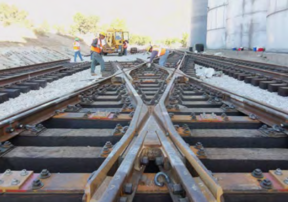
 Railway maintenance of Utah Transit Authority's system (Image courtesy of UTA)
The purpose of FTA's Transit Asset Management (TAM) newsletter is twofold: to keep you up to date on our office’s asset-management
initiatives (as a complement to our web site and e-mail alerts), and to create a forum for communication for
all of us in the industry to share information, so that we can learn from each
other.
The topic for the next
edition is Business Processes for Transit Asset Management. Please share any useful processes that your agency has adopted or let us know if there is any related topic that you would like to know more about. Email us:
TAMNews@dot.gov
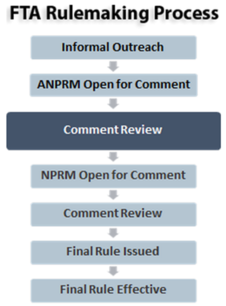
The
FTA Rulemaking is currently in the Comment Review Phase of the process.
News:
TAM-Related Activities at the Transportation Research Board (TRB) Annual Meeting:
-
Workshop: Transit Asset Management and the ISO-55000 Asset Management Series of
Standards Sunday, January 11, 2015 1:30 –
4:30PM
-
Lecture: More Than Roads and Bridges:
Incorporating Other Assets in Transportation Asset Management Planning Monday, January 12, 2015 8:00AM –
9:45AM
-
Lecture: Fleet Management: Safety,
Prioritizing, and Planning Monday, January 12, 2015 3:45PM – 5:30PM
-
Poster: Prioritizing Data for Transit
Management and Performance Decisions Tuesday, January 13, 2015 2:00PM – 3:45PM
Now Available Online:
National Transit Institute, Introduction to Transit Asset Management Course:
- Orlando, FL February 5, 2015
- Thousand Palms, CA March 17, 2015
Resources:
TAM Pilot Projects:
FTA's State of Good Repair Roundtables - The four Roudtables, held between 2009 and 2012, created a forum for experts in the transit industry to discuss the challenges of transit recapitalization and share ideas on how to address them. Each Roundtable offers numerous case studies on a variety of TAM-related topics.
Transportation Research Board’s 10th
National Conference on Transportation Asset Management (2014):
FTA State of Good
Repair Grants
In 2012,
Moving Ahead for Progress in the 21st Century authorized the State
of Good Repair Grant Program (4.9. USC Section 5337) which is a formula-based
program dedicated to maintaining fixed guideway and high-intensity motorbus systems in a State of Good Repair (SGR). Eligible activities include capital projects that maintain SGR,
including the rehabilitation and replacement of a number of different
components of a transit system. The development and implementation of Transit
Asset Management Plans are also eligible activities. LYNX of Orlando, Florida,
has used SGR grant funding to develop a Transit Asset Management Plan. The LYNX
bus system serves the greater Orlando area and is managed by the Central
Florida Regional Transit Authority. The agency is conducting a comprehensive
inventory of primary facilities and stations with the intent of improving its
transit asset management database. The database will include condition
assessments which will detail the order in which assets and deficiencies are
prioritized. FTA is in the process of publishing the State of
Good Repair Program Guidance. Please check FTA's SGR website for updates.
For more information on the State of Good
Repair Grant apportionments, see:
Apportionment Diagram for SGR Grants
Apportionment Table for SGR Grants |
State of Good Repair: Noteworthy Practices
This edition of the Transit Asset Management Newsletter
covers noteworthy practices in State of Good Repair. The first section is an
article that describes some lessons learned from two of the FTA State of Good Repair Pilot
Projects. There is also a list of resources in the left column that includes other noteworthy
practices followed by a brief summary of the FTA State of Good Repair Grant Program.
Introduction
In 2010 FTA released Transit Asset Management Practices – A
National and International Review, which documented 11 case studies of
current practices. The report found that while most agencies are doing some
asset management activities, there is room for improvement, particularly in aligning
policies toward achieving a State of Good Repair (SGR). Later that year,
Congress directed FTA to use up to $5 million of research funds for asset
management initiatives, including a pilot program aimed at improving asset
management in the transit industry.
This article highlights the Utah Transit Authority and Meridian Valley Regional Transit pilot projects. More information about these and the rest of the pilot projects is available in the Resources section of this newsletter.
Utah Transit Authority (UTA)
UTA provides public transportation services to five
metropolitan areas, including Salt Lake City, throughout the Wasatch Front
region of Utah, including light rail, commuter rail, fixed route buses, express
buses, ski buses, Bus Rapid Transit, and Paratransit buses. UTA used the SGR
Pilot Program funding to further develop its existing Asset Management System
(AMS) beyond the simple database inventory of physical assets it had previously
relied on. The previous system was inconsistent as to how asset information was
entered and stored. It was also very limited in detail regarding asset
attributes.
UTA developed objectives for the new AMS based on input from
the UTA staff that would be using the system most often and created a series of
interdependent modules that would allow the agency to achieve those objectives.
The agency’s full report (available in the Resources section of this
newsletter) describes the modules in detail.
The resulting AMS is a versatile, easy-to-use system that
helps the agency make informed investment decisions. Instead of simply having a
list of assets, the new AMS allows the user to prioritize investments based on
several different factors including asset condition, risk, and budget.
UTA largely attributes the success of this pilot to a
well-developed plan that began with a brainstorming session early in the
process. At the session, the participants discussed their needs, including what
information they already had, what information they needed, and the best way
for new information to be presented. UTA was conscious early on of the importance
of engaging with internal and external stakeholders as soon and as often as
possible throughout the development process. This approach led to an AMS that
is well-connected to the initial objectives of the agency and its stakeholders.
Meridian Valley Regional Transit (VRT)
VRT is a Regional Public Transportation Authority in
southwest Idaho, which contracts for transit service in the cities of Boise,
Garden City, Nampa, and Caldwell. The VRT system includes 26 transit routes and
paratransit services with a fleet of six vans, 58 buses, and 11 support
vehicles.
VRT wanted to improve their system for tracking its asset
inventory, which provides basic accounting, work order processing, and
inventory tracking capabilities. Particularly VRT wanted its system to be able
to analyze and prioritize investment needs. To achieve this, VRT formed a formal
partnership with the Boise State University shuttle system, the Idaho State
DOT, a county ridematching service provider, and two local transit providers in
the region. The partnership committed to developing a Regional Recapitalization
Plan and a Transit Asset Management Program.
To begin, the partnership developed a project schedule for
capturing business requirements, identifying team resources and potential
system vendors, and implementing a system. As part of the development process,
each partner agency agreed to help capture requirements for a regional asset
management system, inventory its own assets, and record its asset conditions. The
agencies developed methods for collecting any additional data that would ensure
consistent and comparable data across all the partnership agencies. The
combined assets of the regional partnership include: passenger buses and vans,
support vehicles, park and ride lots, bus shelters and benches, operations and
maintenance facilities, and transit centers. The wide range of assets required that
all partner agencies participate meaningfully throughout the planning process
to ensure that the resulting system is flexible enough to meet each agency’s needs.
As the region’s governing body, the partnership will also be responsible for providing
necessary support and guidance throughout the planning and implementation
process.
The partnership worked together to develop project
objectives, which were then used to identify system requirements. Tier 1 requirements
(SGR Reporting and Management) were implemented first. The data for VRT are now
live and available for generating reports for the National Transit Database. Ongoing activities include integrating
the Tier 1 data for the remaining partner agencies and incorporating the Tier 2
(Maintenance and Operations) requirements, which is scheduled for completion in
September 2015. As the lead agency, VRT will serve as a mentor and support the partnership
agencies as they add their asset inventories to the system.
The success of this pilot has and will continue to depend on
the solidarity and cooperation of the partnership.
Lessons Learned
Although the case studies focus on agencies of different
sizes and complexities, the lessons learned from both were similar and are
relevant and applicable to any agency that is looking to develop and implement
an Asset Management Plan.
Working as a Team
Yields Additional Benefits:
By developing a regional system that pooled resources across
several agencies, the Idaho partnership was able to implement an asset
management system more effectively than any agency could have done alone. Forming
a regional partnership will also allow the region to apply for grants as a
group in the future, maximizing their ability to fund large scale improvements
across multiple agencies.
UTA also found that through early engagement with those who
would be using the system, the agency was able to obtain buy-in and gain an
understanding of the users’ needs. This led to the development of more
user-friendly and versatile system that improves the efficiency of UTA’s
business processes.
Executive Level
Support is Essential:
Both transit agencies found that high-level executive engagement
helped to bring leaders together to form a regional vision, and to provide the
necessary direction to ensure that asset management principles were integrated throughout
the agency.
Transit Agencies Need
to Develop an Asset Management Philosophy:
It is important to develop measurable goals and objectives
in the beginning of the process. Goals and objectives helped the Idaho partnership
understand what is expected and what they are all working toward. UTA used
their goals and objectives to develop an Asset Management Philosophy statement
that guides their decisionmaking.
Identifying and Taking
Advantage of Existing Resources Leads to Efficiency:
By identifying existing data sources and processes, both
agencies were able to streamline the implementation process and minimize
changes to existing work processes, while also maintaining consistency in the
way that the asset management system is used. For example, VRT was able to save
time and effort by leveraging existing practices such as the established FTA asset
hierarchy described in the FTA
Asset Management Guide. |