The purpose of FTA's Transit Asset Management newsletter is twofold: to keep you up to date on our office’s asset-management initiatives (as a complement to our web site and e-mail alerts), and to create a forum for communication for all of us in the industry to share information, so that we can learn from each other.
The topic for the next edition is Noteworthy Practices. Please share any applicable articles or current practices/lessons learned.
Email us: TAMNews@dot.gov
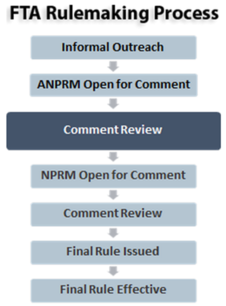 The FTA Rulemaking is currently in the Comment Review Phase of the process.
Resources
-
MAP-21
Fact Sheet: Transit Asset Management (FTA)
– This fact sheet explains the section in MAP-21 that establishes new
requirements for transit asset management by FTA’s grantees as well as new
reporting requirements to promote accountability.
-
Fact
Sheet: State of Good Repair Grants (FTA) –
This fact sheet explains the State of Good Repair Formula Grant program of
MAP-21.
-
Defining
a Transit Asset Management Framework to Achieve a State of Good Repair (American Public Transportation Association, 2013) –
This report is intended as an introduction to the high-level requirements for
building a transit asset management framework to achieve a state of good
repair, including definitional issues and resources for further study.
-
Asset
Management Guide (FTA, 2013) – The guide
provides a transit-specific application of asset management concepts,
processes, and tools to support an agency’s drive to increase the maturity of
asset management practice and to provide tools and resources for agency
managers and practitioners across the country.
-
Introduction to Transit
Asset Management training course (National Transit Institute, NTI) – This
is an introductory training course on transit asset management aimed at mid-
and senior-level managers who are involved in the day-to-day operation and use
transit assets including rolling stock, guideway, and facilities to perform
their duties.
-
Using the Transit
Economic Requirements Model (TERM Lite) training course (NTI) – This course
is directed at transit agency asset management staff and managers who are
involved in long-term capital reinvestment (SGR) needs analysis (5 to 30
years), investment prioritization and strategic planning
-
Transit State of Good Repair:
Beginning the Dialogue (FTA, 2008) – This report discusses FTA’s SGR
initiative and describes the current conditions in the industry that have led
to its development. It is the proceedings for the 2008 FTA State of Good Repair
Workshop which covered the state of current asset conditions; defining and
measuring SGR; transit asset management; standards for preventative
maintenance; core capacity; alternative approaches to financing; and research
needs.
-
Rail
Modernization Study: Report to Congress (FTA,
2009) – This report assesses the level of capital investment required to attain
and maintain a state of good repair for the Nation’s seven largest rail transit
operators. The study estimates the total value of the existing backlog of
over-age assets at these agencies and considers reinvestment needs within the
context of past levels of Federal funding support as well as potential changes
to the current Federal program.
-
Transit
Cooperative Research Program Report 157: State of Good Repair: Prioritizing the
Rehabilitation and Replacement of Existing Capital Assets and Evaluating the
Implications for Transit (Transportation Research Board, 2012) – This
report presents a framework for transit agencies to use for prioritizing
capital asset rehabilitation and replacement decisions.
-
Transit
Asset Management: Additional Research on Capital Investment Effects Could Help
Transit Agencies Optimize Funding (Government Accountability Office, 2013)
– This report examines (1) the extent to which selected transit agencies follow
leading asset management practices to prioritize capital investments, and challenges
in using these practices; (2) the extent to which these agencies measure the
effects of capital investments; and (3) FTA initiatives to support transit
agencies' use of leading practices.
-
Transportation Asset
Management Guide - A Focus on Implementation (American
Association of State Highway and Transportation Officials, 2013) – This is a
general asset management guide that aims to help transportation agencies
address strategic questions they confront in managing the surface
transportation system.
|
Introduction
The first edition of the Transit Asset Management Newsletter serves as an introduction to transit asset management and FTA’s
perspective. In the left-hand column are links to some of the key resources for getting started with transit
asset management.
Background and Need
Transit
infrastructure in the United States is aging and in need of continued
investment to keep conditions safe for riders and workers. Even though Federal,
state, and local funding resources have invested $165 billion in the
preservation and expansion of the nation’s transit system since 1991, current
investments are insufficient to maintain it.[1]
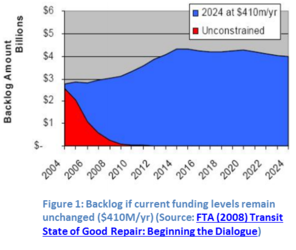
Much of the nation’s rolling stock and infrastructure is deteriorating; in 2008,
roughly one-quarter of the nation’s bus and rail assets were in marginal or
poor condition.[2] This
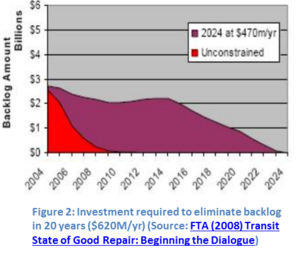
discrepancy between spending and need has created a maintenance backlog in the nation’s
transit system. Current capital reinvestment rates from all sources are only
60% to 80% of that required to address the existing backlog while still keeping
up with normal replacement needs.[3]
  Funding
is also needed to accommodate future increases in ridership. According to DOT’s
2013 Conditions and Performance Report, up to $24.5 billion is needed annually
to both achieve a state of good repair and
to accommodate future increases in demand.[4]
Legislative Process
Some of the most important recent changes affecting the
transit industry have been those instituted by the 2012 transportation law,
Moving Ahead for Progress in the 21st Century (MAP-21). Under
MAP-21, FTA is required to establish a National Transit Asset Management
System. Specifically, FTA must:
- Define
“state of good repair;”
- Set
objective standards for measuring the condition of capital assets (including
equipment, rolling stock, infrastructure, and facilities); and
-
Establish
performance measures for state of good repair, under which all FTA grantees
will be required to set targets.[5]
The
FTA is working to develop regulations to implement these MAP-21 requirements,
following the process outlined in the figure at the top of the left column entitled FTA Rulemaking Process. Currently, FTA is reviewing over 2,500 pages
of comments received in response to its Advance
Notice of Proposed Rulemaking (ANPRM) which
was published in the Federal Register in October 2013. These comments will be
incorporated into the Notice of Proposed Rulemaking (NPRM). You can stay
up-to-date on the rulemaking process by checking the FTA State
of Good Repair and Asset Management website and by signing
up for alerts.
Asset Management Activities
In
addition to regulatory activities, FTA is providing practitioner guidance to
help agencies most effectively utilize available funds. To achieve this, FTA is
focusing on asset management principles to repair and upgrade existing infrastructure
to a state of good repair (SGR). The principles of asset management are [6]:
- Analysis of options and tradeoffs
- Decisions based on quality information
- Monitoring provides clear accountability and
feedback
In
Fiscal Year (FY) 2010, FTA solicited projects through a Notice of Funding
Availability (NOFA) to support reinvestment in bus fleets and bus facilities
for both urbanized and rural areas. In FY 2011, FTA provided almost $753
million for this effort.[7]
Recognizing the need for improved information about transit asset management,
FTA funded six SGR pilot projects.[8] The pilot projects focused on improving each agency’s
transit asset management process, including consolidating existing systems and
upgrading and adding software capabilities that will allow for better analysis
and decision making. Software-system user manuals will also be developed, so
that information can be shared with other agencies.
In addition to the pilots, FTA continues to fund several other
transit asset management projects and research activities. Examples of these
efforts include development of the Transit Economic Requirements Model for
local agency use (TERM-lite); research on assessing asset condition;
improvements to FTA’s National Transit Database; and practitioner training and
coordination. Just recently, FTA dedicated another $1 million toward research that
includes the identification of performance and service quality indicators of transit
asset management.
Beginning in 2013, FTA has been providing over
$2 billion dollars annually through a formula-based SGR program dedicated to
repairing and upgrading the nation’s rail transit systems and high-intensity motor
bus systems, including bus rapid transit. These funds reflect a commitment to
ensuring that public transit operates safely, efficiently, reliably, and
sustainably so that communities can offer balanced transportation choices that
help to improve mobility, reduce congestion, and encourage economic
development. The funds can be used for capital projects to maintain their
system in a state of good repair or for development and implementation of
Transit Asset Management plans.[9]
Thank you for reading this first edition of our
newsletter. In our next edition, this winter, we plan to highlight noteworthy
practices from the SGR pilot program grants and other case studies. We welcome
your feedback on what topics would be of interest in future editions, as well
as pointers to resources or case studies you think should be shared with our community.
Please send any thoughts or resources to TAMNews@dot.gov.
Sincerely,
Robert J. Tuccillo
Associate Administrator for Budget and Policy/Chief Financial Officer
Federal Transit Administration
[1] FTA (2008) Transit State of Good Repair: Beginning the Dialogue
[2] Ibid.
[3] Ibid.
[4] FTA (2013) Conditions & Performance Report
[5] FTA (2011) MAP-21 Fact Sheet: Transit Asset Management
[6] FTA (2012) Asset Management Overview
[7] FTA (2011) State of Good Repair Initiative: Report to Congress
[8] FTA (2013) Progress on State of Good Repair Pilot Projects
[9] FTA (2011) Fact Sheet: State of Good Repair Grants
|