Virginia Department of Transportation's (VDOT) Journey with Safety Helmets
In the spring of 2017, the Virginia Department of Transportation (VDOT) began researching and exploring the advancement of head protection. The driving force for this research was related to six head injuries sustained when VDOT employees were conducting tasks while wearing the “traditional hard hat” and the hard hat not remaining in place on the employees’ heads, contributing to the head injury. VDOT collaborated with other safety and health professionals from the North American Association of Transportation Safety and Health Officials (NAATSHO), in addition to various solution providers. Various models of “helmets” were evaluated and tested. Based on this evaluation, VDOT selected a helmet that met ANSI Z89.1 (top impact and top penetration) plus EN12492 standards (side, rear and front impact). The VDOT helmet is ANSI Type II and continues to meet the EN12492 standards (Figure 1). Integration of accessories was also a key component of the study, and the helmet chosen by VDOT has a wide collection of accessories that are easily interchangeable. In October 2020, with the full support of VDOT’s Commissioner Brich, the traditional hard hat was retired, and the new safety helmet implemented.
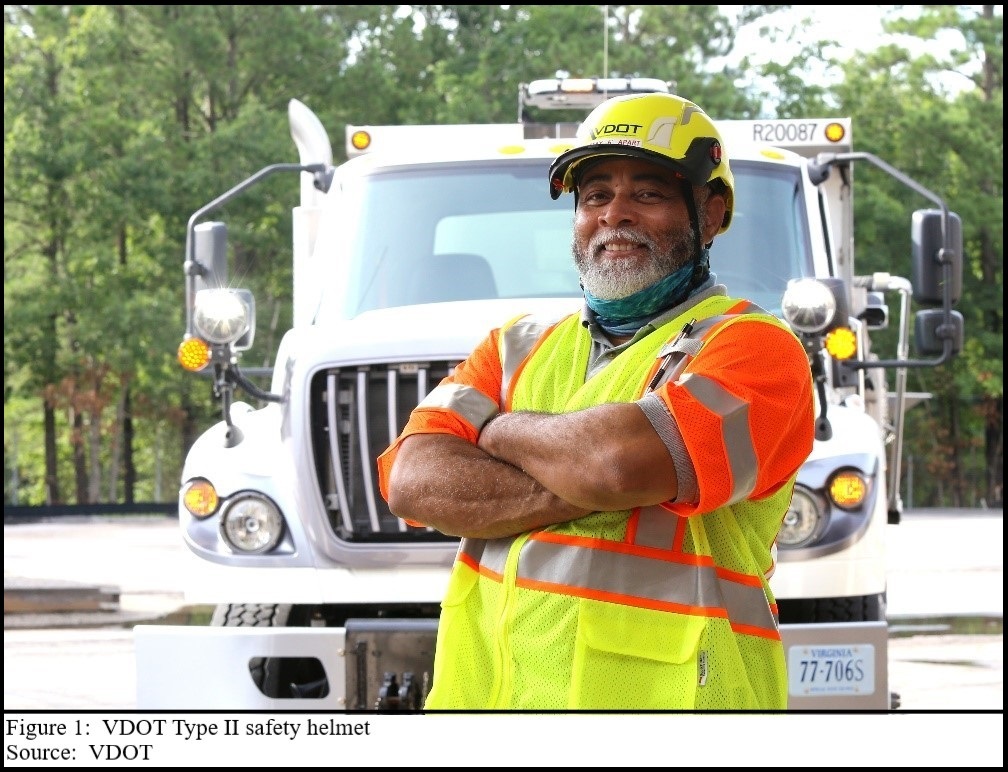 |
In additional to the impact ratings, VDOT focused on visibility. VDOT’s helmet is high visibility fluorescent yellow with retro-reflective tape, as to not blend into the typical work zone orange color of signs and other traffic control devices. Additionally, VDOT’s safety helmet is rated Class E, designed to reduce exposure to high voltage conductors, and offer dielectric protection up to 20,000 volts (phase to ground).
While on a highway, within the right-of-way, all VDOT employees are required to wear their issued helmet along with the required accessories for the task. For example, chainsaw operators receive a full-face mesh face shield/full face solid face shield and intergraded hearing protection (muffs). While VDOT does not require our contracting partners to wear ANSI Type II helmets, more and more highway contractors are beginning to use the ANSI Type II safety helmet.
Since the implementation of the new safety helmets, VDOT has seen a reduction in the frequency and severity of head injuries sustained by employees. If you would like to learn more about VDOT’s implementation of the safety helmet, please contact Ms. Marchel Johnson, Assistant Director of Safety, VDOT. If you would like to learn more about FHWA support in the advancement of ANSI Type II safety helmets, please contact Mr. Bryan Cawley, Highway Engineer, FHWA.
Domestic Scan of Digital Construction Management
There once was a time when written numbers did not exist. We had only our fingers and toes to use as counting devices. The 17th century saw the invention of mechanical machines for calculations. Fast forward to 1945, Electronic Numerical Integrator and Computer (ENIAC) became the first programmable digital computer. In the 1960s, electronic calculators like the Anita Mark series and the advanced HP9100 emerged as the first desktop calculators. Around the same time, General Motors developed the first computer-aided design system, contributing to this digital evolution that continues today.
The National Cooperative Highway Research Program (NCHRP) Project 20-68A recently embarked on a Domestic Scan to capture the progress of the digital construction management (DCM) evolution. The Domestic Scan began with a survey to document proven DCM innovations embraced by state highway agencies (SHAs). With over 24 different DCM innovations identified, the Domestic Scan team categorized these innovations into five groups and identified leading SHA adopters for further exploration. The five groups and leading SHA adopters are:
- Software interconnectivity / standards
- Electronic systems for subcontracts, payroll, verification, prompts payment, equal employment opportunity (EEO), Davis Bacon interviews, et.al.
- Project site documentation (photos, videos, scans, and retention policies)
- Georgia, Pennsylvania, and Utah
- Surveying (with digital devices and quality assurance)
- Nebraska and South Carolina
- Unmanned Aerial Systems (UAS) for inspection, mapping, et.al.
- California and South Dakota
A virtual 5-day workshop was then held in June 2023 to gather insights from the leading SHAs regarding their processes and activities used to advance DCMs. Through presentations, Q&A sessions, and subsequent discussions, the Domestic Scan team noted common elements contributing to success. These elements are:
- Foster a Culture of Innovation
- Secure leadership support
- Partner with industry, solution providers, and others
- Share innovations and resources with others (peer exchanges)
- Motivation
- Law, regulations, or policy
- Funding
- Strategic initiative
- An excited individual or group
- Manage Change
- Supporting and fostering training networks
- Integrating DCM systems
- Overcoming challenges
- Mainstreaming innovation
- Build and embrace culture for DCM
- Identifying and advancing DCM
- Identifying opportunities, investing, and investing in solutions
IT IS AN INVESTMENT!!!
The final report for this Domestic Scan about Experiences in the Use of Digital Construction Management in the Highway Industry is now available. If you have questions about the Domestic scan you may contact Ms. Wei H. Johnson PhD, PE, Construction Metrics Engineer, South Carolina DOT or Mr. Bryan Cawley PE, Highway Engineer, FHWA.
Technical Resources
|
e-Ticketing and e-Construction
Contact Ms. Kathryn (Kat) Weisner or phone: 202-823-2267
|
Innovation in Project Delivery: Progressive Design Build, Washington State DOT, March 25 @ 3:30-4:30 pm ET
Registration
|
|
Leadership Skills for Project Management
Contact Mr. Bryan Dillon or phone: 202-875-4155
|
Digital As-builts and Building Infrastructure Models (BIM)
Contact Mr. David Unkefer or phone: 404-764-7498
|
|
Probabilistic Risk-Based Cost Estimation Training
Contact Ms. Megan Hall or phone: 202-923-5282
|
Value Engineering (VE) and Value Engineering Change Proposals (VECP)
Contact Mr. Jose Granado or phone: 804-682-0072
|
|
Critical Thinking Skills for Managing Contract Changes, Workshop
Contact Mr. Roy Siegel or phone: 404-764-6053
|
Construction Worker Safety
Contact Mr. Wilfred (Wil) Hernandez or phone: 774-991-9045
|
Other Resources
Federal Highway Administration (FHWA) Construction
https://www.fhwa.dot.gov/construction/
Stay Connected |
|
 |
 If you are not already a subscriber, please click on the button above to subscribe to the Innovation in Project Delivery e-news mailing list.
If you are not already a subscriber, the Center for Accelerating Innovation invites you to subscribe to EDC News and Innovator. These newsletters showcase successful deployments of EDC initiatives and other innovative topics in the highway industry.
Note: The U.S. Government does not endorse products, manufacturers, or outside entities. Trademarks, names, or logos appear in this document only because they are considered essential to the objective of the document. They are included for informational purposes only and are not intended to reflect a preference, approval, or endorsement of any one product or entity.
|