 12th Edition Fall 2023
Welcome!

The Federal Highway Administration's Local Aid Support team is 'Driving Innovation Forward' through our collaboration with the 51 Local Technical Assistance Program (LTAP) Centers and 6 Tribal Technical Assistance Program Centers (TTAP). A Notice of Funding Opportunity will publish later this month for a 7th TTAP Center in the Western region, which is comprised of AZ, CA, HI, NV, and UT. The LTAP Centers delivered close to 36,000 hours of training to local agencies in 2022. The momentum has continued into 2023. To support the centers, the Local Aid Support team has new online training coming soon. We recently held a webinar on the federal requirements for grants under the Bipartisan Infrastructure Law (BIL). More than 1800 transportation professionals registered. A recording of the webinar is at this link along with other resources.
Recently, our team traveled to Anchorage, Alaska for the National Transportation in Indian Country Conference; Columbus, Ohio for the National LTAP/TTAP Association Conference; Cedar Rapids, Iowa for the TRB Low Volume Roads Conference, and Oklahoma City, Oklahoma for the South Central Regional LTAP Meeting. Our work is only as strong as our connections and partnerships. We are grateful to work with so many to improve transportation for all.
This edition of the newsletter will highlight our recent activities as well as 2023 Build a Better Mousetrap Winners. (Video) We want to remind everyone that if you have something to share with us or communicate to us, please don’t wait until the end of year, you can reach out to us any time via CLAS@dot.gov. Our website is https://www.fhwa.dot.gov/clas/
And please don’t forget to download the FHWA’s new Geosynthetics Mobile Application via Google Play Store and the Apple Store. We have close to 1800 downloads! Here’s more information on the app on YouTube: https://www.youtube.com/watch?v=Dr-gRj_LIbw
Sincerely,
Joe Conway
Director, FHWA Local Aid Support
|
In this edition:
The Federal Highway Administration (FHWA) recently held a webinar to provide local and Tribal agencies with information on the federal requirements for applying for transportation funding under the Bipartisan Infrastructure Law (BIL). Approximately $567 billion is available across all transportation modes over five years with about $351 billion of that for highway-specific programs.
Training topics covered in the webinar include funding opportunities, federal project delivery requirements, steps to take prior to application, pre-award requirements and resources to leverage throughout the Federal project and grant application processes. A recording of the webinar is now available on the Local Aid Support website.
LOCAL INNOVATION
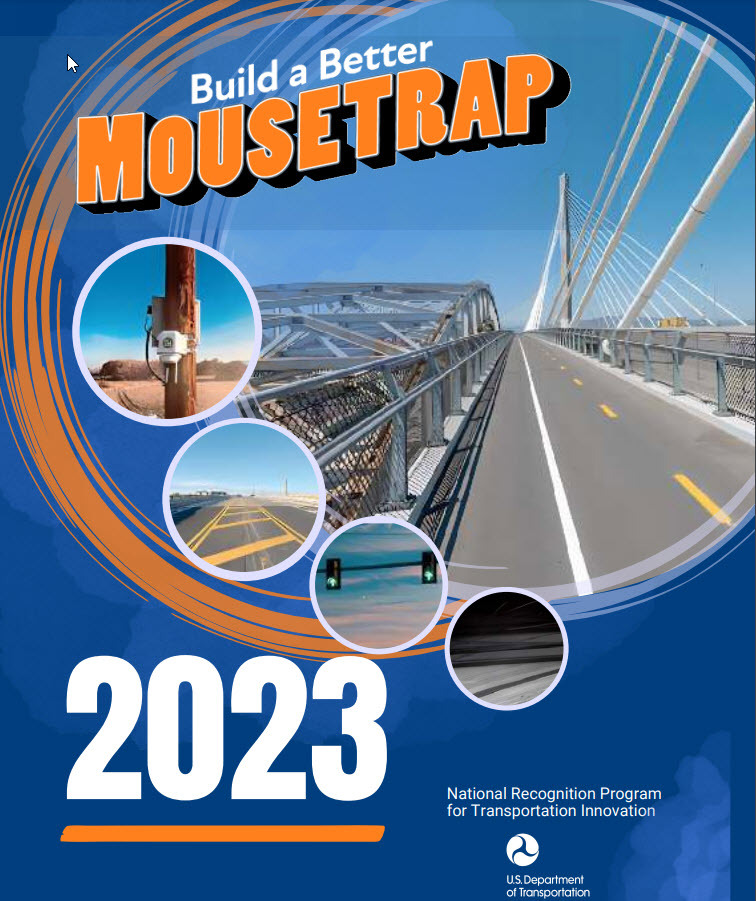
Build a Better Mousetrap is a national program that recognizes local and tribal agencies who use innovative solutions to address challenges in their transportation programs. For 2023, the Federal Highway Administration received 53 nominations for the competition with four winners selected. For this newsletter, we are profiling the four winners. Be sure to download the 2023 booklet for information on all 53 nominations. Visit: Website 2023 Video
Confederated Tribes and Bands of the Yakama Nation
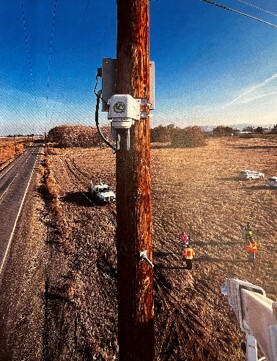
Caption: Mobile Unit Sensing Device attached to an utility pole. Photo Credit: Confederated Tribes and Bands of the Yakama Nation
The Confederated Tribes and Bands of the Yakama Nation is one of the federally recognized tribes in Washington State. Within the Yakama Nation reservation, there are approximately 1,200 miles of public roads. Most of the roads are in rural agricultural settings and crashes happen every day on these roadways. Of the land governed by Tribal Governments, Yakama Nation has both the highest number of pedestrian and vehicle fatality rates in Washington State. Yakama Nation Department of Natural Resources (DNR) Engineering program has been deeply concerned by these crashes and high fatality rates and determined to work on solutions addressing the safety issues and reduce and eliminate serious injuries and fatal accidents. One of the significant challenges faced by Tribal and rural communities is the lack of real-time traffic and safety data, particularly on low-volume rural roads. This data scarcity hinders effective planning and decision-making processes. Moreover, when applying for grants or funding opportunities, the absence of comprehensive data undermines the credibility of their proposals and reduces the chances of securing financial support. Hollyanna Littlebull, Assistant Director of the Northwest Tribal Technical Assistance Program says, “Everything was outdated. The data was like five years or older. We knew that the trending issues did not accurately reflect the data that we had.”
Hollyanna was working on a data portal project when she came across the Mobile Unit Sensing Traffic (MUST) device during a visit to the University of Washington Star Lab. “When I saw the sensor, I immediately knew this was the solution,” she said. The Mobile Unit for Sensing Traffic (MUST) device was customized specifically for use along Tribal and rural roads with limited infrastructure support, including limited internet connectivity. The device is equipped with camera, environment sensor, computing, and communication capabilities. It is ideal for monitoring traffic, detecting dangerous events, and providing real-time warning messages to road users. Hollyanna says, “I worked with the Star lab to program the device to differentiate between farm vehicles, freight vehicles, horseback riders. The device was also programmed to differentiate between fog and smoke. The programming required me to ride around and take a lot of pictures for the sensor. It was a lot of work but once the project started rolling, it went really fast.” A key advantage of the device is the computing capabilities that allows it to operate individually without infrastructure support, which helps in areas without reliable internet connectivity. The device can also individually perform data processing and analysis functions without the use of servers or cloud platforms, thus securing the data. “The device does not record faces or license plates. It only counts the vehicle itself. The cost benefit alone is invaluable. That thing is working 24 hours a day, 7 days a week and it’s constantly getting data,” says Hollyanna. “There’s an app that you can download on your phone to see the information in real time. There is no one needed to service it. You can query any of the data like average temperature or average humidity. The amount of data we can get from this thing is amazing!”
Congratulations to the Confederated Tribes and Bands of the Yakama Nation for their innovative Mobile Unit Sensing Traffic (MUST) device. They are the Build a Better Mousetrap 2023 Innovative Project Award winners.
The Innovative Project Award recognizes any solution that addresses any or all phase(s) of the ‘project’ life cycle – Planning, Design/Engineering, Construction, Operations and Maintenance. This project shall introduce new ideas, is locally relevant, original, and creative in thinking.
For more information, contact Hollyanna Littlebull at littlebu@uw.edu or 509-830-6639.
New Jersey Department of Transportation
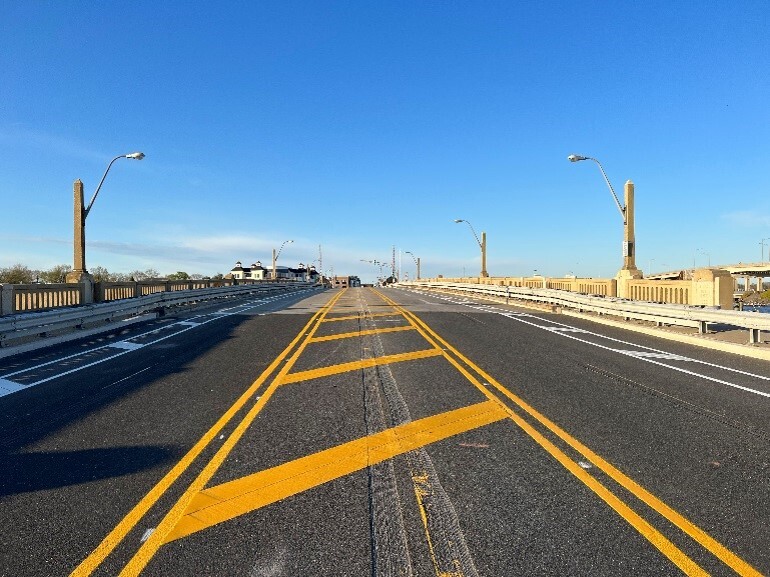
Caption: Completed Road Diet Project in NJ. Photo credit: NJ DOT
The Route 71 Drawbridge is an historic bridge built in 1923 in New Jersey and is heavily traveled. The mechanical span lock equipment that allows the bridge to open and close safely failed in 2021 causing damage to the structural steel. The bridge is slated for replacement within the next 10 years. So, the New Jersey Department of Transportation (NJ DOT) needed a short-term solution that would keep the bridge in operation. “Our options were to either restore the bridge back to pre-failure condition, which would have involved a lot of steel work, cost millions of dollars and require the bridge to be closed for extended periods of time or close the bridge entirely,” says Gerald Oliveto, P.E., Supervising Engineer in Operations Support for NJDOT.
However, there was another alternative solution that would provide a much faster and less expensive response to the issue. The NJ DOT decided to implement a road diet, which meant reducing the roadway to one-lane in each direction, moving the balance of traffic away from the damaged center-section of the bridge. “Initially we had extreme opposition from the local townships. They were not happy hearing about the lanes being reduced. They were worried about heavier congestion, and they just didn’t understand how this works,” says Gerald. “We (NJ DOT) developed an outreach campaign to help them better understand why this was needed and how the community would benefit.”
Implementing the road diet project took one month and only cost the state $150,000. Additionally, residents saw improved signal timings, extended bike lanes, and high visibility crosswalks. “In the end it was a huge safety improvement. We took what could have been a negative with this bridge and turned it into a positive,” says Gerald. “The innovative solution has exceeded expectations as traffic is no longer an issue with the bridge. We knew people were going to use the new bike lanes and crosswalks but not to the extent that we’ve seen.”
The New Jersey DOT is looking to implement the road diet with some other draw bridges. Gerald’s advice to other agencies is if you are pretty sure it is going to work, you will have to work through the obstacles. “Push through and you’ll have a positive outcome. This project was a homerun. The coordination among the DOT was better than anything I’ve seen. Everyone did their part.”
Congratulations to the New Jersey Department of Transportation as the Bold Steps Award Winner for the Route 71 over Shark River Road Diet project. The Bold Steps Award recognizes any locally relevant high-risk project or process showing a break-through solution with demonstrated high reward.
Contact Gerald Oliveto at Gerald.Oliveto@dot.nj.gov or 609-963-1524.
St. Louis County, MN Public Works Department
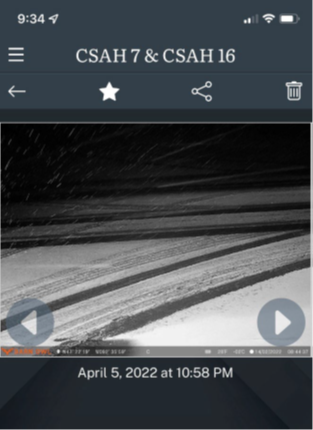
Caption: Nighttime image of snow covered roadway captured by solar camera.
Courtesy: St. Louis County, MN Public Works Department
The St. Louis County, Minnesota Public Works Department is responsible for maintenance and snow removal of approximately 3,000 miles of roads. Road conditions can vary greatly at any given time during winter storms. The agency needed more accurate and immediate access to information to assist with emergency response. Traditional methods for gathering this information can be too expensive for a county budget. “We looked at numerous game cameras costing anywhere from $25,000 to $100,000 per station. Budgetarily, these cameras did not meet our needs,” says, St Louis County Deputy Public Works Director in Maintenance Operations, Brian Boder. He says their task was to find a game camera with an on-demand trigger. Game cameras are rugged and weatherproof and can be activated to record based on movement.
The St. Louis County Public Works Department’s solution was implementation of inexpensive solar powered remote cameras. They include a user-friendly operating system capable of capturing still images day and night and can provide short video clips. The cameras are battery operated but the County chose the solar panel option with a rechargeable internal battery that would require less maintenance. According to Brian, “The game cameras have exceeded expectations in how they function. The most difficult part was finding the proper locations or infrastructure to mount the cameras. Some places had low light areas.” Initially, there was a concern that the solar cameras may not function well in pretty remote areas of the county, but that proved to not be the case.
St. Louis County purchased 51 game camera units at $374 per unit. Total cost to implement was $27,612. Brian says the camera system has the potential to assist any agency or municipality with the decision-making process regarding level of response and deployment timing to winter storm events. Aside from purchasing the equipment, an agency must be able to identify areas where weather conditions seem to change frequently, remote locations that are difficult to access, existing infrastructure for camera mounting and the ability to access it in a timely manner and identify any new infrastructure necessary to accommodate camera placements.
Brian’s advice to other agencies, “You never learn anything from the status quo. Fortunately, for St. Louis County, we have a group of individuals who are continuously thinking outside the box and willing to try something new.”
Congratulations to the St. Louis County Public Works Department in Minnesota for your innovative solution to install solar-powered remote cameras for improving emergency response. They are the Build a Better Mousetrap 2023 Smart Transformation Award Winner.
The Smart Transformation Award recognizes a locally relevant significant change in any transportation activity or process that is SMART “Specific, Measurable, Achievable, Realistic and Time-bound” in nature that results in improved efficiencies.
For more information contact Brian Boder, P.E. at boderb@stlouiscountymn.gov or 218-625-3859.
City of Walnut Creek, CA
 Caption: Unobstructed Traffic Lights in City of Walnut Creek, CA.
Photo Credit: City of Walnut Creek, CA
Traffic signals are crucial to helping drivers properly and safely navigate the roadway system. They provide visual cues for when to stop, go, yield, giving the driver sufficient time to make informed decisions. When these traffic signals are obstructed in anyway, this can create major safety hazards for everyone on the roadway including pedestrians and cyclists. The City of Walnut Creek in California would often conduct regular inspections to ensure their traffic signals are clearly visible to drivers, but this process was often labor intensive and involved trained personnel to verify visibility for traffic signal lights. City officials wanted to improve the process to be safer for the workers and more proactive.
Their solution was the Safe Sightings of Signs and Signals (SSOSS) Software. The innovation added an automated process to assessing traffic signal visibility using readily available, off-the-shelf hardware components such as a cell phone with built-in camera and lots of storage, GPS receiver, a cell phone mount for windshield, and a laptop computer. After setting up smartphone on vehicle dash to record GPS points and video, the vehicle is driven through as many intersection approaches as desired, ensuring data is being recorded the entire time. Once the route is completed, the collected data/video is transferred to a computer and processed using the SSOSS program to save images of each of the driven intersection approaches. Matt Redmond, Associate Transportation Engineer with the City of Walnut Creek says, “I was very surprised at the accuracy of the data. It (the SSOSS) just gives you clear insight about whether a signal is blocked or not. With this software-based system, all of our agency’s intersection, about 350 approaches, can be checked for sight distance in a single day without anyone getting out of their car. Moreover, this solution has promoted a proactive approach to ensure traffic signals are visible to drivers, rather than a reactive approach that may leave traffic signals obstructed for longer than necessary.”
The innovative solution has resulted in significant time-savings and increased productivity for the city’s staff. According to Matt, conducting sight distance checks could take 15 to 45 minutes per intersection, depending on location, which includes parking and measuring the required sight distance for each of the four approaches. “Implementing the software-based system required a lot of driving and recording data, but once you have the information, you don’t have to do it again,” says Matt. “There were so many times, I didn’t think I could do it. It required me to learn to program and then I had to keep wracking my brain about how to get this angle or that angle.”
Matt’s advice to anyone on using innovative solutions is three-fold, 1) Innovation takes time and that this was not an overnight solution. 2) Explore the potential for an innovation by asking the questions, “what if we could do this” or “what if this is a possibility”. And 3) Collaboration is important, “I spent a lot of time talking to other professionals about this innovation, making sure the solution makes sense to them,” says Matt.
Congratulations to the City of Walnut Creek, CA for the innovative SSOSS software-based system. They are the Build a Better Mousetrap 2023 Pioneer Award Winner.
The Pioneer Award recognizes a locally relevant product or tool that is among the first to solve a maintenance problem with a home-grown solution.
Notice
This is disseminated under the sponsorship of the U.S. Department of Transportation in the interest of information exchange. The U.S. Government assumes no liability for the use of the information. The U.S. Government does not endorse products or manufacturers. Trademarks or manufacturers’ names appear in this report only because they are considered essential to the objective of the information provided.
Back to top
LTAP HIGHLIGHTS
Kentucky Transportation Center Technology Transfer
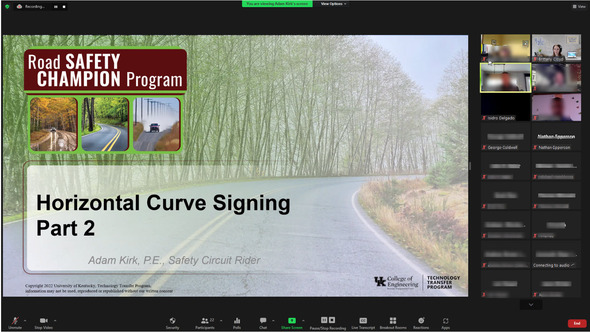 Image courtesy of the Kentucky Transportation Center - Technology Transfer
The Kentucky LTAP Center, also called the Kentucky Transportation Center - Technology Transfer Program has launched the “Road Safety Champion” Certificate Program or RSCP. The program is designed to develop a transportation workforce that is knowledgeable and safety-focused when operating, maintaining, and designing local roads in Kentucky. Participants in the program must take six core courses and six elective courses specific to their line of work. Everyone who completes the course receive a certificate. The trainings are held via live Zoom webinars on the fourth Wednesday of each month. Brittany Cloyd, Information Resources Manager at the Center says, “We have over 150 enrolled in the free program and about 35-45 who regularly attend classes and are on track for graduation. Since last year's program launch, we are proud to have five graduates and many on track to graduate soon” Mike Thomas, who is a Road Safety Champion Graduate, says “I can’t say it enough, anyone affiliated with road construction, or highway road departments should participate. Especially for public works in state and local government road departments. The information taught is going to be useful every day.” George Caldwell is another graduate of the program and articulates, “I enjoy the ease of taking the classes online and [the program enables me] to return to the City with better ideas and procedures on how to maintain and keep safer streets and signage.” Both local government transportation professionals, Thomas and Caldwell, feel more prepared to implement road safety measures in their communities.
For more information on the Road Safety Champion program, contact Brittany Cloyd at brittany.cloyd@uky.edu.
Photo: Courtesy of NLTAPA Website
Congratulations to Tim Colling, PhD on being elected as the 2023- 2024 President of the National Local and Tribal Technical Assistance Program Association (NLTAPA). Tim is Director of the Michigan Local Technical Assistance Program (LTAP).
NLTAPA’s main objective is to build awareness about the Local and Tribal Technical Assistance Program in the transportation community, assist FHWA with developing strategies for the Program, and build the capacity of each Center to best meet the needs of its customers. Tim is a registered professional engineer in Michigan and Wisconsin and worked as a Civil Engineering consultant for 10 years prior to joining Michigan Tech University in 2003. Tim has a Bachelor of Science degree in environmental engineering from Michigan Tech University and has a Master of Science degree and a PhD. in civil engineering and from Michigan Tech University. Tim is a 2009 Eno Transportation Foundation fellow. Since 2015 Tim has been a panel member for National Cooperative Highway Research Program Projects 17-71 and 17-71A which are developing the second edition of the AASHTO Highway Safety Manual. Tim is a member of the Transportation Research Board ACS20 Safety Performance and Analysis Technical Committee.
Tim has been the instructor for over 380 professional development and continuing education classes on pavement management and traffic safety engineering reaching over 8,900 students (2004-2023), and acts as the primary instructor for classes in the fields of traffic safety, pavement distress identification, and asset management for his center.
Tim, FHWA looks forward to collaborating with you and the NLTAPA Executive Committee this year.
Visit NLTAPA's website for more information: https://nltapa.org/
Photo Courtesy: NLTAPA
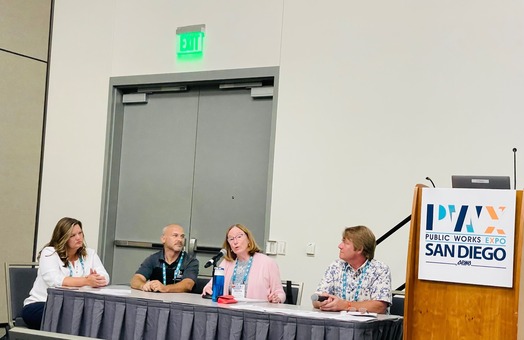
The National LTAP/TTAP Association (NLTAPA) recently hosted a session on the LTAP Centers during the American Public Works Association's Expo in San Diego. Directors from the LTAP Centers presented ways the centers develop training and technical assistance programs to meet the unique need of their states. "It had been many years since I had the opportunity to attend PWX. I was VERY impressed with the options and quality of the education sessions. It is also a great way to connect with local agencies from all over the US. I would absolutely recommend it if you have the opportunity to attend in the future," says Donna Shea, Connecticut's LTAP Director. APWA and NLTAPA have a strategic partnership that allows for collaboration in support of local public works agencies. Directors participating in the event were from centers in North Carolina, Connecticut, California, Kentucky, Nebraska, and Indiana. Additionally, congratulations to Kate Davison, North Carolina's LTAP Director for her selection as a liaison between NLTAPA and APWA. The next expo will be held in Atlanta, GA 2024.
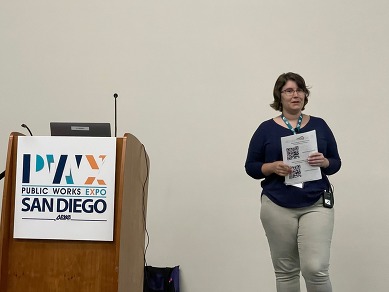 |
Caption: Kate Davison is new liaison for NLTAPA and APWA.
TTAP HIGHLIGHTS
The FHWA Local Aid Support team is working to re-establish the Western TTAP Center, which covers AZ, CA, HI, NV, and UT. A Notice of Funding Opportunity is expected to publish in October with an award by early next year.
The Local Aid Support team in collaboration with the FHWA Office of Tribal Transportation are developing the first Tribal Transportation Program (TTP) - 101. The course will provide an overview of Tribal Transportation Topics that we heard are important and can assist with managing Tribal transportation programs. More details coming soon.
Back to top
NEWS & HAPPENINGS
Submitted by: Bryan Cawley, Construction Engineer, FHWA Resource Center
The Texas DOT (TxDOT) began their Digital Delivery journey back with Every Day Counts Two (EDC-2) and the deployment of 3D Engineered Models for Construction. At that time, it was providing cross sections, xsr files, upon the request of contractors. Since that time, TxDOT has embraced additional technologies and modified processes to advance the digital delivery of projects. Figure 1 presents TxDOT’s status and roadmap to Digital Delivery and Digital Twin.
 Digital Delivery is the delivery of models for bidding, construction, and as-builts of projects in lieu of traditional paper or pdf plan sets. This is sometimes called Model As the Legal Document (MALD)
Digital Twin is a virtual representation that serves as the real-time or near real-time counterpart of a physical object. The model will have sufficient data and accessible to the people who need it.
While on this journey, TxDOT has seen and anticipates seeing additional benefits in the areas of enhanced precision of design quantities, enhanced design detail, less change orders, less requests for information, improved efficiency in construction, enhanced construction management, and concluding construction with a digital ad-built plan that can be used in operations, maintenance, and asset management. This all means a more efficient and effective highway transportation system.
TxDOT is currently working on the development of a pilot project for MALD (Figure 1, Step 6). The project will be a full depth reconstruction with adding of shoulders on a 0.30 miles of asphalt pavement in the San Antonio District. The project is currently scheduled to be let in March of 2024. TxDOT and the Transportation Industry are excited to advance this first MALD project.
If you would like to learn about TxDOT’s journey toward digital delivery and a digital twin, please contact Mr. Jacob Tambunga, P.E., TxDOT Director of Digital Delivery. If you would like to learn more about digital project delivery, please contact Mr. David Unkefer, Construction and Project Management Engineer, FHWA.
Submitted by: Bryan Cawley, Construction Engineer, FHWA Resource Center
Nondestructive evaluation (NDE) techniques are becoming increasingly important for the assessment and maintenance of bridges and pavements. NDE techniques enable inspectors to gather critical information about the condition of these assets without the need for coring and other destructive testing. The data obtained from these assessments can be used to determine the remaining service life of the bridge decks and pavements and to prioritize maintenance and repair activities.
To keep highway infrastructure asset owners who deal with highway infrastructure performance challenges up to speed on developing and refined NDE technologies, the FHWA NDE Program initiated and developed the InfoTechnology web portal. InfoTechnology provides concise information about NDE technologies for the assessment of highway infrastructure. It is a problem focused tool that help practitioners and asset owners select the most applicable and recommended technology based on the target of investigation. This web portal provides information on the available technologies for detecting and characterizing a specific issue; allows for a better understanding of the technologies and methods of analysis; and describes limitations and advantages of NDE methods.
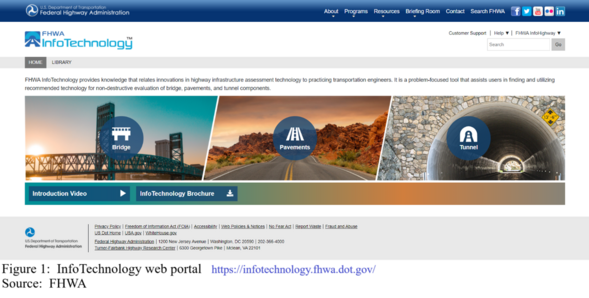 InfoTechnology has an intuitive and user-friendly interface that provides an overview of most NDE technologies. A description of the technology, the engineering principles used by the method, and application of the technology, analysis procedures, limitations, and advantages are displayed in an easy-to-read format. The information is supplemented with images, diagrams, tables, and references. InfoTechnology offers a wide range of features and capabilities. For instance, navigation of the site is facilitated by easy-to-use filters enabling users to quickly identify and access information on NDE technologies used to assess conditions of bridges, pavements, and tunnels.
If you would like to learn more about FHWA InfoTechnology, please visit the web portal or contact Dr. Hoda Azari, NDE Research Program Manager.
Back to top
Bipartisan Infrastructure Law (BIL) Competitive Grant Programs:
https://www.fhwa.dot.gov/bipartisan-infrastructure-law/grant_programs.cfm
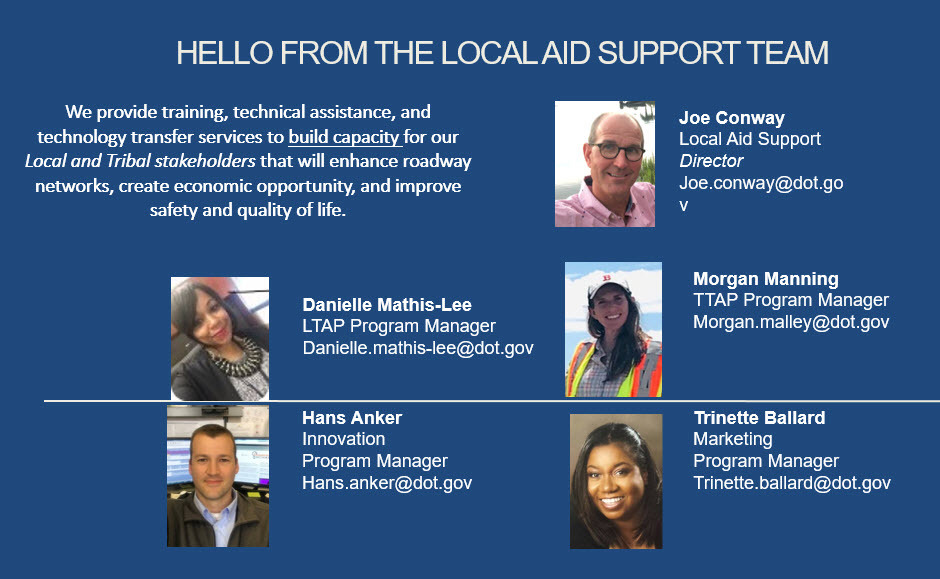
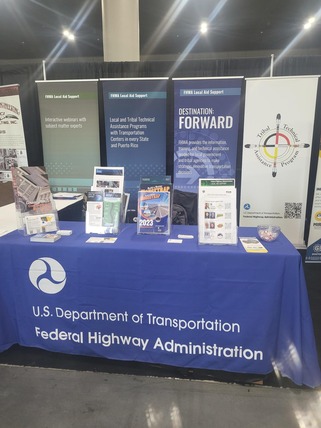
About Local Aid Support Team
Courtesy of FHWA
Courtesy of FHWA
Back to top
Bulletin Board
UPCOMING EVENTS
October 2023
October 18, 1:00 - 3:00 pm ET - Value Capture Strategies and Asset Recycling: Advancing Public Infrastructure in a Time of Funding Uncertainty
Register Now
October 23, 1:00 – 2:00 pm ET – FHWA Non-Destructive Evaluation Webinar Series - Long-Term Project and Network-Level NDT Implementation Plan for Indiana
Zoom Meeting Room
November 2023
November 14, 1:00 - 3:00 pm ET - Value Capture and Debt Financing Strategies: Tax-Exempt Debt Financing
Register Now
November 27, 3:30 – 4:30 pm ET – FHWA Digital As-Builts Forum, NCHRP 2022-02: Digital Construction Management Domestic Scan
Registration
December 2023
December 6, 1:00 - 3:00pm ET - Value Capture: Advertising, Naming Rights, & Sponsorships
Register Now
October 26, 2023
Colorado DOT Transportation Demand Conference
Denver, CO
November 12-16, 2023
AASHTO Annual Meeting
Indianapolis, IN
|