|
Dear Traffic Incident Management (TIM) Colleagues:
As we begin the year 2023, we also begin round seven of the Federal Highway Administration's (FHWA’s) Every Day Counts Program (EDC-7), which includes the innovation Next Generation TIM: Technology for Saving Lives. We invite you to register for the EDC Virtual Summit, taking place February 14–16, 2023, to learn about TIM technologies for saving lives and improving operations, such as emergency vehicle lighting and queue warning solutions.
Looking back at 2022, we marked two significant milestones for our Nation's TIM program: the 20th anniversary of applying the TIM Capability Maturity Self-Assessment (TIMSA) and the 10th anniversary of the National TIM Responder Training. This newsletter shares how the TIMSA and the National TIM Responder Training are evolving to better serve the TIM community.
Also of note, the Talking TIM webinar series embarks on its fifth year of sharing good practices and innovations in TIM. We welcome feedback from the TIM community to help make this monthly information-sharing platform even more relevant to every TIM responder community. And finally, we share the value of local TIM newsletters and examples from across the United States.
Happy and Safe 2023,
Paul Jodoin, Jim Austrich, and Joe Tebo, FHWA TIM Program Team
Every Day Counts (EDC) is a State-based initiative of FHWA's Center for Accelerating Innovation. The EDC program works with State, local, and private-sector partners to encourage the adoption of proven technologies and innovations that improve safety, shorten the project delivery process, create an equitable transportation system, and build sustainable and resilient infrastructure. January 2023 marks the start of EDC-7, and Next Generation TIM: Technologies for Saving Lives is one of seven innovations for this 2023–2024 cycle.
The EDC-7 Virtual Summit is an integral component of the EDC model, bringing together transportation leaders and front-line professionals to learn about the seven innovations that are a part of EDC-7. The Summit registration is free, and registrants can access videos, presentations, fact sheets, virtual booths, and PDFs about the innovations developed by the National State Transportation Innovation Council (STIC) Network.
The following table summarizes content specific to the initiative, Next Generation TIM: Technologies for Saving Lives. View the Summit agenda, watch the breakout session preview videos, or visit the EDC-7 website to learn more about all seven innovations.
|
Next Generation TIM Content at the EDC-7 Virtual Summit
|
|
Date
|
Time (EST)
|
Topic
|
|
Tuesday,
Feb. 14
|
2:00 – 3:00 p.m.
|
Breakout – Next Generation TIM: Technology for Saving Lives
|
|
3:45 – 4:45 p.m.
|
Office Hour – Get Answers to Your Innovation Questions from Innovation Leads
|
|
5:00 – 6:30 p.m.
|
Breakout – Next Generation TIM: Technology for Saving Lives (repeat)
|
|
Wednesday,
Feb. 15
|
2:30 – 4:00 p.m.
|
Advanced Warning Technologies
- In-Vehicle Digital Alerts
- Smart Emergency Vehicle Lighting
- Synchronize and Sequential Lighting
|
|
Thursday,
Feb. 16
|
2:00 – 3:00 p.m.
|
Post-Crash Care Roundtable Discussion
|
|
3:00 – 3:30 p.m.
|
Office Hour– Get Answers to Your Innovation Questions from Innovation Leads
|

In 2003, FHWA facilitated the initial assessments of TIM programs for the largest 75 urban areas of the United States. Now, 20 years later, the TIM Capability Maturity Self Assessment (TIMSA) remains a valuable tool among established and newer TIM programs. Eileen Singleton, Principal Transportation Engineer with the Baltimore Metropolitan Council has led nearly two decades of TIMSA in the Baltimore Region. She commented that the TIMSA, "continues to be a very useful tool to identify and focus improvements" for Baltimore Regional Transportation Board’s TIM Committee. Many other TIM champions help their program, coalition, or committee apply the TIMSA to prioritize strategic and tactical efforts that improve the value, efficiency, and impact of their TIM programs.
The TIMSA provides a formal process for State and local transportation, public safety, and private-sector partners to collaboratively assess their TIM programs and identify opportunities for improvement. The 2003 TIMSA consisted of 34 questions, and the average 2003 TIMSA score was 47 out of 100. The 2021 TIMSA consisted of 41 questions, and the average 2021 TIMSA score for the more than 90 TIM programs participating was 72 out of 100, showing significant advancement among and growth in TIM programs across the United States.
Today, the TIMSA is an online tool, live and accessible year-round, and customized for traditional TIM programs as well as for emerging and rural regions. It is best completed collaboratively among response disciplines as a part of a TIM committee meeting. And, programs no longer need to wait for analysis and feedback reporting. As a result, the TIMSA remains instrumental in every TIM program. To learn more about the TIMSA, view the Fall 2022 TIMSA webinar, or register to complete the TIMSA here.
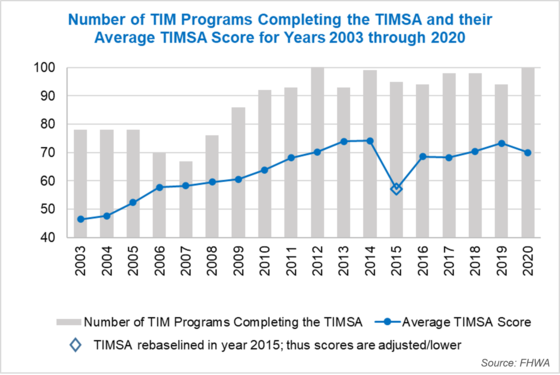 The number of TIM programs and their collective average TIMSA scores reflects advances in TIM program strength from 2003 through 2020.
TIM instructors delivered the first National TIM Responder Training in 2012 as a 2-day course that included case studies, seminars, tabletop exercises, and field practicums—all of which collectively impart skills that keep responders safer when clearing roadway incidents. Now, 10 years later, more than 620,000 responders from EMS, fire and rescue, law enforcement, transportation, towing, and other disciplines have completed the now 4-hour National TIM Responder Training.
While the National TIM Responder Training has undoubtedly saved responder lives, the roadway incident response community continues to suffer injuries and loss of life. In 2022, more than 40 traffic incident responders were killed in the line of duty. Thus, while the FHWA TIM program team congratulates every responder who has completed the course, we encourage the many more responders who have yet to complete the course to make it a priority in 2023. The National TIM Responder Training course is accessible online through FHWA's National Highway Institute and in person through each State's TIM coordinator.
This year, there is a new set of five supplemental technical lessons to the National TIM Responder Training. These lessons provide additional information to improve safe, quick incident clearance and cover transportation management centers, computer-aided dispatch integration, TIM data and crowdsourcing, unmanned aircraft systems, and connected vehicles and automated vehicles. Also new in 2023 is a Rural TIM focus lesson. Please contact Jim Austrich, FHWA TIM Program Manager, to learn more about the technical and focus lessons, instructor-led virtual training, and train-the-trainer classes.
The FHWA TIM Team partners with the National Operations Center of Excellence (NOCoE) to offer the Talking TIM webinar series. Webinars take place on the fourth Wednesday of each month from 1:30 – 3:00 p.m. EST. Topics on recent webinars include:
- Predicting Incident Duration and Queuing for Better Real-Time Response (Oct 2022).
- Move Over and Responder Safety Technologies (Sep 2022).
- Florida's Expanded Deployment of Cameras on Road Ranger Vehicles (Aug 2022).
Register for the January 25 Talking TIM webinar to learn how unmanned aircraft systems (UAS) help mitigate incidents in work zones and how, collectively, local law enforcement agencies in Indiana are benefitting from centralized UAS image processing. To offer to share your agency's TIM practices, improvements, and innovations through a future Talking TIM webinar, please reach out to Paul Jodoin, FHWA TIM Program Manager.
Local TIM newsletters spotlight good practices, recognize responders, and introduce new program features to TIM responders. Newsletters foster a vibrant TIM community and demonstrate to leaders in every response discipline the life- and resource-saving value of investments in TIM. Often, newsletters are shared electronically and available through the TIM program website. Following are a few links to local or State TIM program newsletters.
|