FHWA Work Zone Newsletter: ITS Implementation Tool, Resources, and Events

Banner. U.S. Department of Transportation Federal Highway Administration. Work Zone Management Program Office of Operations.

Quarterly Newsletter - Summer 2017


Work Zone ITS Planning Tool

FHWA has released a beta version (click 'Download' when the link opens) of the software tool companion to the Work Zone ITS Implementation Guide. Watch the webinar and give us your comments

 Contact Todd Peterson to submit your comments or for additional information on the tool.


Capability Maturity Framework

The interactive Work Zone Management Capability Maturity Framework (WZM CMF) Assessment Tool is now available to agencies. The tool helps agencies assess and improve their work zone management program's effectiveness. It is based on the overall transportation systems management and operations capability maturity model, with a focus on agencies’ processes and activities that relate specifically to WZM. See the user guide for more information.

Workshops are currently being offered to facilitate tool use (see Upcoming Events).  


Work Zone Safety Grant Program

In January 2017, the latest round of work zone safety grants were awarded to the following seven organizations:

  • American Road and Transportation Builders Association (ARTBA)
  • American Traffic Safety Services Association (ATSSA)
  • University of Illinois
  • Iowa State University
  • Oklahoma State University
  • University of Wisconsin-Madison
  • Wayne State University

Work will include worker safety training along with guidance development and training on connected and autonomous vehicles, large trucks in work zones, analytical methods, project evaluation, low-cost WZM strategies, work zone crash modification factors, traffic management, speed management, traffic incident management, and much more. 

 For information on work zone safety grant products, click here


National Work Zone Safety Information Clearinghouse

A new cooperative agreement has been signed with ARTBA to fund the operations of the National Work Zone Safety Information Clearinghouse for another five years. The agreement includes continued support for the operation and continuous improvement of the Clearinghouse website. Educational and training activities are also supported, including the biennial national work zone safety conferences.

Photo of people looking at computer.

New Publications

Sharing Work Zone Effective Practices for Design-Build Projects

  • This new report shares effective practices and guidance on work zone management, quality assurance, and transportation management plan (TMP) development for design-build projects.

Transportation Management Plan Effectiveness Framework and Pilot  

  • This report helps practitioners formulate and follow a clear, consistent approach toward assessing the effectiveness of TMP strategies.


National Work Zone Awareness Week

Building upon this year's theme, “Work Zone Safety Is in Your Hands,” federal, state, and other agencies shared tips, statistics, and other resources with the public during National Work Zone Awareness Week (April 3-7, hosted by the state of Maryland). 

Learn more about the week’s activities at the National Work Zone Safety Information Clearinghouse.
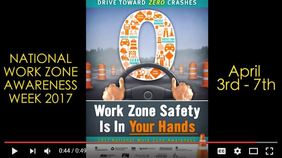
Screen grab of National Work Zone Safety Awareness Week video.

This AASHTO video shares how drivers can put #SafetyFirst.

Contents


Upcoming Events

CDOT Automated TMA Site Demonstration. FHWA’s SWZ Implementation Team is sponsoring a two-day demonstration site visits featuring ATMA (Fort Collins, CO) September 19-20, 2017.

WZM CMF Workshops. Includes a half-day discussion on process review coordination with CMF activities. Washington State DOT (Olympia, WA) September 26-27, 2017.

Recent Events

  • WZM CMF and Work Zone Process Review. Tennessee DOT (Nashville, TN) June 19-20, 2017
  • WZM CMF Workshop. Kentucky Transportation Cabinet (Lexington, KY) July 26-27, 2017

Smarter Work Zones

Banner Logo. Smarter Work Zones


Resources

While the official Every Day Counts (EDC-3) period concluded in December 2016, Smarter Work Zones (SWZ) resources remain available. 

Transportation agencies can access more information on FHWA’s SWZ initiative, including links to available resources, related publications, case studies, tools, and webinars. 

The final report for the SWZ initiative is now available here.

Demonstration Site Visits

Maryland (Dec 2016) - The Maryland State Highway Administration and FHWA collaborated on a SWZ field demonstration. 

  • Participants from Arizona, Connecticut, Georgia, Maryland, New Jersey, New Mexico, Oklahoma and Pennsylvania learned about strategies to minimize travel delays and enhance safety for motorists and workers in work zones. 
  • The demonstration included automated speed enforcement technology and project coordination strategies.

Texas (May 2017) - A demonstration showcase enabled transportation practitioners from 10 States to see portable queue warning systems, a SWZ technology application promoted in EDC-3 and deployed at construction sites in Austin. 

  • The Texas Department of Transportation (TxDOT) uses the systems to improve safety and mobility on construction projects around Texas. 
  • The systems alert drivers to a line of vehicles ahead so they can slow down safely. The demonstration included presentations on Austin’s Combined Transportation, Emergency, and Communications CenterTxDOT’s intelligent transportation system standards for work zones, and the State’s integration of connected vehicle technology into work zones.

Utah (June 2017) - A demonstration of dynamic Variable Speed Limit technology for deployment in work zones.

Colorado (September 2017) - The Colorado Department of Transportation will be sharing its experience with Autonomous Truck- Mounted Attenuator technology and conducting a live demonstration in both closed-track and live-traffic situations.

Deployment News

Minnesota - The Minnesota Department of Transportation (MnDOT) deployed a variable downstream speed notification system on an I-94 pavement project in St. Paul and Maplewood during the 2016 construction season. 

  • The system—one of the SWZ technology strategies recommended in EDC-3—notifies drivers of downstream traffic speeds to better manage speeds and reduce crashes when work zone congestion develops. 
  • MnDOT plans to use the system again in the 2017 construction season. The University of Minnesota will analyze data from the system to evaluate its effectiveness in reducing work zone crashes.