|
August 17, 2020 • Volume 19, Issue 14 • A twice monthly newsletter with information about workplace safety and health.
|
 |
|
 |
COVID-19 Resources
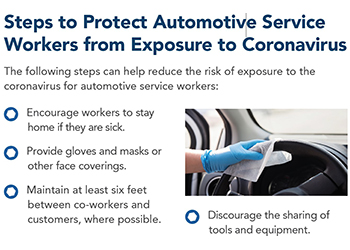
A new poster, available in English and Spanish, lists steps to protect automotive service workers from exposure to coronavirus.
|
|
Pandemic Safety Partnership
McCarthy Construction partnered with OSHA and used health screenings, face coverings, and social distancing to protect workers during a medical facility construction project.
|
 |
|
 |
Safe + Sound Week
Thank you to the thousands of businesses and organizations that helped make Safe + Sound Week a success.
|
|
|
 |
Disaster Response
OSHA has information to protect workers responding to hurricanes, tornadoes, floods, and other natural disasters.
|
|
|
|
|
Social Media
Follow @OSHA_DOL on Twitter. For more safety and health resources and information, visit the U.S. Department of Labor's social media accounts:
|
 |
|
COVID-19 Q&A
|
 |
Does wearing a medical/surgical mask or cloth face covering cause unsafe oxygen levels or harmful carbon dioxide levels to the wearer?
|
 |
No. Medical masks, including surgical masks, are routinely worn by healthcare workers throughout the day as part of their personal protective equipment ensembles and do not compromise their oxygen levels or cause carbon dioxide buildup. They are designed to be breathed through and can protect against respiratory droplets, which are typically much larger than tiny carbon dioxide particles. Consequently, most carbon dioxide particles will either go through the mask or escape along the mask's loose-fitting perimeter. Some carbon dioxide might collect between the mask and the wearer's face, but not at unsafe levels.
Like medical masks, cloth face coverings are loose-fitting with no seal and are designed to be breathed through. Workers may easily remove their medical masks or cloth face coverings periodically (and when not in close proximity with others) to eliminate any negligible buildup of carbon dioxide that might occur. Cloth face coverings and medical masks can help prevent the spread of potentially infectious respiratory droplets from the wearer to their co-workers, including when the wearer has COVID-19 and does not know it.
|
|
|
|