|
|
"In The Flow" is the newsletter of the Maryland, Delaware, Washington, D.C. Water Science Center focused on water science issues and solutions in our region.
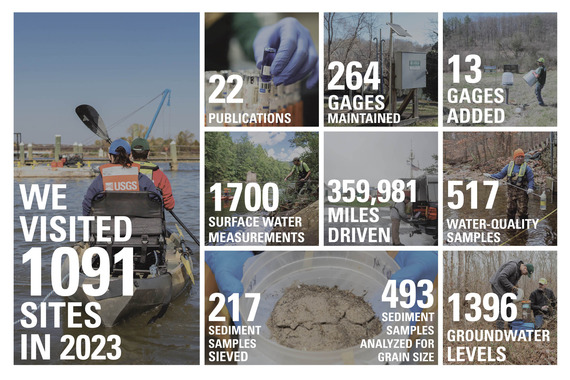
There's a saying that goes, "What have you done for me lately?" Well, in 2023 we were focused on our mission to provide high-quality science to the public. We would have to write a long essay to describe all of our water science commitments, so instead, here’s a small snapshot of what we accomplished: We crisscrossed the Maryland-Delaware-Washington, D.C. region to maintain and expand our network of 264 gages, visited 1,091 sites, collected 517 water quality samples, recorded 1,700 surface water measurements, measured groundwater wells 1,396 times, analyzed 493 sediment samples for grain size in our sediment lab, as well as published and contributed to 22 scientific papers.
And we couldn’t do this without the support of our cooperators and partners who make it all possible! As we look to the new year, we thank you for your continued interest in all things water science.
We are always looking for new collaborations that advance our understanding of water in the region, so feel free to say hello and start that conversation.
|
|
Welcoming Our New Surface Water Specialist
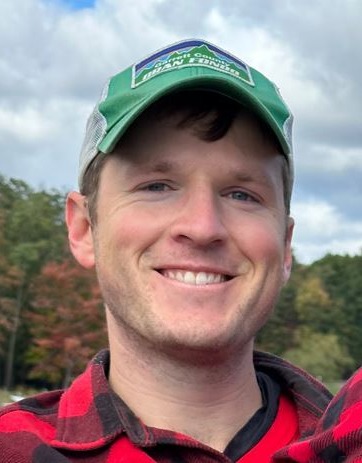
Please join us in welcoming our new Surface Water Specialist, Scott Bass, to our Center.
Scott’s long career has been focused on hydrologic and hydraulic modeling in both the private and public sectors. He has designed and reviewed hydraulic infrastructure intended to pass events ranging from the 1-year storm all the way up to the probable maximum flood.
Scott is joining us from the Maryland Department of the Environment where he worked as the Dam Safety Division’s expert hydrologic and hydraulic engineer.
Prior to that, Scott worked as a water resources engineer at a private engineering firm working on environmental site design (ESD) stormwater management practices and pond retrofits, dam hydraulic modifications, culverts and channels, and conducting floodplain studies, among other things. Scott has extensive experience with HEC-RAS and other hydrologic and hydraulic modeling software, and has taught classes on various modeling software, such as HEC-RAS 1D and 2D, catered to meet the needs of both private sector design engineers and public sector reviewers.
Scott received his degree in Civil Engineering from University of Maryland College Park and is a registered professional engineer in the state of Maryland. He enjoys spending time with his family, singing and playing his guitar and fiddle, and when Scott is not in Baltimore, he enjoys spending time in the great outdoors of the Allegheny Mountains.
MD-DE-DC Studies Section Supervisor Selected
Congrats to Natalie Hall, who has been selected as our Center’s new Studies Section Supervisor. Natalie will lead a group that studies water science both locally nationally and will be an active part of center leadership. She will continue to split her time between supervisory activities and with scientific projects. |
|
 |
It’s Been A Busy Season Of Hiring
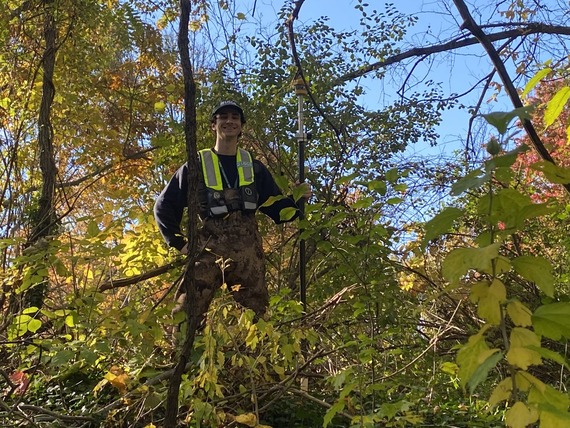 HFA Augustine Barquin poses for a photo in the field.
Please join us in welcoming our new Physical and Data Scientists and Hydrologic Field Assistants (HFAs).
Physical scientist Josh Kasper joins the USGS after 23 years with the Delaware Department of Natural Resources and Environmental Control (DNREC), where he focused on hydrogeology. Josh will be involved in a variety of projects involving the surficial aquifer system and its interactions with surface water. His current projects include the Chesapeake Bay non-tidal network (NTN) small agricultural watershed study, hydrogeologic studies in the Dover Air Force Base area, and the study of water quality from public drinking-water wells in the surficial aquifer in Delaware.
Data scientist Kyle Hurley will be working on modeling water quality and assisting with data and model analysis. Kyle served a decade in the Navy and received his Master’s in Environmental Science from Towson University.
Physical scientist Anna McClain will be working with the Fate and Bioremediation team. She received her M.S. in Environmental Engineering from UMBC. Anna’s master’s thesis focused on the impacts of septic systems in Baltimore County.
Additionally, we hired 6 new HFAs: Augustine Barquin, Caleb Boucher, Anna Helgeson, Cade Jones, Emily O'Donnell, and Kathryn Wolferman. The HFAs have already begun working in the field and in our labs and we’re excited to see their water science careers begin.
|
|
|
These videos are fresh off the water, so to speak.
|
|
|
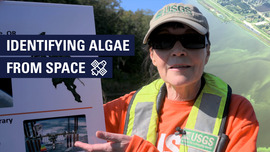
Physical Scientist Natalie Hall is researching how to identify Harmful Algal Blooms, aka HABs, and especially toxic cyanobacteria, using satellite imagery. HABs can cause problems for human and aquatic health.
|
|
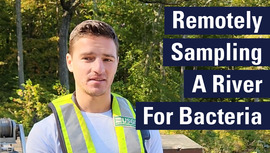
It's well known that the Anacostia River has a bacteria problem, but recently, improvements to infrastructure have reduced sources of bacteria in the watershed. The USGS has been testing a method to remotely sample for bacteria in the river. Hydrologic technician Jeremy Malen discusses.
|
|
|
From storms to conferences, we've been very busy this Fall and Winter.
We were thrilled to participate in the Maryland Water Monitoring Council's Annual Conference to discuss and present important water issues with regional partners.
|
|
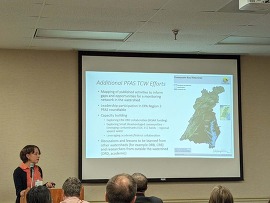 Emily Majcher discusses "PFAS: Ongoing efforts within the toxic contaminant workgroup of the Chesapeake Bay program partnership."
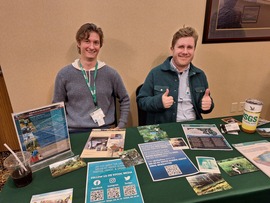 Tristan Mohs and Zach Clifton manning the USGS information table.
|
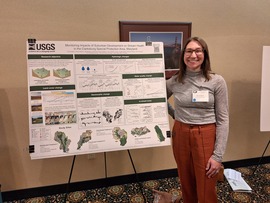 Marina Metes with her poster titled, “Monitoring Impacts of Suburban Development on Stream Health in the Clarksburg Special Protection Area, Maryland.”
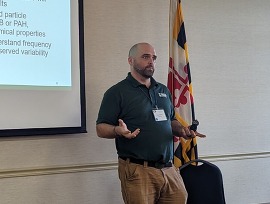 Trevor Needham presents on the topic of "Particulate Transport of Legacy Contaminants in the Anacostia River Watershed."
|
|
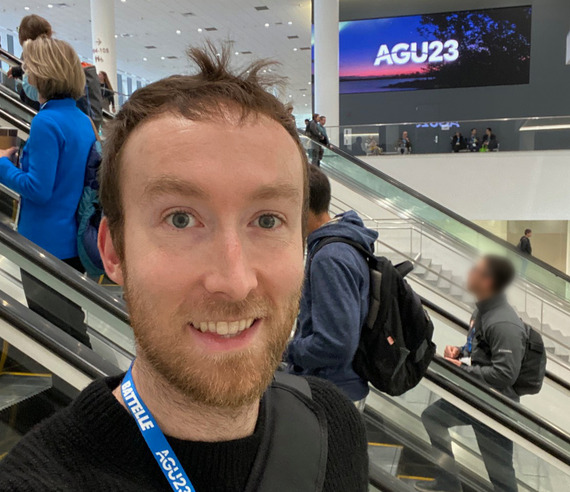 Hydrologist John Hammond gave two talks on drought forecasting and prediction at the AGU23 conference in December.
After storms in mid-December, we were gave us an opportunity to collect data and learn more about local watersheds.
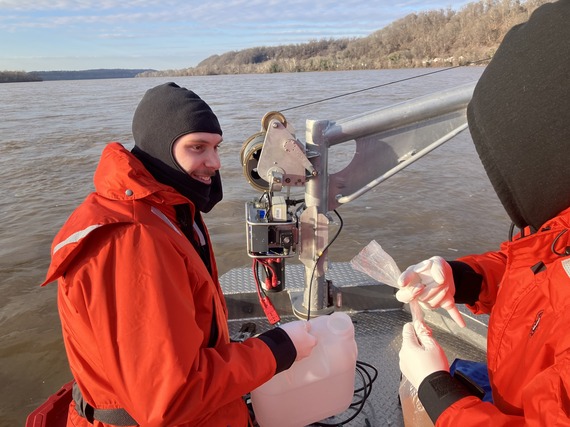 Photo credit: John Tapscott
After the mid-December rainfall, USGS hydrologic technicians Shane Mizelle and Chris Cook collected a storm sample and a discharge measurement from the Susquehanna River downstream of Conowingo Dam. We were eager to get a water-quality sample at these high-flow conditions!
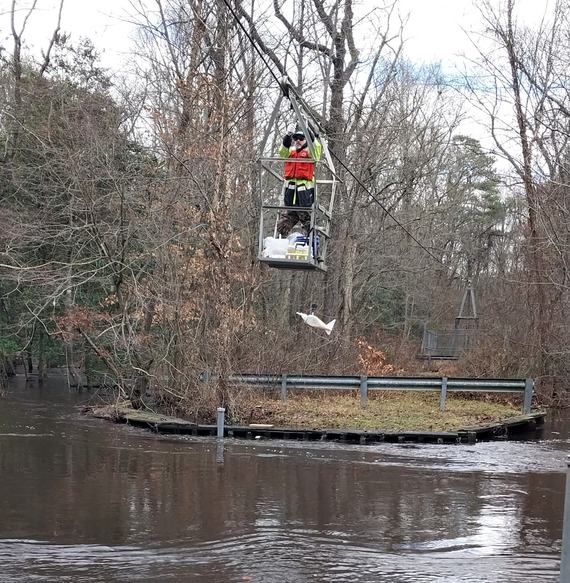 Photo credit: Angela Flack
Hydrologic technician Michael Brownley used the cableway to collect a storm sample from a flooded Choptank River near Greensboro, MD (01491000), the only safe way to sample at such high flows.
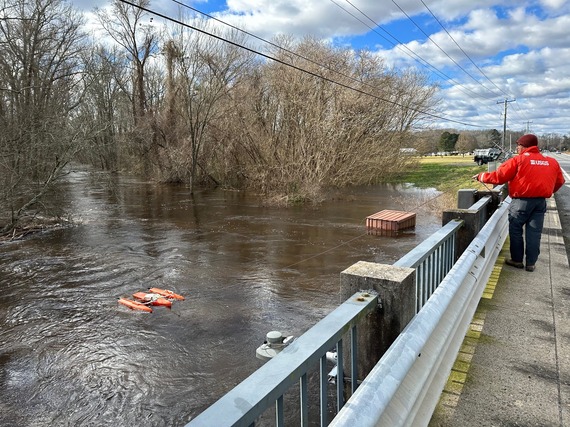 Photo credit: Sam Woomer
Hydrologic technicians Nate Harris, Sam Woomer, and Chris Lewis visited Pocomoke River near Willards, MD (01495000) to measure streamflow at flood stage.
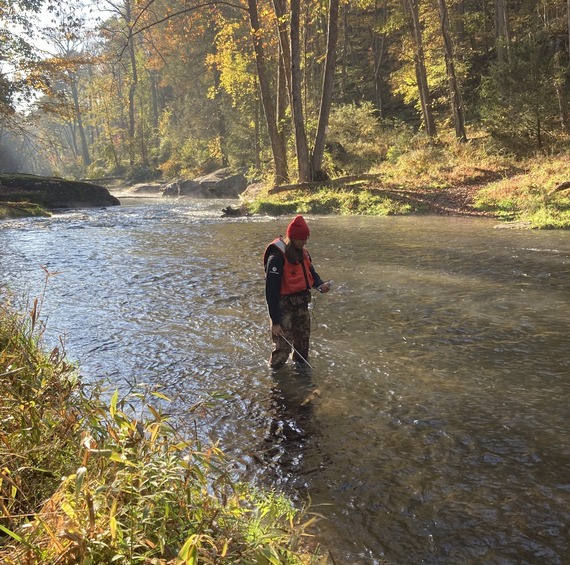 Photo credit: Kelly McVicker
Hydrologic technician Anna Helgeson performed a water temperature check at Gunpowder River near Parkton, Maryland (01581920).
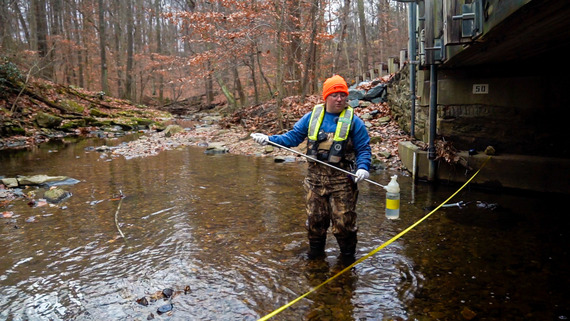 Nothing is better than sampling from a stream like Plumtree Run near Bel Air, MD (01581752). Hydrologic technician Kelly McVicker collected water samples here as part of our December fixed-frequency water-quality sampling.
|
|
Follow Us On Social Media |
|
|
|
|