|

May 4, 2018
What's Wild
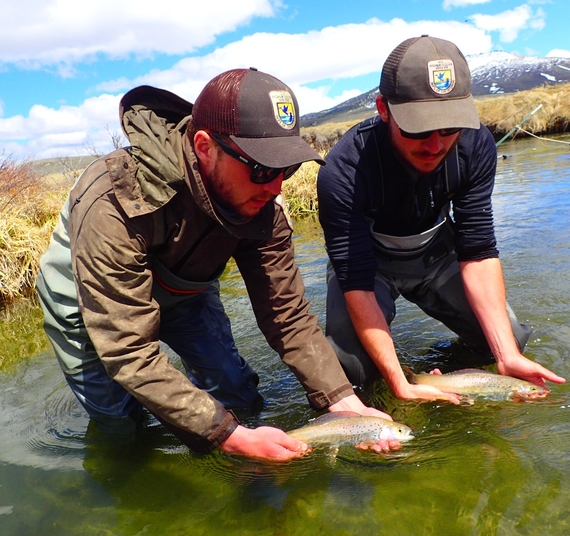 U.S. Fish and Wildlife Service biologists surveying arctic grayling near the spring head of Elk Springs Creek on Red Rock Lakes National Wildlife Refuge in Montana by Jason Marsh/USFWS
Arctic Grayling Reclaim Historic Spawning Territory For Second Consecutive Year
Earlier this week, U.S.Fish and Wildlife Service (Service) fisheries staff made an exciting discovery: Arctic grayling were found near the spring head of Elk Springs Creek in Montana. This marks the second consecutive year these unique western fish were recorded in this location, where natural spawning has not happened in decades! The creek is located on Red Rock Lakes National Wildlife Refuge near the state's southwestern corner.
A particularly encouraging observation was the capture of a reproductively mature (“ripe”) female grayling. Her presence indicates local habitat conditions are amenable to supporting successful reproduction for these rare fish.
The finding also provides evidence that previous and ongoing conservation efforts, which focus on restoring Elk Springs Creek, have successfully re-established historic use of the stream by wild spawning grayling. Spawning season has just begun (it generally lasts from early to late May), and biologists are hopeful they will find even more grayling inhabiting these waterways.
From 1898 through 1908, the United States Fish Commission (a predecessor of the Service) harvested 33 million grayling eggs from Elk Springs Creek to recover grayling in their historic ranges across the United States. These recent surveys indicate Elk Springs may once again become a significant spawning stream for this imperiled, yet improving fish species in Montana.
This Upper Missouri River population in Montana is 500 miles south of the next most southern population, which is in the Canadian Province of Saskatchewan. Arctic grayling need cold water, normally found closer to the Arctic. (The species remains extinct in Michigan, the only other location in the lower 48 states where a distinct population historically existed. Arctic grayling are also found in the wild in Alaska.)
The Service wishes to thank all those who have helped in researching why grayling stopped using Elk Springs Creek and how we might encourage them to return and thrive well into the future. Participating recovery partners over the years include Montana Fish, Wildlife & Parks Fisheries biologists and managers; fisheries staff of the Montana Fish and Wildlife Conservation Office; D.C. Booth Historic National Fish Hatchery and Archives; Ennis National Fish Hatchery staff; students from Montana State University and University of Montana (Western); refuge volunteers; The Nature Conservancy; the blasting team from Beaverhead-Deerlodge National Forest; USFWS Partners for Fish and Wildlife program; the Arctic Grayling Recovery Program; the Centennial Valley Association; Miller Recreational Construction; and The Red Rock Lakes National Wildlife Refuge's Friends group.
Learn more about fish migration and dozens of other native North American fishes that benefit from conservation, habitat restoration, and fish passage efforts across the United States.
New Funding for Collaborative Conservation Efforts Will Benefit People and Wildlife in Sagebrush Country
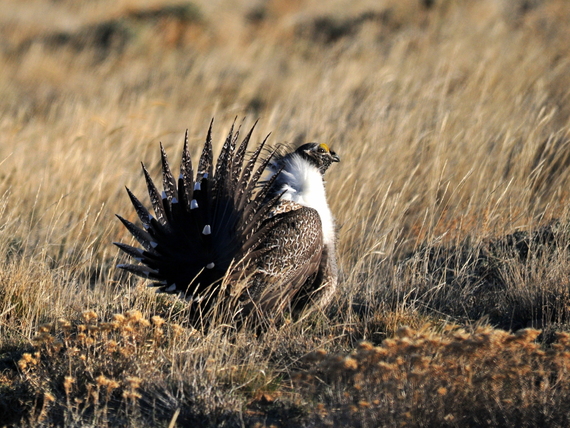 Greater sage-grouse at Seedskadee National Wildlife Refuge in Wyoming by Tom Koerner/USFWS
$2.81 Million in Sagebrush Conservation Grants includes projects in Nebraska, North Dakota, South Dakota, Montana, and Wyoming
Last month the National Fish and Wildlife Foundation (NFWF) announced $2.81 million in grants to benefit grasslands in Nebraska, North Dakota, South Dakota, Montana, and Wyoming. The projects funded by these 16 grants will cover 65,000 acres of native North American grasslands throughout the Northern Great Plains. Conservation work funded through these grants will benefit native wildlife - including pronghorn, mule deer, black-footed ferrets, and greater sage-grouse - while also supporting local communities and ranchers.
The U.S. Fish and Wildlife Service is pleased to join NFWF and our public and private partners in supporting healthy ecosystems throughout the American west. These grants provide our conservation partners with vital resources to deliver on-the-ground projects that directly benefit wildlife, habitats, people, and livelihoods (including ranching) across intermountain habitats.
Learn more about the wildlife these collaborative conservation grants will help, including those in Sagebrush Country.
Working with Public and Private Partners on Western River Habitat Conservation
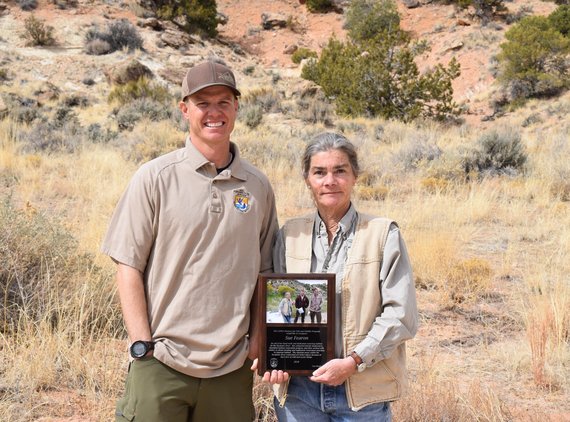 Photo: U.S. Fish and Wildlife Service Biologist Clint Wirick and Sue Fearon of Grand Staircase Escalante Partners by USFWS
Escalante Watershed Restoration Partner Recognized in Utah
The Escalante Watershed Restoration Partnership (EWRP) is a coalition of private and public agencies, groups, and individuals working towards restoring native habitats and hydrology on the Escalante River and its tributaries in the Escalante Watershed in Southern Utah. The U.S. Fish and Wildlife Service’s Partners for Fish and Wildlife Program (PFW) in Utah is a member of this coalition, as is Grand Staircase Escalante Partners (GSEP).
Sue Fearon is the private lands coordinator for GSEP and a key partner assisting with habitat work done with the PFW program on private lands. Sue helps coordinate partnerships between private landowners, GSEP, PFW, and other organizations to fund and implement restoration projects. She was recently recognized for her exhaustive efforts in furthering this conservation mission. Projects have focused on removing non-native woody plants, primarily Russian olive, and restoration of riparian habitat.
The Escalante River is a tributary to the Colorado River and is one of the last free flowing rivers today; 90 miles of riparian corridor support over 200 species of migratory birds, including endangered Southwestern willow flycatchers, threatened yellow-billed cuckoos, federally-listed Mexican spotted owls, and peregrine falcons. This habitat also supports rare fish, including remnant populations of Colorado River cutthroat trout, as well as bluehead sucker, roundtail chub, and flannelmouth sucker.
|