|
Having trouble viewing this email? View it as a webpage: https://content.govdelivery.com/accounts/USDOES4/bulletins/42d4f19 |
|
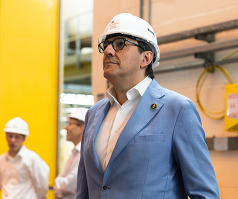
September offered a firsthand look at the expanding scope and impact of the Genesis Mission. Across sectors, the transformative power of AI-enabled science and engineering is rapidly moving from potential to practice. In light of the broader national conversation around artificial intelligence, I recently sat down with HPCwire to share my perspective on the immense potential of AI for science and how it will shape our technological future.
That real-world impact was evident throughout our recent engagements: at the Global Fusion Policy Summit in London, we explored AI’s critical role in accelerating commercial fusion, while at the National Cleanup Workshop, we highlighted how these same advanced capabilities can make nuclear cleanup safer, faster, and more efficient.
Crucially, this mission is powered by a growing, passionate community. That shared momentum was on full display with the launch of the Quantum Genesis Q Competition, which sparked immense engagement across the science and technology ecosystems. We felt that energy again last week as more than 1,200 participants joined our Genesis Mission Graduate Fellowship Pilot Virtual Town Hall to listen, engage, and share valuable input as we launch this new four-year PhD pathway for researchers.
With the next round of Genesis Mission RFA project awards to be announced imminently, this is only the beginning. I look forward to continuing this journey together.
—Darío
|
|
|
Our National Labs and partners are continuing to make progress on our nation’s toughest science and technology challenges—from advancing next-generation nuclear power to recentering microelectronics in America.
Idaho National Lab is leading a Genesis Mission Phase II project, Prometheus, with Oak Ridge, Argonne, and Sandia National Laboratories, alongside university and industry partners, to speed up the development and deployment of nuclear reactors. The team leverages AI agents to coordinate engineering, licensing, manufacturing, and construction workflows. Grounded in validated nuclear codes and decades of curated research data, these agents run physics-based simulations and continuously learn across projects. Ultimately, Prometheus aims to accelerate design and licensing by 10x and manufacturing by 3x—cutting deployment timelines and operating costs in half to meet surging energy demands.
 Prometheus leverages AI to accelerate nuclear energy development, from design to deployment. Photo courtesy of Idaho National Lab, U.S. Dept. of Energy
Meanwhile, Fermilab is pioneering AI-driven agentic design tools to engineer resilient microelectronics for extreme environments, including particle accelerators, fusion reactors, and quantum systems. By speeding up chip-design optimization up to 500x, this workflow enables engineers to evaluate thousands of variations instead of just one, accelerating breakthroughs across quantum science, fusion energy, and materials discovery.
|
|
Conversations That Stuck with Me
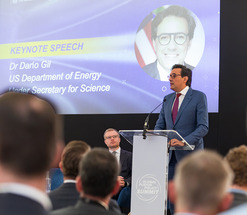
On September 14, I had the privilege of co-hosting the Global Fusion Policy Summit alongside UK Minister for Energy Michael Shanks. Throughout our discussions, one message resonated clearly: the profound urgency surrounding fusion energy.
For decades, fusion was viewed as a long-term aspiration. Today, that horizon is firmly within reach, shifting the dialogue from foundational discovery to commercial deployment. Our imperative now is to move with shared purpose and momentum, uniting scientific and engineering breakthroughs, government, industry, artificial intelligence, and international partners to turn the promise of fusion into a practical source of abundant, reliable energy.
Artificial intelligence will be a critical catalyst in this transition. From optimizing complex plasma models to leveraging digital twins for rapid iterative engineering across successive power plant generations, AI is accelerating our path forward.
The conversations at the summit reinforced what an exciting time this is for energy innovation, with fusion poised at the forefront of shaping our global future.
|
|
|
What's Moving
September was another busy month across the Genesis Mission and Office of Science. Here are the latest updates.
-
We launched the Quantum Genesis Q Competition, with up to $215 million in planned funding to develop and deploy the world’s first fault-tolerant, scientifically relevant quantum computers. The competition challenges private-sector companies to deploy systems with at least 100 logical qubits capable of performing hundreds of millions fault-tolerant operations and scientific demonstration programs. We also announced a $45 million lab call to tap our National Labs’ expertise to build the capabilities needed to test and validate these systems. View the opportunities and apply through the Funding Opportunities webpage.
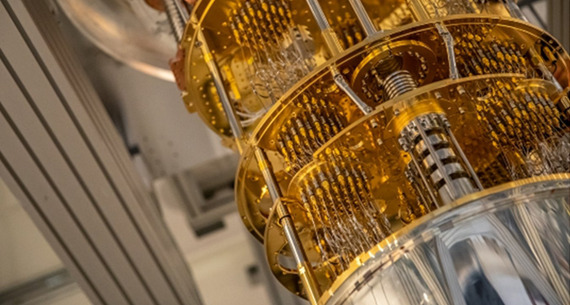 Cryogenic dilution refrigerator at Berkely Lab’s Advanced Quantum Testbed is used to keep qubits cold enough for future use in quantum computers. Photo courtesy of Berkeley Lab, U.S. Dept. of Energy
-
The Office of Science Advisory Committee (SCAC) Quantum Subcommittee released its report, Path to an Integrated Quantum Future, outlining a roadmap toward demonstrating a scientifically relevant, error-corrected quantum computer by 2028 and articulating a long-term vision for a dedicated quantum computing user facility. The report calls for measuring success not only by hardware milestones, but by scientific utility and our ability to solve otherwise intractable problems. My blog post shares more about this science-first approach and what comes next.
-
Another new SCAC report, Genesis Mission Frameworks for AI-Accelerated National Breakthroughs, evaluates the scientific landscape to identify how artificial intelligence can drive transformative innovation. The Genesis Mission Subcommittee conducted deep dives into three pivotal Genesis Mission challenge areas: harnessing biology at digital speed, accelerating fusion energy through AI, and rebuilding domestic magnet sovereignty. The report underscores the Genesis Mission's capacity to expedite scientific discovery, bolster American competitiveness, power economic growth, and secure the nation's energy future.
-
Three scientists whose Office of Science-supported research helped launch the field of twistronics recently received the 2026 Kavli Prize in Nanoscience. Eva Andrei, Pablo Jarillo-Herrero, and Allan H. MacDonald were recognized for their contributions to the field, showing how twisting layers of two-dimensional materials can reveal new properties and offer potential breakthroughs in computing, quantum technologies, and custom materials design. I was honored to attend the ceremony and celebrate their achievements.
It’s been great to see the interest and excitement around the Quantum Genesis Q Competition and other Genesis Mission initiatives across recent media coverage.
|
|
|
There’s more news ahead, and I’m excited to keep sharing the milestones and breakthroughs we’re achieving as we advance AI for science.
Upcoming events:
|
|
 |
|
|
|
If a colleague shared this newsletter with you and you’d like your own subscription,
please sign up here.
Follow Us on Social Media!
 
|
|
|
|
|