|
Having trouble viewing this email? View it as a webpage: https://content.govdelivery.com/accounts/USDOES4/bulletins/427b104 |
|
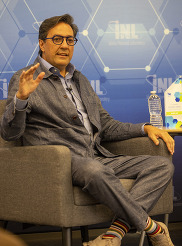
Our growing momentum captured national attention this month when I had the honor of being included in the TIME 100 AI list. While this is a personal recognition, it truly reflects a much broader achievement: the dedication of the extraordinary people and partners behind the Genesis Mission, and our shared commitment to transforming science and engineering through artificial intelligence.
One of the most rewarding aspects of leading the Genesis Mission is witnessing ambitious ideas turn into tangible results. Across our expanding AI-for-science ecosystem, scientists, engineers, and partners are uniting cutting-edge science, advanced AI, world-class infrastructure, and new ways of working to tackle national challenges that once seemed out of reach.
This collaborative spirit was on full display at the Genesis Mission Summit, the capstone of our summer, where we celebrated our inaugural cohort of 278 projects. Today, these multidisciplinary teams across the country are actively addressing critical science and technology priorities, delivering on our promise of real-world impact.
In addition to these focused efforts, vital work continues across our entire network, and below, I’m excited to share a few key highlights from this past month and offer a glimpse of what’s ahead.
—Darío
|
|
|
|
Our National Labs continue to make significant progress on the national challenges central to the Genesis Mission. At SLAC National Accelerator Laboratory, researchers are leveraging AI to enhance particle accelerators for discovery—improving performance, reliability, and scientific throughput. By integrating agentic AI workflows, AI/ML system modeling, continual learning, and digital twins, and enabling real-time integration between high-performance computing and the Linac Coherent Light Source (LCLS), SLAC has increased digital twin prediction speeds by over a million-fold and enabled much faster beam customization. These advances deliver higher-quality beams on demand for applications ranging from computer chip manufacturing to medicine, while accelerating scientific discovery.
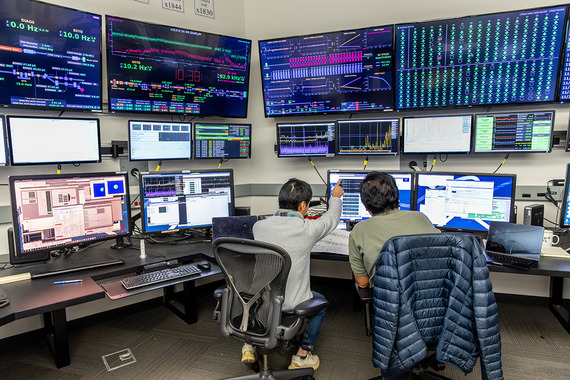 From left, Yuantao Ding and William Colocho, in SLAC's accelerator control room. SLAC's X-ray laser, LCLS, has reached a major milestone: delivering 93 kHz – almost 100,000 pulses per second – a new world record for X-ray free-electron lasers. The achievement marks a critical step toward the machine’s goal of up to 1 million pulses per second, 8,000 times more than the original machine.
At Brookhaven National Laboratory, scientists are harnessing AI-driven biotechnology to secure America’s critical minerals supply. Traditionally, extracting these minerals from ore or waste involves more than 500 chemical steps using toxic, expensive reagents at high temperatures. Now, Brookhaven is deploying AI-engineered biomolecules, cells, and closed-loop autonomous laboratories to potentially cut that process to fewer than five steps, achieving equal or higher purity. AI has already enabled the discovery of two biomolecules that capture the rare earth element terbium, paving the way for a domestic supply that is faster, cheaper, and far less chemically intensive.
|
|
Conversations That Stuck with Me
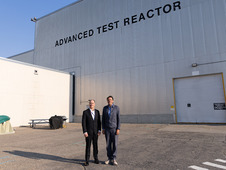
During my recent visits to Idaho National Laboratory (INL) and the National Laboratory of the Rockies (NLR), I witnessed firsthand how our National Labs are deploying cutting-edge technologies to address national priorities. At INL, touring the Advanced Test Reactor and Materials and Fuels Complex, I saw scientists harnessing AI and high-performance computing to advance nuclear energy, strengthen critical mineral supply chains, and address national security challenges.
I also shared in the excitement surrounding major milestones as three privately developed test reactors participating in the Department of Energy’s Reactor Pilot Program recently achieved zero-power criticality at INL. The momentum on the ground confirms what we already know: American innovation is driving the next nuclear renaissance.
|
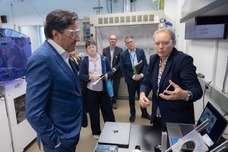
At NLR, researchers are driving progress in next-generation photovoltaics, critical minerals research, power systems integration, and digital infrastructure testing, moving advanced energy technologies from research to real-world deployment.
What truly stayed with me after both visits is the National Labs’ unique ability to bring together technologies, infrastructure, and expertise across disciplines, delivering scientific breakthroughs that once seemed out of reach.
|
|
|
|
Momentum from the Genesis Mission Summit continues, with new initiatives underway to expand the tools, capabilities, and support needed to scale the mission and advance AI-enabled scientific discovery. From a DOE-led open models initiative to a White House roadmap for the future of American science, here’s what’s moving.
- We recently launched the Genesis Open Models Initiative to develop a new class of open-weight foundation models aimed at accelerating scientific discovery. The first model, Genesis-Science-1, is being developed in partnership with Arcee. Researchers and organizations across industry and academia are invited to help build shared infrastructure for scientific innovation, contributing models and data, co-developing evaluations and benchmarks, and collaborating on fine-tuning and application deployments. Learn more here.
- The Office of Science has announced $7.3 million in funding for eight projects applying quantum information science and technology to high energy physics experiments and simulations. The projects will develop quantum sensors and applications for quantum computers, unlocking new insights into particle colliders and neutrino experiments. This work also supports the Genesis Mission’s Quantum Genesis initiative, which aims to deliver scientifically relevant quantum computing by 2028. Learn more here.
- In July, the White House Office of Science and Technology Policy published Science: A New Golden Age. The report centers on four pillars: revitalizing America’s science and technology enterprise, securing U.S. leadership in critical and emerging technologies, launching a golden age powered by AI for science, and ensuring that science and technology improve the lives of all Americans. It also calls on the federal government to scale the Genesis Mission and advance high-value datasets, autonomous laboratories, machine-augmented research, and more. Read the report here.
|
|
|
Recent media coverage of the Genesis Mission has highlighted our first research projects, the Genesis Mission Platform, international partnerships, and the expanding impact of our work. I’ve had the opportunity to participate in these conversations and share insights into the mission’s future direction.
Check out some recent highlights:
|
|
In the coming weeks, we’ll have new opportunities and announcements to share as we continue expanding the mission, investing in the next generation of scientific talent, and moving our research efforts forward. Stay tuned—there’s a lot to look forward to. |
|
 |
Upcoming events:
-
Kavli Prize Week, August 29–September 3: This week, I am in Norway attending the Kavli Prize Award Ceremony. We are exceptionally proud that three of this year's award recipients conducted their landmark research through support from the DOE’s Office of Science.
-
Global Fusion Policy Summit, September 14: I’m honored to co-host and represent the United States as we convene global leaders across government, industry, academia, and international organizations to accelerate the commercialization of fusion energy.
-
Quantum World Congress, September 23–25: On September 25, I’ll join a fireside chat to discuss the DOE's science and technology agenda—how quantum fits in and how these technologies will shape America’s scientific, industrial, and physical infrastructure.
-
Experience POWER, September 28–30: I’ll deliver a keynote on September 29 about the Genesis Mission and how AI is rewriting the rules of American science and energy.
|
|
|
If a colleague shared this newsletter with you and you’d like your own subscription,
please sign up here.
Follow Us on Social Media!
 
|
|
|
|
|