|
 19 December 2022
|
|
|
This is the last CommUnique of 2022! We wish you happy holidays and look forward to bringing you the news of the DOE Office of Science again in 2023.
|
|
|
|
|
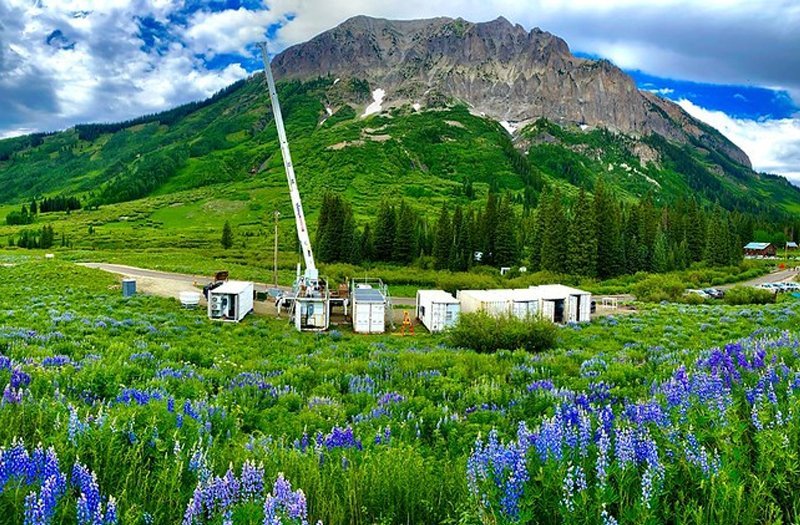
About 40 million people across seven states depend on the Colorado River for their water. Droughts in the Colorado River Basin ripple out to affect agriculture and energy production in an even wider area.
Like most of the world’s freshwater supplies, the source of the Colorado River starts in snowpack high up in the mountains. Understanding the intricacies of these systems requires scientists to connect field measurements with predictive Earth system models. These details include understanding how much precipitation will fall as rain or snow at high elevations, how it moves its way downstream, and how climate change will affect these processes.
To tie these tools together, the Department of Energy’s (DOE) Office of Science is supporting a comprehensive field laboratory. The Surface Atmosphere Integrated Field Laboratory campaign in the Upper Colorado River Basin integrates the research of many of our national lab scientists
Learn more about DOE’s field observations in the Upper Colorado River Basin and what we can learn from them.
|
|
|
Biological memory: Researchers at DOE’s Oak Ridge National Laboratory have shown that an artificial cell membrane is capable of a hallmark of biological learning and memory. This is the first evidence that a cell membrane alone can have this process persist for several hours. It is also the first time scientists have identified a nanoscale structure in which they can encode memory. This finding could help scientists design materials and computers that act like brains.
|
|
|
|
Drones to improve biofuels: Researchers at the Center for Advanced Bioenergy and Bioproducts Innovation used computer systems modeled on the human brain to analyze very high-resolution aerial imagery of the crop miscanthus. These images allowed them to identify key traits of the plant during the crop’s growing season. Miscanthus is one of the most promising perennial crops for bioenergy. |
|
|
Toughest material ever: A team of scientists has measured the highest toughness ever recorded for any material. The group – which includes scientists from DOE’s Lawrence Berkeley National Laboratory and Oak Ridge National Laboratory – was investigating a metallic alloy made of chromium, cobalt, and nickel. They found that the metal was extremely malleable and strong. In addition, its strength and ductility improve as it gets colder, which runs counter to most other materials in existence.
|
|
Insights into batteries: To design better rechargeable batteries, researchers from the University of Illinois Urbana-Champaign visually pinpointed areas of chemical and physical change within ion batteries. They combined a powerful electron microscopy technique and data mining. With this technique, they achieved a 10-fold increase in resolution over current X-ray and optical methods. |
|
Battery chemistry: A team of scientists led by chemists at the DOE’s Brookhaven National Laboratory and Pacific Northwest National Laboratory has unraveled the chemical mechanisms of the interphase, a battery component crucial for boosting energy density. Using the National Synchrotron Light Source II DOE Office of Science user facility, they developed a detailed chemical map of the interphase components. This information will make it possible to develop better batteries. |
|
Grassland viruses: Viral communities across a grassland area are not uniform, according to a new study from University of California, Davis. The researchers found that understanding viral dynamics could lead to better insights into how bacteria in soil will react to drought and other climate changes.
|
|
|
The Office of Science posted four new highlights between 12/6/22 and 12/19/22.
|
|
Narrowing down the critical point in quark-gluon plasma: Nuclear matter consists of quarks and gluons. Like ordinary matter, it can exist in different phases. In today's world, it exists mostly as protons and neutrons in atomic nuclei. By colliding heavy ions, scientists have revealed the quark gluon plasma (QGP), a phase of nuclear matter with freely moving quarks and gluons. The QGP is like the matter in the early universe and dense compact stars. Scientists are trying to establish if a critical point exists where the QGP would coexist with a gas of protons, neutrons, and other particles. Scientists found that colliding gold ions at the lowest energies accessible at the Relativistic Heavy Ion Collider do not form a QGP. In contrast, they observe a QGP at energies above 20 giga-electron volts. This indicates that the critical point, if it exists, should be between collision energies of 3 GeV and 20 GeV. |
|
|
NPR Shortwave: Don’t call it dirt: The science of soil
This episode featured DOE Office of Science Director Asmeret Asefaw Berhe discussing the importance of soil and soil science for World Soil Day.
|
|
|
|
The New York Times: 22 things that happened for the first time in 2022
This list includes the discovery of a bacterium that people can see without the help of microscopes by scientists at DOE’s Lawrence Berkeley National Laboratory, the Joint Genome Institute Office of Science user facility, and the L'Université des Antilles.
|
|
|
|
Popular Science: The 100 greatest innovations of 2022
Among the greatest innovations of 2022, Popular Science listed the LSST Camera built by DOE’s SLAC National Accelerator Laboratory.
|
|
|
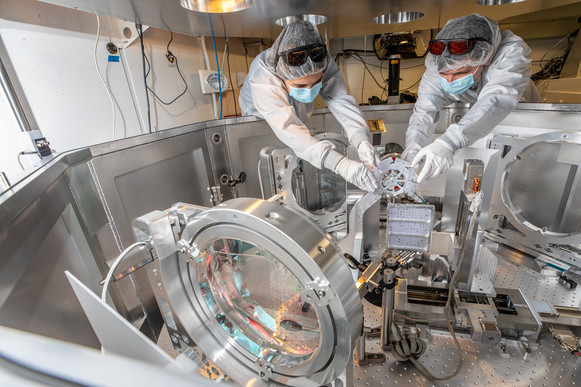
Laser Upgrade Opens New Research Possibilities
|
|
Things are looking brighter than ever at the Berkeley Lab Laser Accelerator (BELLA) Center run by DOE’s Lawrence Berkeley National Laboratory. A recently completed upgrade will expand the center’s capabilities into new areas, including studies of particle acceleration, extremely hot plasmas, cancer treatment techniques, and materials for quantum science. The upgrades were funded by the Fusion Energy Sciences program of the DOE Office of Science. |
|
Happy Holidays from the Office of Science!
|
|
|
CommUnique provides a review of recent Office of Science Communications and Public Affairs stories and features. This is only a sample of our recent work promoting research done at universities, national labs, and user facilities throughout the country.
|
|
|
|
|