|
 22 February 2022
|
|
|
The Early Career Research Program provides financial support that is foundational to early career investigators, enabling them to define and direct independent research in areas important to Department of Energy (DOE) missions. The Early Career Award Winner series provides awardees with an opportunity to explain the results of their research in their own words.
There’s a famous expression attributed to Albert Einstein. He said that mathematical models should be as simple as possible, but no simpler than necessary to explain the answer to the questions you are asking.
The DOE Early Career Research Program Award enabled us to develop mathematical methods for finding simple models. These models have the potential for improving the accuracy and efficiency of computer codes in a wide variety of scientific applications, including carbon dioxide sequestration in subsurface areas, the fate and transport of contaminants in aquifers, and battery design.
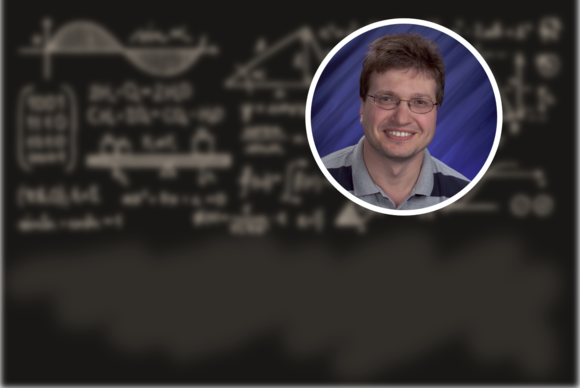
Read more about how Alexandre M. Tartakovsky used his Early Career award to develop models to describe and explain fundamental processes in physics.
|
|
A team of researchers at MIT has designed one of the strongest lightweight materials known. They compressed and fused flakes of graphene, a two-dimensional form of carbon. The new material has a density of just 5 percent and can have a strength 10 times that of steel. The strength appears to come from the material’s configuration, which suggests that similar strong, lightweight materials could be made from a variety of starting materials. |
|
Scientists have long suspected a link between viral infections and the development of multiple sclerosis (MS), an autoimmune disease that affects almost one million Americans. A study led by Stanford Medicine researchers has proved that the Epstein-Barr virus can trigger MS. The team used the Stanford Synchrotron Light Source DOE user facility for chemical analysis. |
|
An international research team that includes scientists from DOE’s Lawrence Berkeley National Laboratory using computers at the National Energy Research Scientific Computing Center user facility has established a new upper limit for the mass of the neutrino. This measurement sets the stage for future discoveries in nuclear and particle physics as well as cosmology. |
Quantum computers could be useful for many applications, but the short memory time of qubits limits their usefulness. A team at the University of Chicago has made two major steps forward. They read out a qubit on demand and then kept the quantum state intact for more than five seconds. In addition, they made their qubits from an easy-to-use, fairly common material. |
|
The Office of Science posted five new highlights between 2/8/22 and 2/22/22.
|
|
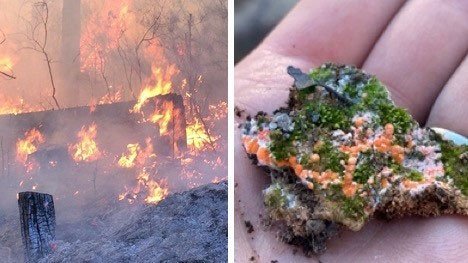
Wildfires can cause significant changes in the carbon found in soils. Carbon affected by fire, called pyrolyzed organic matter, is difficult for many organisms to use as food. But researchers at the University of California, Berkeley found that a specific fungus that thrives after fires uses this form of carbon to grow. This study reveals new information into the ecology of fire-loving fungi and how they may recycle carbon back into the food web after a fire. |
|
|
Discover: Scientists scour sewage for coronavirus clues
Scientists are using municipal wastewater to track COVID-19 cases. Researchers at the University of Illinois-Chicago are using resources at DOE’s Argonne National Laboratory to sequence the samples.
|
|
Office of Science Graduate Student Research Program Open for Applications
|
|
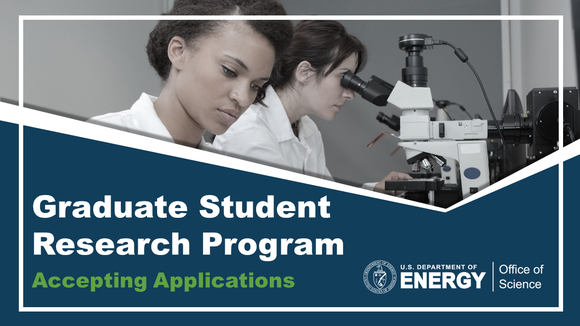
The DOE’s Office of Science has a commitment to foster the next generation of scientists, with their great ideas and innovative thinking. Our Office of Science Graduate Student Research program supports awards to outstanding U.S. graduate students to conduct part of their thesis research at a DOE national laboratory or host site in collaboration with a DOE laboratory scientist. Its goal is to prepare graduate students for scientific and technical careers critically important to the DOE mission. Since the program started in 2014, it has provided support to more than 780 graduate awardees from more than 150 different U.S. universities to conduct research at all 17 DOE national laboratories. The program is currently open for applications, which are due on May 4. Please spread the word so we can support a greater diversity of graduate students than ever! |
|
Video: Jefferson Lab – Revealing the Nature of Matter
|
|
Our national laboratories are powerhouses at addressing the nation's and science’s most pressing questions and problems. DOE’s Thomas Jefferson National Accelerator Facility – also called Jefferson Lab – is leading the way in revealing the secrets of everyday matter. Its core mission is to enable the study of the subatomic world that exists inside the nucleus of the atom. Check out this video for a brief look inside the lab's facilities to discover what it takes to explore the nature of matter. |
|
|
CommUnique provides a review of recent Office of Science Communications and Public Affairs stories and features. This is only a sample of our recent work promoting research done at universities, national labs, and user facilities throughout the country.
|
|
|
|
|