|
 12 July 2021
|
|
|
CommUnique provides a biweekly review of recent Office of Science Communications and Public Affairs work, including feature stories, science highlights, social media posts, and more. This is only a sample of our recent work promoting research done at universities, national labs, and user facilities throughout the country. Please note that some links may expire after time.
|
|
|
|
What are the basic building blocks of our cosmos, and how do they interact? What happens at the smallest levels, and what hidden potential lies therein? How did our universe evolve, and what may the future hold? Particle physics research seeks that knowledge. Scientists supported by the U.S. Department of Energy (DOE) tackle these fundamental mysteries at universities and national labs across the country. They build state-of-the-art experiments that yield incredible discoveries and achievements. Along the way, they create new technologies, applications, and a highly trained workforce.
Read more about the role DOE has played in high energy physics and the innovations that have evolved from that research.
|
|
The Office of Science posted 61 news pieces between 6/30/2021 and 7/12/2021.
|
|
|
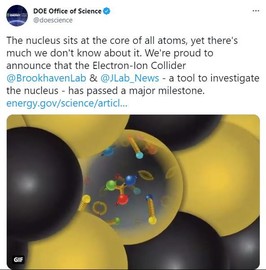
DOE has granted Critical Decision 1 (CD-1) for the Electron-Ion Collider, a one-of-a-kind nuclear physics research facility to be built at DOE's Brookhaven National Laboratory. DOE’s approval of CD-1 provides the authorization to begin the project execution phase, starting with preliminary design.
|
|
|
Researchers at the Massachusetts Institute of Technology; the University of California, Berkeley; and their partners have found a new way to connect 2D materials to conventional electronic parts. This discovery will help make it easier to use 2D materials and further the miniaturization of components in electronics.
|
|
|
|
From 1979 to 2019, increases in greenhouse gases and reductions in human-generated aerosols triggered about a four-day delay in seasonal rainfall over tropical land and the Sahel, according to research from DOE’s Pacific Northwest National Laboratory. That lag could result in delayed crop production, exacerbated heat waves, and worsened wildfires.
|
|
|
While the prevailing hypothesis was that intense, wide-spread melting events in Greenland are causing much of its ice loss, research from the University of California, Irvine shows that they only account for a small portion of the ice sheet’s deterioration. Instead, most of the ice loss and resulting sea level rise is from more gradual, day-to-day processes.
|
|
|
|
Fatty acids, compounds that provide benefits through diets rich in leafy greens and fish, can also be used in biofuels. Scientists at the Great Lakes Bioenergy Research Center and the University of Wisconsin-Madison discovered how to use bacteria to make one kind of fatty acid that can substitute for petroleum-based products.
|
|
|
The Office of Science posted one new highlight between 6/30/2021 and 7/12/2021.
|
|
|
The isotope Aluminum-26 provides rare insight into the processes inside stars. The daughter isotope that Aluminum-26 decays into is in matter that carries the fingerprints of ancient stars. But Aluminum-26 is difficult to study in the laboratory. Researchers from Michigan State University and the University of Surrey created an isotope of silicon that has a similar excited quantum state as Aluminum-26, allowing them to study it in more detail.
|
|
|
The Office of Science sent out 105 tweets between 6/30/2021 and 7/12/2021. Here are the two most popular:
|
|
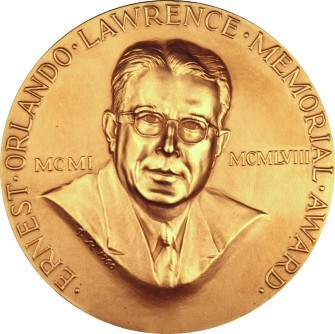
Ernest Orlando Lawrence Awards are Now Open for Nominations
|
|
DOE has issued a call for nominations for the 2021 Ernest Orlando Lawrence Award, one of the longest running and most prestigious science and technology awards given by the U.S. Government. The Lawrence Award is presented by the Secretary of Energy to honor mid-career U.S. scientists and engineers for exceptional contributions and achievements in research and development supporting the broad missions of DOE and its programs to advance the national, economic, and energy security of the United States. Awards will be considered in nine categories. Nominations are due by August 24. Information on how to nominate a scientist is available on the Office of Science Honors and Awards website. |
|
Video: Emerging technologies – Particle accelerator R&D
|
|
|
A beam of particles is a very useful tool. It can diagnose a disease, destroy a tumor, improve a chip, clean up dirty drinking water, scan containers for suspicious content, and much more. Check out this video featuring Sam Posen from DOE’s Fermilab describing how the Office of Science is a world leader in particle accelerator science and technology.
|
|
|
|
|