|
 14 June 2021
|
|
|
CommUnique provides a biweekly review of recent Office of Science Communications and Public Affairs work, including feature stories, science highlights, social media posts, and more. This is only a sample of our recent work promoting research done at universities, national labs, and user facilities throughout the country. Please note that some links may expire after time.
|
|
|
|
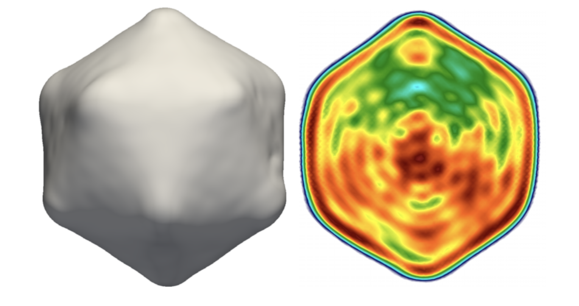
The Department of Energy’s (DOE) X-ray light source complex is a physical-science tool belt that stretches from Long Island to suburban Chicago to the San Francisco Bay area. Researchers use these light sources to glean physical and chemical data from experiments, generating millions of gigabytes of data annually, rolling in hour by hour, day by day. Keeping up with all that burgeoning information and complexity requires advanced mathematics and state-of-the-art algorithms. To meet these challenges, the DOE Office of Science’s Advanced Scientific Computing Research and its Basic Energy Sciences program fund a research project called CAMERA, the Center for Advanced Mathematics for Energy Research Applications.
Read more about CAMERA and how it’s enabling scientists to get the most out of our light sources.
|
|
The Office of Science posted 69 news pieces between 6/2/2021 and 6/14/2021.
|
|
|
The National Energy Research Scientific Computing Center (NERSC), a DOE user facility at Lawrence Berkeley National Laboratory, unveiled the first phase of its next-generation supercomputer, Perlmutter. The system will increase the high performance computing capability for a variety of scientific research in the DOE’s Office of Science.
|
|
Researchers from the University of Delaware’s Center for Plastics Innovation (CPI) have developed a direct method to convert single-use plastic waste — plastic bags, yogurt containers, plastic bottles and bottle caps, packaging and more — to ready-to-use molecules for jet fuels, diesel, and lubricants. |
|
|
New results from the Dark Energy Survey use the largest ever sample of galaxies over an enormous piece of the sky to produce the most precise measurements of the universe’s composition and growth to date. DOE is a major supporter of the Dark Energy Survey.
|
|
|
Researchers at the University of Chicago have designed a completely novel potential treatment for COVID-19. The treatment uses nanoparticles that capture SARS-CoV-2 viruses within the body and then enables the body’s own immune system to destroy them.
|
|
|
|
University of California, Berkeley chemists have discovered a way to simplify the removal of toxic metals, like mercury and boron, during desalination to produce clean water. At the same time, the new technique can potentially capture valuable metals, such as gold.
|
|
|
The Office of Science posted five new highlights between 6/2/2021 and 6/14/2021.
|
|
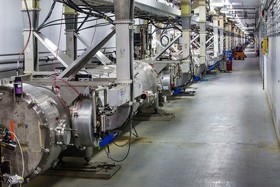
Scientists and engineers at DOE’s Jefferson Lab have designed and built a machine learning system to use with the Continuous Electron Beam Accelerator Facility (CEBAF) DOE user facility. The system monitors structures inside the particle accelerator that impart energy to beams of electrons. In its first field test, the machine learning system correctly identified which structures were tripping off the equipment about 85 percent of the time. |
|
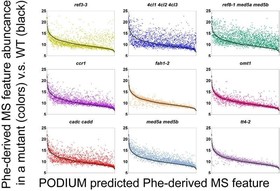
Plants synthesize hundreds to thousands of different chemicals called metabolites. One way that scientists study how plants make metabolites is to introduce precursors (chemicals or compounds a step before the targeted chemical). They label these precursors with radioactivity or isotopes. Scientists can then track them as they move through the pathways the plants use to make metabolites. Previous labeling studies tracked just a few substances involved with plant metabolites. New research developed an easy-to-use computational tool that locates all the substances with carbon-13 labeled precursors in an experiment. |
|
|
Black carbon, or soot, enters the air mainly as a byproduct of fuel combustion. It absorbs sunlight, which has a strong warming effect on the Earth’s atmosphere. However, scientists do not have a complete understanding of the exact impact. This analysis shows that a soot particle’s shape and chemical composition can vary significantly. This research provides a framework that explains globally disparate observations of black carbon. Scientists can use this framework to improve their estimates of how much sunlight black carbon absorbs globally.
|
|
|
|
CNN: This 'wandering meatloaf' chiton has a rare mineral in its teeth
This article describes how scientists have discovered, for the first time in a living organism, a rare iron mineral that had only previously been seen in rocks. They used the Advanced Photon Source, a DOE user facility at Argonne National Laboratory, to analyze the creature’s teeth.
|
|
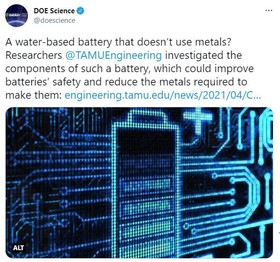
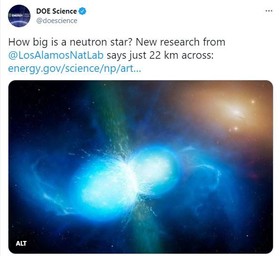
The Office of Science sent out 91 tweets between 6/2/2021 and 6/14/2021. Here are the two most popular:
|
|
Office of Science Funding Opportunities, Program News, and More!
|
|
|
You get CommUnique in your email inbox every two weeks, but did you know that this is only one of many Office of Science email newsletters? We have 27 different email subscriptions available! Depending on your selections, you can receive information about our funding opportunity announcements, events, press releases, and jobs. Each of our research program areas also distribute news as well, with email lists for artificial intelligence, fusion, physics and astronomy, supercomputing, and many others. Sign up for one or all of them on our email list subscriber site.
|
|
|
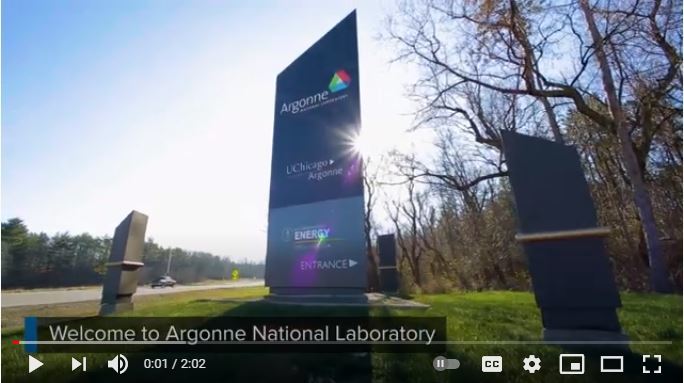
Video: See Argonne National Laboratory from a Bird’s-Eye View
|
|
|
Want a bird’s-eye view of DOE’s Argonne National Laboratory? When DOE Secretary Jennifer Granholm took a virtual tour of Argonne, the laboratory created this video to give her an idea of the laboratory and its facilities. Check out the video, which includes an overview of the Argonne Leadership Computing Facility, the Smart Energy Plaza, the Energy Sciences Building, the Advanced Photon Source, and the Materials Engineering Research Facility.
|
|
|
|
|
|