|
LAS VEGAS - A 5.8-magnitude earthquake centered near Lone Pine, California recently prompted rapid notifications from the EM Nevada Program to waste generators shipping classified and low-level, and mixed low-level radioactive waste to the Nevada National Security Site (NNSS).
That swift reaction to ever-changing road conditions in the region is a routine occurrence that demonstrates the EM Nevada Program’s commitment to the safe transportation of waste for the protection of the public, workers, and the environment.
Following the earthquake, Lee Stevens, a transportation expert with Navarro Research and Engineering, the lead environmental program services contractor for EM Nevada, immediately relayed key information concerning regional road conditions and closures to waste generators with shipments en route to the NNSS. His quick thinking and proactive communication helped ensure the safety of drivers and their loads, minimized rerouting or shipping delays, and facilitated continuous situational awareness for DOE staff supporting NNSS waste management operations.
“EM Nevada is doing great work to keep waste generators across the DOE complex aware of road and weather conditions on routes to the NNSS,” EM Nevada Program Manager Rob Boehlecke said. “Lee’s rapid response on June 24 not only helped to ensure the safety of drivers and their cargo, but also demonstrated that EM Nevada is ready, willing, and able to respond decisively to a more significant event if the need arises.”
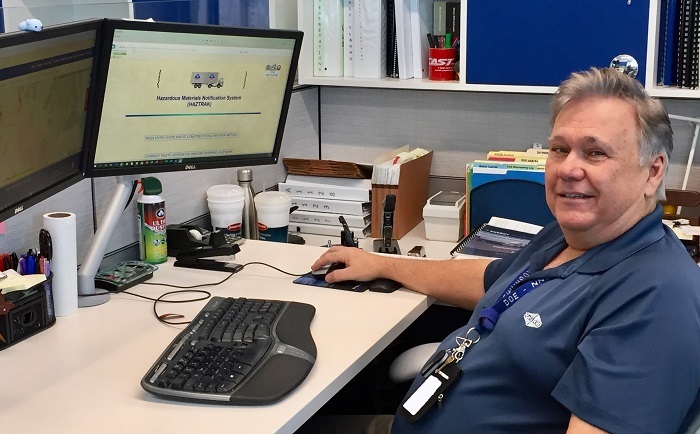 Lee Stevens, a transportation expert with Navarro Research and Engineering, the lead environmental program services contractor for EM Nevada, uses the Nevada National Security Site-based Hazardous Materials Notification System to monitor and manage shipments from waste generators.
EM Nevada uses the NNSS-based Hazardous Materials Notification System (HAZTRAK) to monitor and manage such shipments. Applicable information from HAZTRAK is also accessible to intergovernmental partners and the general public on the NNSS website here.
EM Nevada also recently worked with personnel from the Nevada Department of Transportation (NDOT) to publish guidance that ensures NDOT route approvals are consistent with agreements between DOE and Nevada stakeholders.
Since 1999, more than 31,000 radioactive and classified waste shipments have been safely transported to the NNSS. To learn more, click here for the EM Nevada waste transportation fact sheet.
-Contributors: Michelle French, Jesse Sleezer
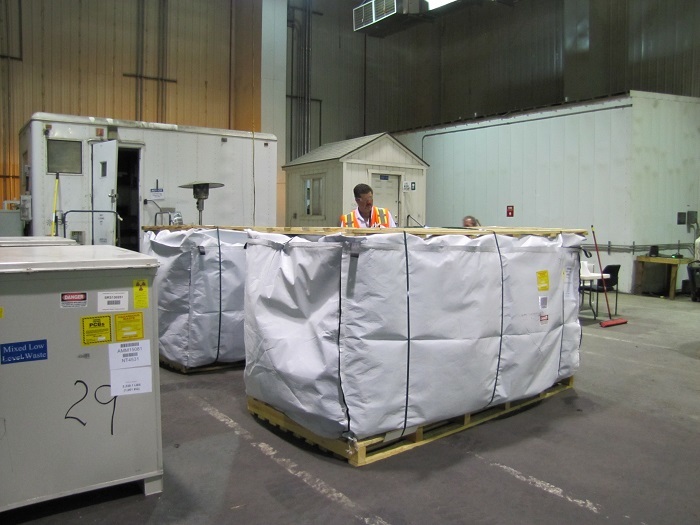 Fluor Idaho Waste Disposal and Waste Generator Services Manager Bruno Zovi inspects a pending shipment of mixed low-level waste prior to shipment offsite.
IDAHO FALLS, Idaho – DOE cleanup agreements with the state of Idaho require EM to ship nuclear waste for disposal, whether it’s newly generated or been stored at the Idaho National Laboratory (INL) Site for decades.
“Our responsibilities are diverse,” said Bruno Zovi, waste disposal and waste generator services manager of Fluor Idaho, EM’s INL Site cleanup contractor. “While the transuranic waste that’s shipped offsite is crucially important to meeting the Idaho Settlement Agreement, there are other wastes that must also leave the state of Idaho.”
In the last 15 years, EM has completed 1,772 low-level and mixed low-level waste shipments from the INL Site, including 40,115 containers with a total volume of 25,204 cubic meters. “Most importantly, we’ve done it safely and compliantly,” Zovi said.
EM has shipped contaminated debris, soils, sludges, salts, and liquids to seven treatment and disposal facilities across the U.S.
Fewer than 100 containers of mixed low-level debris waste remain to be shipped for disposal.
As sludges and soils are treated to meet criteria for disposal at treatment and disposal facilities, the volume of waste sometimes increases. This is due to absorbent, inert material added to absorb liquids present in the waste.
If no liquids are found and all other conditions are acceptable, the waste is packaged, sent for final characterization and certification, and prepared for shipment and disposal. The site’s waste management project is preparing to ship several hundred containers of non-transuranic waste that will be generated from the ongoing sludge repackaging project.
Employees implemented the use of multi-layered, mixed low-level waste disposal bags that have eliminated the need for offsite treatment prior to shipment to an offsite waste repository, resulting in a cost savings of approximately $10 million since 2014.
-Contributor: Erik Simpson
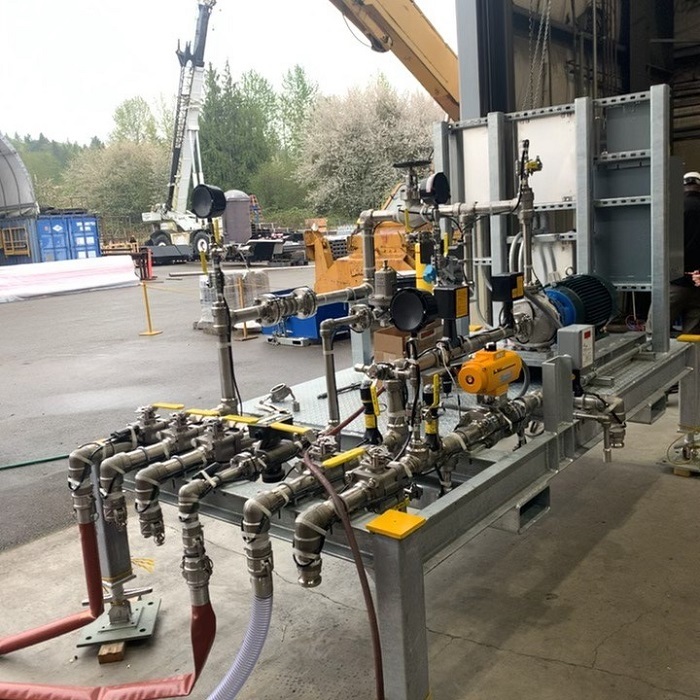 A factory acceptance test for a Savannah River Remediation equipment procurement was completed remotely instead of in-person at the manufacturer’s site due to COVID-19 travel restrictions.
AIKEN, S.C. – EM and its liquid waste contractor at the Savannah River Site (SRS) used creativity to complete a critical equipment test recently while adhering to COVID-19 guidelines.
The Savannah River Remediation (SRR) tank closure team needed to complete a factory acceptance test for a water addition pump skid being procured to supply water for Tank 27 salt dissolution. The tests, which help identify issues with new equipment and correct them prior to shipment, are a significant step in the procurement process at SRS.
Water additions are necessary for salt dissolution, allowing the salt waste to be transferred from the tank for processing and immobilization. Tank 27 salt dissolution is key to the site’s liquid waste program and will feed multiple salt batches when the Salt Waste Processing Facility comes online.
After bulk salt dissolution is completed, Tank 27 will be available for continued use as a hub or blend tank to support salt waste processing and eventual closure of F Tank Farm.
The tests are typically conducted at the manufacturer’s site prior to delivery and installation at SRS. However, SRR tank closure staff couldn’t travel for the onsite inspection at the manufacturer due to restrictions resulting from the COVID-19 pandemic.
Instead, the team held video calls on their smartphones to conduct a group surveillance of the skid equipment. SRR Project Manager Sam Rollings said the test was completed satisfactorily.
“Thanks to the team’s adaptability and willingness to work together, we were able to complete this critical step in the procurement and keep the delivery on schedule for this important piece of equipment,” Rollings said.
-Contributor: Colleen Hart
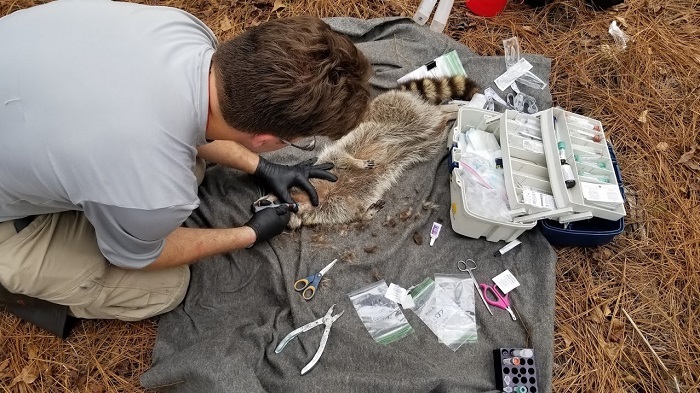 Patrick Ryan, a technician at Savannah River Ecology Laboratory, collects biological samples from a sedated raccoon.
AIKEN, S.C. – Since 2017, the wild lands of the Savannah River Site (SRS) have served as a front line in the U.S. Department of Agriculture’s (USDA) fight to eradicate rabies in the nation.
Researchers at the University of Georgia’s (UGA) Savannah River Ecology Laboratory (SREL) have been conducting studies focused on the elimination of rabies in raccoons in partnership with the National Rabies Management Program operated by USDA’s Animal Plant Health and Inspection Service (APHIS). The research is intended to determine the most efficient method for vaccinating the raccoon population to support the goal of preventing the spread of wildlife rabies.
Olin “Gene” Rhodes, director of SREL and a wildlife ecologist, said the site’s 310-square-mile landscape and its diverse habitats, characteristic of the southeast U.S., are ideal for conducting the research.
“Rabies is classified as a zoonotic disease because it is transmitted from animals to humans. If not quickly treated, it is fatal to humans, and it is a significant issue in the southeastern U.S.,” Rhodes said. “Large areas of federally owned land like the SRS are excellent locations for critical research on zoonotic diseases as they are home to large populations of animals that commonly carry the variants of the rabies virus in the southeastern U.S., like raccoons, skunks, foxes, and bats.”
According to APHIS and the Centers for Disease Control and Prevention, raccoons are the dominant carrier and species of concern for rabies in the region.
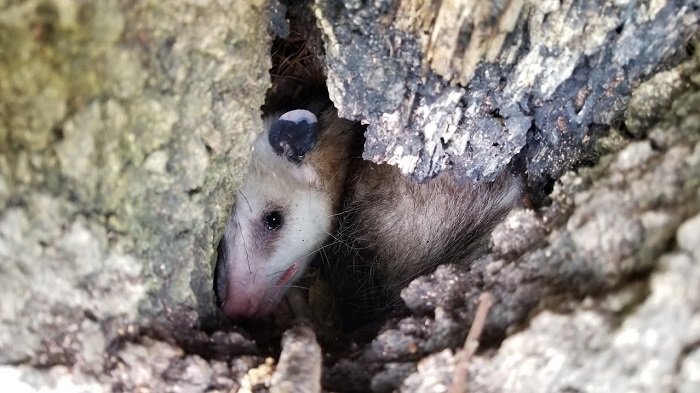 A female Virginia opossum shelters in a tree stump at the Savannah River Site.
Guha Dharmarajan, an assistant research scientist at SREL, supervises graduate students working on the project. He said inoculating raccoon populations in southeastern states requires overcoming an obstacle: opossums.
Opossums, non-carriers of the virus, can be found in the same habitats as the raccoons — bottomland swamps, isolated wetlands, and upland pine. As a result, they often consume the bait intended for raccoons, according to Dharmarajan.
“We are using capture-recapture methods and remote camera surveillance to determine how densities of raccoons and opossums differ among common southeastern habitat types, like those found on the SRS. Using this data, we can improve the efficacy of USDA’s baiting strategy in the region,” he said.
A major component of the research is the cost-effective approach of distributing oral placebo baits in the habitats to determine the percentage of baits eaten by the raccoons as well as the percentage taken by non-target species such as opossums. The results will provide guidance to USDA on the most efficient method to distribute oral vaccines to ensure a high rate of inoculation in the species.
Rhodes said ensuring the health of wild species is vital to ensuring human health, particularly in the case of zoonotic diseases. He also said research data that may be used to combat the spread of the disease is critical to the environmental stewardship goals of DOE and other federal agencies that are large landholders in the U.S.
Through its cooperative agreement with the DOE, UGA has been able to develop facilities, expertise, and capabilities to use the SRS as a testing ground for research focused on solving large-scale issues critical to human health and the control of zoonotic disease in the U.S.
-Contributors: David Bernasconi, Vicky Sutton-Jackson
|