|
Welcome to the new NRIC newsletter. These publications provide our partners and stakeholders with updates on NRIC activities and topics important to the nuclear industry. This newsletter focuses on NRIC's Digital Engineering efforts.
NRIC’s Digital Transformation
Megaprojects - coordinated ventures to build humanity’s most ambitious machines and structures - can provide huge benefits. Complex projects like next-generation aircraft, bridges, tunnels, concert halls and advanced nuclear reactors can improve the way we live, travel and work. But megaprojects also present daunting challenges. Experts estimate that less than one percent of megaprojects finish on time and on budget while meeting expectations. Undetected design errors can cascade into schedule delays during construction, increasing the project cost. Correcting problems early in the design process costs less than addressing them during construction or operations. Leveraging digital engineering tools to find these defects early in the process significantly reduce cost and schedule overruns. At the Idaho National Laboratory, the National Reactor Innovation Center (NRIC) is using digital engineering techniques to help developers of advanced nuclear technologies and other advanced energy systems.
|
|
Why Digital Engineering?
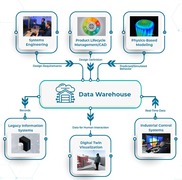
Recently, NRIC deployed several applications to transform how projects produce engineering files and in what format. The IBM Engineering Lifecycle Management DOORS Next was deployed for data-driven requirements management, Innoslate was configured for web-based model-based systems engineering, and Confluence serves as a project wiki to store select documentation, meeting notes and background information. These tools are installed in INL’s Azure for Government cloud subscription to facilitate access from companies outside of the laboratory or federal space. DeepLynx, an open-source, INL-developed data warehouse, connects these tools. The application uses a common schema to organize and relate information sourced from software tools that are not natively designed to communicate with one another. That way, engineers can search the warehouse to discover related data across engineering applications or discipline barriers.
Recently, NRIC has added a product life cycle management (PLM) tool to the mix. In the context of digital engineering, PLM is software central to the collection, organization, management and control of data relating to the design of engineered equipment. The data can take the form of 3D models, engineering drawings, technical reports, presentations, manuals, procedures, work orders, schematics, contracts or even metadata. NRIC deployed PTC Windchill for new reactor demonstrations at INL, serving as the authoritative source of truth for engineering design and engagement. The use of this application is not novel in industries like aviation and defense, but its use as the hub for design information and design review is rarely practiced in the nuclear energy industry. Windchill works in coordination with DeepLynx - while Windchill maintains configuration management of data, DeepLynx routes this data within the ecosystem.
|
 |
The Near Future: A Facility-Scale Informational Digital Twin
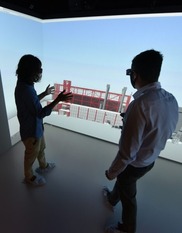
Once information is stored in a central repository and meaningful ties are created between disparate sources, we can use more advanced forms of digital engineering, including informational digital twins. Informational digital twins combine design definition artifacts (CAD, requirements, etc.), analysis and simulation results, and real-time data collected by sensors placed throughout the real-world physical asset to create a comprehensive virtual replica surrounding the as-is state. As a supplement to the digital twin, immersive extended reality (XR) helps designers and operators visualize and interact with physical assets and their data. XR creates an environment where users can collaborate in real time regardless of their physical location, while all accessing the same information. This data consumption mechanism can take a few forms. NRIC has primarily experimented with both internet browser-based interactions, as well as mixed reality headsets such as the Microsoft Hololens.
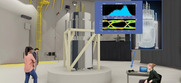
Today, engineers and project managers can enter the Demonstration and Operation of Microreactor Experiments (DOME) test bed at INL’s Materials and Fuels Complex with a headset and see the virtual facility model overlaid on the physical space. DOME will host experimental reactors to help nuclear developers commercialize their designs. Soon, users will also be able to interact with these virtual assets. The model will display information associated with the as-designed object: its name, tag number, construction material and supplier. Connected data from the digital thread - such as requirements from DOORS Next, related schedule activities from Primavera P6, risks from Active Risk Manager (ARM), etc. - will also be retrievable within the same environment. Simulated data derived from analytical models (e.g., Simulink) will be used to demonstrate the ability to merge design definition artifacts with operational data. Once the facility completes construction and moves into the startup phase, the NRIC DE team will stream live data from the DOME control system into the application, completing the informational digital twin and giving facility operators comprehensive data on their equipment.
|
|
Exploring the Integration of the Engineering Design & Analysis Domains
The model-based design group is developing capabilities to improve and automate model data exchange between architectural BIM software (e.g., Revit, AVEVA E3D, ArchiCAD, etc.) and structural analysis software (e.g., SAP2000, ANSYS). The goal is to expedite and automate as much of the pre-processing step for creating analytical models in finite element analysis software as much as possible. This automatic “BIM-to-FEA” conversion tool is being built around the open, non-proprietary data standard (i.e., openBIM) known as Industry Foundation Classes (IFC). The vision is to have the conversion tool be open-sourced for the community and for it to be widely applicable to BIM software that incorporates openBIM functionalities, namely IFC data import and export. Figure 1 shows a typical use case for the BIM-to-FEA conversion tool, going from an architectural Revit model to an analytical model in SAP2000 using the non-proprietary IFC schema as the data exchange pathway.
The BIM-to-FEA conversion tool is being developed for compatibility with typical commercial building designs of steel-framed structures. The tool can import architectural BIM data of framed building structures, recognize and extract the aspects of the model that are required for structural analysis, adjust the connectivity of frame members, and export an analytical model in the IFC format. The exported model can then be imported into various types of OpenBIM compliant software. Such capabilities have already been tested on commercial software and continue to be improved. At the end of the current fiscal year, NRIC plans to (1) showcase a robust and reliable workflow between the commercial software Revit and SAP2000 as a proof-of-concept; (2) develop a user-friendly interface; and (3) incorporate the conversion tool into the DeepLynx data warehouse.
Future development of the tool will include adding the ability for efficient, iterative risk assessment of generative building designs, all within a workflow that uses open-source tools. One such open-source tool will be MOOSE, an advanced, finite element analysis tool developed at INL. The conversion tool will also branch out from typical commercial building designs to incorporate nuclear construction. A future use case will be the Revit model of the DOME project. The aim will be to convert both structural and non-structural components of nuclear facilities, such as curved concrete containment structures and piping systems, respectively.
|
|
|
|
Battelle Energy Alliance manages INL for DOE’s Office of Nuclear Energy. INL is the nation’s center for nuclear energy research and development, and also performs research in each of DOE’s strategic goal areas: energy, national security, science and the environment. |
|
 |
|
INNOVATION CENTRAL
Winter / 2025
|
|
|
|
|
|