Success Stories
Happy Anniversary to the Morrill Act
July 2nd marks the 155th
anniversary of the passage of the Morrill Act, the basis of the
land-grant university system. Signed into law by President Abraham Lincoln on
July 2, 1862, the Morrill Act enabled states to use proceeds from the sale of
the federal "land-grants" to establish colleges in engineering,
agriculture and military science. The land-grant university system
provided the framework to give working class families critical access to higher
education, which it continues to do today.
NIFA celebrates our
partnership with the nation’s land-grant universities (LGUs), which play a
critical role in teaching the next generation of agricultural science
professionals and developing the groundbreaking research to produce our
nation’s food, fuel, and fiber. The success stories you read in this week’s
Fresh from the Field and beyond are the legacy of this groundbreaking
legislation.
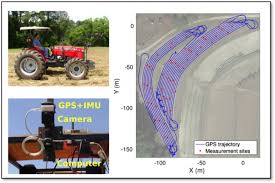
4D innovation in Georgia fields
Traditionally, crop
monitoring has been done manually, which is very labor and cost
intensive. More recent precision agricultural tools such as satellites and
unmanned aerial and ground vehicles have reduced costs, but the amount of
useful information that can be gathered from 2D images and 3D reconstructions
is limited. Thanks to a new research collaboration by the Georgia Institute
of Technology, University of Georgia, and Georgia Tech Research
Institute, farmers may soon have a 4D crop monitoring system at their
fingertips. The team constructs 4D images by compiling a series of 3D images
collected over time. The 4D data can provide farmers with detailed crop
information including plant heights and growth rates. This new method of
autonomously monitoring agricultural crops may lower costs, improve harvest
yields, and ultimately provide more food to people around the world. This
effort was funded by NIFA's Agriculture and Food Research Initiative.
Read more about 4D
research. Image provided by Georgia Institute of Technology.
|
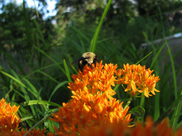 Hot cities spell bad news for bees
As urban temperatures
increase, common wild bee species decline, according to a new study from North
Carolina State University. This study was funded by NIFA's Agriculture Food
Research Initiative (AFRI).
“We looked at 15 of the
most common bee species in southeastern cities and – through fieldwork and lab
work – found that increasing temperatures in urban heat islands will have a
negative effect on almost all of them,” says Steve Frank, an associate
professor of entomology at NC State and co-author of a paper describing the
work.
“What’s exciting is that
we were able to use a relatively easy lab test on individual bees to predict
how whole populations will fare at higher temperatures in urban areas,” says
Elsa Youngsteadt, a research associate at NC State and co-lead author of the
paper. “This is a tool we can use for additional bee species in the future,
giving us insights into how urban warming affects ecosystems.
Read more about NCSU's wild bees. Image provided by Elsa Youngsteadt.
|
 Program develops
individual strengths to create stronger communities
The University of
Connecticut Extension’s People Empowering People (UConn PEP) is a personal
and family development program with a strong community focus. With support from
NIFA, UConn PEP builds upon each person’s strengths to help them grow in
communications, goal setting, problem solving, parent and family relationships,
and community involvement. They also find their voice, share stories, and begin
to believe they can make a difference.
UConn PEP has expanded to
other states, including Michigan, California, Missouri, Massachusetts, Vermont,
and Florida. Connections have been made with professors in South Africa and
Egypt to establish the program in universities in those countries as well.
Read the UConn Pep blog. Image provided by Dr. Cathleen Love with UConn PEP.
|
News Coverage
 Pigweed is no match for DNA testing
Last summer, farmers in
the Midwest got an unwelcome surprise after planting native seed on
Conservation Reserve Program acres: Palmer amaranth (aka Palmer’s pigweed), an
aggressive and hard-to-kill weed that is native to the Southern United States.
Pat Tranel, molecular weed
scientist at the University of Illinois, noted that growers who sell
seeds are in jeopardy due to the spread of this noxious weed.
“Unless they have a way to
certify their product is Palmer-free, they can’t sell it,” Tranel said.
The typical testing method
of testing seed lots (batches of seeds) involves growing a sample of seeds
until the plants are large enough to be identified, but this is a slow and
potentially unreliable process.
Tranel and graduate
student Brent Murphy developed a way around these issues. Their low-cost method
can identify Palmer amaranth DNA from within a mixed sample without having to
grow the plants.
Using this research, the
University of Illinois Extension’s Plant Clinic developed a protocol for
commercial testing of seed lots, and is now offering the service at a low
cost.
This project was made
possible with support from NIFA.
Read the Lancaster Farming coverage. Image provided by Pat Tranel with University of Illinois.
|
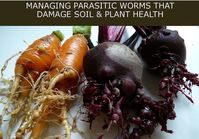 Good and bad worms
To sustain agriculture and
food security, farmers in the Northeastern U.S. need healthy soils. Microscopic
worms, or nematodes, play an important role in soil health. Some nematode
species are parasites, and high population densities can lead to poor soil and
low crop yields. Other nematode species can be beneficial to soil and plants. To
assist farmers, producers, crop advisors, and others interested in learning
more about managing parasitic worms, the Multistate Research Fund, a NIFA initiative to
foster collaboration among universities, has implemented a project to provide simple,
low-cost tools and methods for effectively managing nematodes and protecting
soil health.
Learn more about worms and nematodes. Image provided by Morgan Creek Chronicles.
|
Video
 Organic farms and wild bees
Organic farming promotes
greater biodiversity and ecosystem services compared to conventional farming.
Yet, little is known about which aspects of organic farming help promote native
bee community health and pollination services. A Washington State University project is helping to evaluate these transitions with
support through NIFA’s Organic Transitions
program and Western SARE
(Sustainable Agriculture, Research, and Education). The research and
extension project has collected data from more than 35 farms, investigated habitat
augmentation, and conducted a range of field days, farmer presentations, web
resources, and other tools to help farmers and communities as they transition
to organic farming.
More information is
available in this video. Image provided by Sam Droege at USGS.
|
Tweet of the Week
#NIFAIMPACTS

|