|
|
|
Fresh from the Field is a weekly album showcasing transformative impacts made by grantees funded by the National Institute of Food and Agriculture.
June 22, 2017
|
|
Success Stories
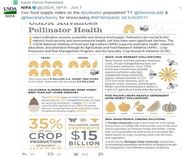 National Pollinator Week is
all the buzz
Pollination is critical to
the production of fruits, vegetables, and nuts. Pollinated crops contribute $15
billion to farm income in the United States. Recent declines in pollinator
populations pose a threat to farm production and U.S. food security.
To help raise awareness of
the perils facing pollinators, Secretary Sonny Perdue declared June 19-25 as
National Pollinator Week at a June 6 event at the Vice President’s
residence in Washington, D.C. Karen Pence, wife of Vice President Mike Pence,
installed a honey bee hive on the grounds of the residence at the event and
encouraged Americans to take similar steps to promote pollinator health. The
event is part of an international celebration of the valuable ecosystem
services provided by pollinators such as bees, birds, butterflies, bats and
beetles.
Between 2008 and 2014,
NIFA invested approximately $42 million in competitive grants on research,
education, and extension programs on bee health. NIFA-funded projects are
helping to understand the causes of pollinator declines and educate growers and
citizens with best practices to foster pollinator populations
Learn more about
NIFA-supported endeavors in this week’s issue of Fresh from the
Field.
|
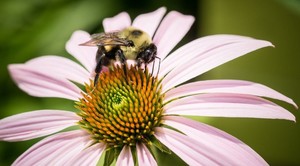 What wild bees need
A new national assessment
estimates that wild bees declined in 23 percent of the contiguous United States
between 2008 and 2013. The team of Project ICP
researchers, led by Insu Koh at the University of Vermont, found that
the decline was generally associated with conversion of natural habitats to row
crops. Areas of intense agriculture (e.g., the Midwest Corn Belt and the Central
Valley of California) have among the lowest levels of predicted wild bee
abundance.
The study, published in
the December issue of Proceedings of the National Academy of Sciences, shows
that 39 percent of the U.S. croplands that depend on pollinators—from apple
orchards to pumpkin patches—face a mismatch between rising demand for
pollination and a falling supply of wild bees. As the acreage of
pollinator-dependent crops expands, the concurrent loss of natural habitat
leads to lower abundance of the wild bees needed to pollinate these crops. To
maintain stability in pollinators, crop pollination, and yields of these crops,
the authors suggest that farmers may need to maintain or enhance habitats for
wild bees on and around their farms or invest more heavily in managed
pollinators.
Read
more in this
ICP blog.
|
 Pollen power
Bumble bees have
discriminating palettes when it comes to their pollen meals, according to
researchers at Penn State. With NIFA's Agriculture and Food Research Initiative funding, the researchers found that bumble bees can detect
the nutritional quality of pollen, and that this ability helps them selectively
forage among plant species to optimize their diets.
"Populations of many
bee species are in decline across the world, and poor nutrition is thought to
be a major factor causing these declines," said Christina Grozinger,
director of the Center for Pollinator Research at Penn State. "Our
studies can help identify plant species and stocks that provide high-quality
nutrition for bumble bees and potentially other bee species, which will help in
the development of pollinator-friendly gardens and planting strips."
According to Anthony Vaudo,
a graduate student in entomology who led the study, scientists previously
believed that bees' preference for flowering plants were driven by floral
traits, such as color, scent, morphology or nectar concentration.
"Here we show that
bumble bees actually choose a plant for the nutritional quality of its
pollen," said Vaudo. "This is important because pollen is bees'
primary source of protein and lipids." "
Read more at Eureka
Alert.
|
News Coverage
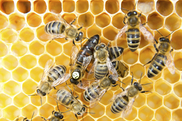 Bee informed about bee health
Beekeepers across the
United States lost 44 percent of their honey bee colonies during the year
spanning April 2015 to April 2016, according to an annual nationwide survey of
commercial and small-scale beekeepers. The survey found that summer losses –
when bees are at their healthiest – rivaled winter loss rates.
This survey was conducted
by the Bee Informed Partnership, which receives a majority of its funding from the NIFA's Agriculture
and Food Research Initiative.
The researchers note that
many factors are contributing to colony losses. A clear culprit is the varroa
mite, a lethal parasite that can easily spread between colonies. Varroa is
a particularly challenging problem among backyard beekeepers (defined as those
who manage fewer than 50 colonies).
"Many backyard beekeepers don't have any varroa control strategies in
place. We think this results in colonies collapsing and spreading mites to
neighboring colonies that are otherwise well-managed for mites," said
Nathalie Steinhauer, a graduate student in the University of Maryland
Department of Entomology who leads the data collection efforts for the annual
survey. "We are seeing more evidence to suggest that good beekeepers who
take the right steps to control mites are losing colonies in this way, through
no fault of their own."
Read more in Bright
Surf.
|
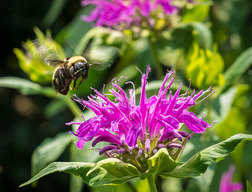 Almonds, wildflowers, bees, oh my!
Some almond growers have
started planting wildflowers on the edges of managed fields as a way to help
bees do their jobs in the face of pollinator pressures. There are, however
concerns that the wildflowers may pull valuable pollination services away from
the almond crops. New research reveals that almond growers can put this
particular concern aside.
The study notes that
planting wildflowers next to almond orchards does not cause fewer honey bees to
visit the orchard. This finding is important because it shows wildflower
plantings can help keep bee populations healthy while also not harming almond
crops.
“The high honey bee
visitation rates to the flower plantings suggest benefits of wildflower
plantings for honey bees,” said Ola Lundin of the University of California,
Davis, one of the researchers and an author on the paper. “Such benefits
may include the ability to support or increase bee population sizes before and
after almond bloom and increased resistance to harmful effects of pesticides
and pathogens through a more diverse diet.”
This research was supported
through a five-year NIFA grant to the Integrated
Crop Pollination project (ICP), funded by NIFA’s Specialty
Crop Research Initiative. Michigan State University (MSU) leads this this collaboration of
scientists from 10 universities and other public and private partners to
develop sustainable pollination strategies and offer resources and education
for growers and consumers.
Read
more in Entomology
Today.
|
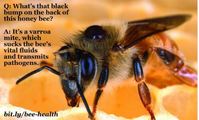 A multistate hive mind of
research
Bees provide essential
pollination for many of the nut, berry, fruit, vegetable, and seed crops grown
in the U.S. To supplement wild bee pollination, farmers often rent managed
honey bee colonies. Demand is skyrocketing, but catastrophic die-offs are
threatening the supply of healthy honey bee colonies. Parasitic mites,
pathogens, pesticide chemicals, nutritional deficits, and environmental
conditions have contributed to the decline of honey bees. With NIFA's Multistate Research Fund, researchers
at the University of Arkansas collaborate with twenty other institutions to
seek solutions.
Extension specialists and
educators are sharing information with beekeepers, farmers, home gardeners,
regulatory agencies, and others. Beekeepers following research-based
recommendations have saved an estimated 10,500 honey bee colonies, which provide
a value of over $5,750,000 each year they are used to pollinate crops.
Read more about protecting
pollinators.
|
Video
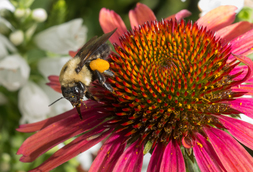 Busy bee researchers in Minnesota
There
are almost 20,000 known species of bees in the world. About 3,500 live in the United States and an
estimated 400 native bee species find their home in Minnesota. For nearly 100 years, the University of Minnesota has conducted
research on bees. The university has even hired faculty specializing in native
bees. University researchers remain committed to finding ways to organically
assist bee colonies and native bees. In this video, entomologist Marla Spivak
discusses how U of M researchers are working to address the changing needs of
bees in Minnesota.
This research was supported by NIFA's Agriculture and Food Research Initiative.
Watch the video about
University of Minnesota pollinator
research.
|
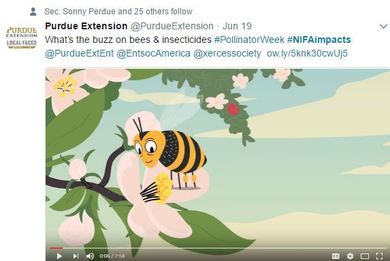
Tweet of the Week
#NIFAIMPACTS
|
|

For more NIFA Impacts, visit nifa.usda.gov/impacts or the Land-Grant University Impacts website. Send us your NIFA-funded impacts at impactstories@nifa.usda.gov or share them on Twitter @USDA_NIFA, #NIFAimpacts.
NIFA invests in and advances agricultural research, education, and extension and promotes transformative discoveries that solve societal challenges.
Fresh from the Field is a weekly compendium of news and information that may be of interest to land-grant and non-land-grant universities, NIFA stakeholders, and other subscribers.
Editor: Falita Liles, Co Editor: Carlos Harris
|
|
|
|