New Census Bureau Population Estimates Reveal Metro Areas and Counties that Propelled Growth in Florida and the Nation
RELEASED: THURSDAY, MARCH 26, 2015
New Census Bureau Population Estimates Reveal Metro Areas and Counties that Propelled Growth in Florida and the Nation
The Villages, Fla.,
Nation’s Fastest-Growing Metro Area for Second Year in a Row
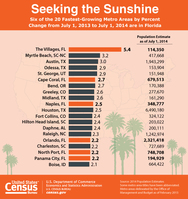
Florida was home to the nation’s fastest growing metro area
from 2013 to 2014, according to new U.S. Census Bureau metropolitan statistical
area, micropolitan statistical area and county population estimates released
today.
The Villages, located to the west of the Orlando metro area,
grew by 5.4 percent between July 1, 2013, and July 1, 2014, to reach a
population of about 114,000. State population estimates released in
December revealed that Florida had become the nation’s third most populous
state. Today’s estimates show Florida’s growth to reach this milestone was
propelled by numerous metro areas and counties within the state.
Florida contained seven of the nation’s top 50 numerically
gaining metro areas between July 1, 2013, and July 1, 2014, and these areas
accounted for more than three-quarters of the state’s population gain over the
period:
·Miami-Fort Lauderdale-West Palm Beach (with a one-year gain of
about 66,000).
·Orlando-Kissimmee-Sanford (about 50,000).
·Tampa-St. Petersburg-Clearwater (about 41,000).
·Jacksonville (about 23,000).
·Cape Coral-Fort Myers (about 18,000).
·North Port-Sarasota-Bradenton (about 16,000).
·Lakeland-Winter Haven (about 11,000).
In
addition, eight counties within these metro areas were among 50 counties
nationwide that gained the most population between 2013 and 2014. Collectively, these counties accounted for
more than half of the state’s population gain over the period:
·All three counties in the Miami-Fort
Lauderdale-West Palm Beach metro area: Broward (with a population gain of about
24,000 over the period), Palm Beach (about 22,000) and Miami-Dade (about
21,000).
·Two counties in the
Orlando-Kissimmee-Sanford metro area: Orange (about 26,000) and Osceola (about
11,000).
·One county in the Tampa-St.
Petersburg-Clearwater metro area: Hillsborough (about 22,000).
·The single counties that comprise the
Cape Coral-Fort Myers and Lakeland-Winter Haven metro areas: Lee (18,000) and
Polk (11,000), respectively.
Furthermore, six metro areas in Florida were among
the 20 fastest-growing in the nation between 2013 and 2014. In addition to The
Villages, they were Cape Coral-Fort
Myers (sixth), Naples-Immokalee-Marco Island (10th), Orlando-Kissimmee-Sanford
(16th), North Port-Sarasota-Bradenton (18th) and Panama City (19th).
“Florida’s
ascension, revealed when the 2014 state population estimates were released last
December, was a significant demographic milestone for our country,” Census
Bureau Director John H. Thompson said. “These county and metro area estimates
provide a more detailed picture of how this happened, showing growth in areas
such as central and southern Florida.”
Migration
to Florida from other states and abroad was heavy enough to overcome the fact
that in about half the state’s counties, there were more deaths than births
over the 2013 to 2014 period.
Lone Star
State’s Notable Growth
There were two states — Texas (with 11) and
California (with 10) — with even more counties than Florida on the list of the
top 50 numerical gainers. Two Texas metro areas — Houston-The Woodlands-Sugar
Land and Dallas-Fort Worth-Arlington — were the only ones in the country to add
more than 100,000 residents over the 2013-2014 period. Within the Houston metro
area, Harris County alone gained almost 89,000 people, more than any other
county in the nation. The Lone Star State also had four metro areas among the
nation’s 20 fastest growing by rate of change: Austin-Round Rock (third),
Odessa (fourth), Midland (ninth) and Houston (11th).
With a population increase of 8.7 percent from July 1, 2013,
to July 1, 2014, Williams, N.D., remained the nation’s fastest-growing county
(among counties with populations of 10,000 or more in 2013), although its growth
slowed from the previous one-year period. Following Williams on the list
were Stark, N.D. (7.0 percent), whose growth accelerated from the previous year;
Sumter, Fla. (5.4 percent); Pickens, Ala. (5.1 percent); and Hays, Texas (4.8
percent).
Other findings:
Counties
·Los
Angeles, Calif., is still the nation’s most populous county with a July 1, 2014,
population surpassing 10.1 million.
·Between
2013 and 2014, North Carolina became the ninth-most populous state (up from
10th). Its growth was fueled by two counties that were among the 50 top
numerical gainers: Wake (Raleigh), which added about 24,000 people over the
period, and Mecklenburg (Charlotte), which grew by about 20,000.
·Although
New York fell out of third place in state population between 2013 and 2014, it
did have three counties among the top 50 numerical gainers. Each was a New York
City borough: Kings (Brooklyn), which added about 19,000; Queens, which gained
about 18,000; and Bronx (with an increase of about 11,000).
·Among
the largest counties (those with total populations of 250,000 or more in 2013),
the three fastest growing were in Texas: Fort Bend, Montgomery and Williamson.
Each grew by at least 3.8 percent over the period.
·Among
very small counties, Sterling, Texas, was the fastest growing of those with a
population of fewer than 5,000 people in 2013 (8.9 percent growth). Among those
in the 5,000-9,999 population range, McKenzie, N.D., led in rate of growth
(18.3 percent).
·The
fastest-losing county between July 1, 2013, and July 1, 2014 (among counties
with 2013 populations of 10,000 or more) was Chattahoochee, Ga., which declined
by 4.2 percent. Hale, Texas (-3.0 percent) and Colfax, N.M. (-2.9 percent)
followed.
·Wayne,
Mich. (Detroit) remains the county with the largest numeric decline, by far, at
just less than 11,000. The next largest decline belonged to Cuyahoga, Ohio
(Cleveland) at slightly more than 4,000.
Metro
areas
·The
Carolinas were home to four of the nation’s 20 fastest-growing metro areas
between 2013 and 2014: Myrtle Beach-Conway-North Myrtle Beach, S.C.-N.C.
(second); Hilton Head Island-Bluffton-Beaufort, S.C. (13th); Raleigh, N.C.
(15th); and Charleston-North Charleston, S.C. (17th).
·The
nation’s metro areas contained about 272.7 million people in 2014, an increase
of about 2.4 million from 2013.
·Bismarck,
N.D., was the fastest-growing metro area outside of the South or West between
2013 and 2014 (22nd overall).
·Overall,
298 of the 381 metro areas in the United States gained population between 2013
and 2014.
·There
were 53 metro areas with 2014 populations of 1 million or more. New York was
the nation’s largest metro area in 2014, with about 20.1 million people.
·The
Tucson, Ariz., metro area surpassed the 1 million population threshold between
2013 and 2014.
Micro
areas
·The
nation’s micro areas contained about 27.2 million people in 2014, an increase
of about 13,000 from 2013.
·The
two fastest-growing micro areas between 2013 and 2014 were in North Dakota:
Williston and Dickinson.
·Two
Utah micro areas, Heber and Vernal, also were among the top-five fastest
growing between 2013 and 2014.
·Overall,
fewer than half (244 out of 536) of the U.S. micro areas gained population
between 2013 and 2014.
Puerto
Rico
·San
Juan continued to be the most populous municipio (which are similar to
counties), with 365,575 residents on July 1, 2014, followed by Baymón with
194,210 and Carolina with 165,820 residents.
·Gurabo
had the largest numerical increase of any municipio between July 1, 2013, and
July 1, 2014, gaining about 246 residents.
·Four
municipios experienced growth in their populations between July 1, 2013, and
July 1, 2014: Gurabo (0.52 percent growth), Barceloneta (0.08 percent growth),
Culebra (0.06 percent growth) and Toa Alta (0.01 percent growth). The remainder
experienced a population decline over the period.
·Each
of Puerto Rico’s seven metro areas and five micro areas declined in population
between 2013 and 2014.
In the coming months, the Census
Bureau will release 2014 population estimates of cities and towns, as well as
national, state and county population estimates by age, sex, race and Hispanic
origin.
-X-
The Census
Bureau develops county, metro area, and micro area population estimates by
measuring population change since the most recent census. The Census Bureau
uses births, deaths, administrative records and survey data to develop
estimates of population. For more detail regarding the methodology, see <http://www.census.gov/popest/methodology/>.
The Office of Management and Budget’s
statistical area delineations (for metro and micro areas) are those issued by
that agency in February 2013. Metro areas contain at least one urbanized area
of 50,000 or more population and micro areas contain at least one urban cluster
of at least 10,000 (but less than 50,000) population. Both metro and micro
areas consist of one or more whole counties or county equivalents. Some metro
and micro area titles are abbreviated in the text of the news release. Full
titles are shown in the tables.