U.S. Mover Rate Remains Stable at About 12 Percent Since 2008, Census Bureau Reports
FOR IMMEDIATE RELEASE: WEDNESDAY, MARCH 18, 2015
U.S. Mover Rate Remains Stable at About 12 Percent Since 2008, Census Bureau Reports
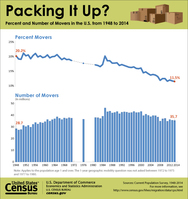
For the past several years, the mover rate has remained between 11.5
and 12.5 percent, according to new 2014 statistics released today from the U.S.
Census Bureau. The mover rate between 2013 and 2014
was 11.5 percent or 35.7 million people age 1 year and over.
“When the Current
Population Survey started collecting migration information in 1948, about one-in-five
people moved over a one-year period,” said David Ihrke, a demographer
with the Census Bureau’s Journey-to-Work and Migration Statistics Branch. “Today, that number has fallen to about one
in nine.”
This information comes from Geographical
Mobility: 2013 to 2014, a collection of national- and regional-level tables
from the Annual Social and Economic Supplement of the Current Population
Survey. The tables describe the movement of people in the United States,
including type of move, reason for moving and characteristics of those who
moved one year earlier. Distance moved is also
available for people who moved to a different county or state.
Between 2013 and 2014:
·Movement to the
suburbs continued:
The suburbs had a net gain of 2.2 million movers, while principal cities had a
net loss of 1.7 million.
·Renters
continued to move at high rates: 24.5 percent of all people living in
renter-occupied housing units lived elsewhere one-year prior. The mover rate of
all people living in owner-occupied housing units was 5.0 percent.
·New job or job
transfer
was the highest job-related reason for moving at 9.7 percent.
Young Adult Migration
In addition to the
statistics released today from the Current Population Survey, the Census Bureau
also released an American Community Survey report titled Young
Adult Migration: 2007-2009 to 2010-2012, which looks at 18 to 34-year-olds
who moved.
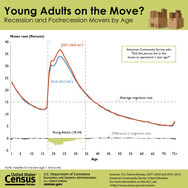
The report shows that the migration of young adults declined 1.4
percentage points during the postrecession period. While young adults are still the largest migrant group,
much of the decline in migration at the national level between 2006 and 2009
has been because of the decline in the movement of this age group, according to
the ACS.
“The two releases and surveys conducted by the Census Bureau provide a
detailed picture of migration in the United States,” said Megan Benetsky, an
analyst with the Census Bureau’s Journey-to-Work and Migration Statistics
Branch and one of the report’s authors. “Migration statistics from the Current
Population Survey give us a national view, while the American Community Survey
allows us to focus on smaller geographies and more specifically provides the
only detailed information available on small population groups, like young
adults, at lower levels of geography.”
The American Community Survey report describes the demographic and
socio-economic status of movers ages 18 to 34 using data collected from 2007 to
2009 and from 2010 to 2012.
During the postrecession period:
·The migration rate of adults ages 18-34
declined by 1.4 percentage points, while the rate for older adults stayed
relatively steady.
·Females 18 to 24 years old had a higher
rate of migration than males of the same age (32.4 percent compared with 29.8
percent), but among 25- to 29-year-olds and 30- to 34-year-olds, the pattern
reversed, and males were more likely to migrate than females (29.5 percent
compared with 28.6 percent, and 22.5 percent compared with 20.4 percent,
respectively).
·Non-Hispanics were more likely to
migrate than Hispanics. This is especially apparent in the 18- to 24-year-old
age group, where 32.9 percent of non-Hispanics migrated in the last year
compared with 24.2 percent of Hispanics.
·Employed individuals were least likely
to move. Compared with other young adults, those age 30 to 34 who were employed
had the lowest migration rate (20.1 percent).
The
report provides additional detail about young adult migration for metropolitan
areas, which can be accessed via census.gov.
-X-
Data in this report
are subject to sampling variability as well as nonsampling errors. Sources of
nonsampling errors include errors of response, nonreporting and coverage.