Income
in Puerto Rico Holds Steady After Recession
Puerto Rico Community Survey Releases Statistics on Education,
Jobs and 40 More Topics
Statistics released
today from the U.S. Census Bureau’s Puerto Rico Community Survey show that the
median household income for Puerto Rico and most of its 10 largest municipios
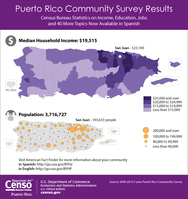
held steady after the most recent recession. Puerto Rico’s median household
income was $19,518 during the post-recession period of 2010 to 2012,
statistically unchanged from 2007 to 2009.
Among the island’s
10 largest municipios, only three showed statistical differences — all
decreases — between the recession period of 2007-2009 and the post-recession
period of 2010-2012. The
median household income (in 2012 inflation-adjusted dollars) in the San Juan
Municipio decreased from $24,565 during the recession to $22,734
post-recession, the Bayamón Municipio decreased from $26,760 to $23,848, and
the Ponce Municipio decreased from $18,204 to $16,930.
The Puerto Rico
Community Survey provides annual statistics on more than 40 topics, such as
education, occupation, language, ancestry and housing costs, for every
community in Puerto Rico on its interactive American FactFinder tool. The Puerto Rico Community Survey is
similar to the American Community Survey, which can show statistics for Puerto
Ricans living elsewhere in the U.S. For
example, Puerto Ricans in the New York metro area — which has the most Puerto
Ricans of any metro area in the U.S. — had a median household income of
$36,613.
“The Puerto Rico
Community Survey is unique in that it gives detailed information for small
geographic areas every year,” said Mario Marazzi, executive director of the
Puerto Rico Institute of Statistics. “This information is used by researchers,
students and private companies in their work and by the government to disperse
federal funding to Puerto Rico.”
Among topics
available with today’s release, the Puerto Rico Community Survey shows the
variation in education levels and labor force participation across the island
using data collected from 2010 to 2012:
Median Household Income
·In Guaynabo Municipio, the household
income was $33,848, among the highest for the island’s municipios. Lares
Municipio had one of the lowest median household incomes with $11,353.
·In the San Juan-Caguas-Guaynabo metro
area, the household income was $21,611, among the highest for the island’s
metro areas. The Yauco metro area had one of the lowest household incomes with
$15,070.
Labor Force Participation
·In Puerto Rico, 46.1 percent of the
population 16 and older was in the labor force.
·In Guaynabo, 57.7 percent of the
population was in the labor force. This rate was among the highest for the
island’s municipios. Lajas Municipio had one of the lowest labor force
participation rates at 25.7 percent.
·In the Fajardo metro area,49.2 percent of the population
was in the labor force. This rate was among the highest for the island’s metro
areas. The San Germán-Cabo Rojo metro area had one of the lowest labor force
participation rates at 33.3 percent.
Educational Attainment
·In Puerto Rico, 23.2 percent of the
population 25 and older had a bachelor’s degree or higher.
·In Guaynabo, 43.7 percent of the
population had a bachelor’s degree or higher. This rate was among the highest
for the island’s municipios. Lajas Municipio had one of the lowest rates at
11.6 percent.
·In the San Juan-Caguas-Guaynabo metro
area, 25.0 percent of the population had a bachelor’s degree or higher. This
rate was among the highest for the island’s metro areas. The Yauco metro area
had one of the lowest rates at 16.6 percent.
School Enrollment
·In Puerto Rico, 66.5 percent of the
population 3 and older enrolled in school were in kindergarten to 12th grade.
Among them, 77.1 percent were enrolled in public school, while 22.9 percent
were enrolled in private school.
·Comerío Municipio had among the highest
rates of kindergarten to 12th grade students enrolled in public school at 97.5
percent and Guaynabo Municipio had among the lowest at 50.6 percent.
·The Yauco metro area had among the
highest rates of kindergarten to 12th grade students enrolled in public school
at 91.7 percent and the San Juan-Caguas-Guaynabo metro area had among the
lowest at 74.1 percent.
Puerto Ricans Living in the U.S.
The American
Community Survey also has statistics regarding Puerto Ricans living in the
United States. For example:
·For Puerto Ricans living in the Miami
metro area, the household income was $47,516. In the Chicago metro area, the
median household income was $43,067 and in the Orlando metro area the median
household income was $37,262. The income for the Orlando and New York areas
were not statistically different from each other.
·For Puerto Ricans living in the Miami
metro area, 67.7 percent were in the labor force, compared with 64.7 percent in
the Chicago metro area and 64.2 percent in the New Haven, Conn., metro area.The rates for the Chicago and New Haven areas
were not statistically different from each other.
·For Puerto Ricans living in the Miami
metro area, 22.2 percent had a bachelor’s degree or higher, compared with 18.3
percent in the Orlando metro area and 16.2 percent in the Tampa metro area. The
rates for the Orlando and Tampa areas were not statistically different from the
rate for the Yauco metro area, and the rates for Puerto Rico and the Miami
metro area were not statistically different from each other.
·Three-year
statistics derived from data collected from 2010 to 2012 for
geographic areas with populations of 20,000 or more.
·Five-year
statistics covering 2008-2012 for all areas regardless of
population size.
Additionally, Census Explorer, a new interactive mapping tool, paints a
portrait of how neighborhoods within Puerto Rico have changed over the past two
decades.
About the Puerto Rico Community Survey
The
Puerto Rico Community Survey provides a wide range of important statistics
about all communities in the island. The Puerto Rico Community Survey gives
communities the current information they need to plan investments and services.
Retailers, homebuilders, police departments, and city planners are among the
many private- and public-sector decision makers who count on these annual
results.
The
survey is the only source of local statistics with popular topics that covers
educational attainment, housing, employment, commuting, veteran status, health
insurance and selected monthly homeowner costs. With this release, the
statistics are now available in Spanish. They were previously released in
English.
More information
about Puerto Rico and the nation’s social, economic and housing characteristics can be found on the Census Bureau’s American
FactFinder website.