About Three in Four Parents Living with Children are
Married,Census Bureau
Reports
The
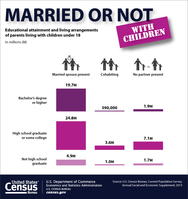
U.S. Census Bureau reports that 76 percent of American parents living with
children under 18 are married. Another 16 percent have no partner present, and
8 percent cohabit with a partner.
Among parents living with an unmarried
partner, two-thirds (66 percent) share a biological child with their partner.
This
information comes from America’s Families
and Living Arrangements: 2013, tabulations released today using data
from the 2013 Annual Social and Economic Supplement to the Current Population
Survey. The table package provides a
current portrait of the composition of families and households and shows
historical changes in living arrangements in the United States. New this
year is a table that profiles American parents living with their children.
The
table shows that living arrangements are different for mothers than for
fathers. Fathers living with their children are much more likely to have a
spouse present (86 percent) than mothers (67 percent), while 25 percent of
mothers with children under 18 have no partner present, compared with only 6
percent of fathers.
“Mothers are more likely than fathers to be raising a child without a
partner present and fathers are less likely to live with their children,” said
Jamie Lewis, a demographer with the Census Bureau’s Fertility and Family
Statistics Branch. In 2013, 36.6 million mothers and 28.7 million fathers resided with children
under 18. This includes both married and unmarried parents.
Other
highlights:
Sixty-six percent of households in 2013 were
family households, compared with 81 percent in 1970. Family households include
two or more people (one of which is the householder) living under the same roof
related by blood, marriage or adoption; it does not have to include anyone who
is married.
Between 1970 and 2013, the share of
households that were married couples with children decreased by about half from
40 to 19 percent; the proportion of married couples without children dipped
slightly, from 30 to 29 percent.
The proportion of one-person households
increased by 10 percentage points between 1970 and 2013, from 17 percent to 27
percent.
Between 1970 and 2013, the average number of
people per household declined from 3.1 to 2.5. During the same period, the
average number of children per family decreased from 1.3 to 0.9.
The
median age at first marriage in 2013 was 29.0 for men and 26.6 for women, up
from 23.2 for men and 20.8 for women in 1970.
In 2013, 48 percent of children living with a
mother only, had a never-married mother, up from 7 percent in 1970.
Seven percent of American households are
maintained by a cohabiting couple. More than one-third (37 percent) of
cohabiting-couple households contain children under 18.
Most children under 18 (64 percent) live with
married parents; 96 percent of children under 18 live with at least one parent.
Black (55 percent) and Hispanic children (31
percent) are more likely to live with one parent than non-Hispanic white (20
percent) or Asian children (13 percent).
Children living with neither parent (47
percent) or with a mother only (45 percent) are most likely to be below
poverty, followed by those living with a father only (21 percent), and those
living with two parents (13 percent). The estimates for children living with
neither parent and those with a mother only are not significantly different.
Of
the 73.9 million children in the United States in 2013, approximately 7.1
million (10
percent) lived with a grandparent. Of children living with a grandparent, 20
percent did not have a parent present.
Forty
percent of married parents with children under 18 had at least a bachelor’s
degree.
The latest Annual Social and Economic
Supplement to the Current Population Survey was conducted in February, March
and April of 2013 from a nationwide sample of about 100,000 addresses.
Statistics from surveys are subject to sampling and nonsampling error. For more
information on the source of the data and accuracy of the estimates, including
standard errors and confidence intervals, see Appendix G at <http://www.census.gov/prod/techdoc/cps/cpsmar13.pdf>.