PROFILE AMERICA
FACTS FOR FEATURES: CB17-FF.11
JULY 19, 2017 (RESEND)
On July 26, 1990, President George
H.W. Bush signed into law the Americans with Disabilities Act, which prohibits
discrimination against people with disabilities in employment, transportation,
public accommodations, commercial facilities, telecommunications, and state and
local government services.
This Facts for Features provides a demographic snapshot of
the U.S. population with a disability and examines various services available
to them. The statistics come from various Census Bureau censuses and surveys,
covering differing periods of time.
Population Distribution
56.7 million
The
number of people in the United States with a disability in 2010, representing
19.0 percent of the civilian noninstitutionalized population. People with a
disability have a physical or mental impairment that affects one or more major
life activities, such as walking, bathing, dressing, eating, preparing meals,
doing errands alone or doing housework. A disability can occur at birth or at
any point in a person’s life. Source: Americans With Disabilities: 2010
www.census.gov/content/dam/Census/library/publications/2012/demo/p70-131.pdfht
15.7
million
The number of people age 65 and older with at least one
disability, according to data collected from 2008 to 2012, which makes up 39.0
percent of the population in this age group. Of this group, two-thirds had
difficulty in walking or climbing stairs. The second-most cited disability was
difficulty with independent living, such as visiting a doctor’s office or
shopping. Source: Older Americans With a Disability: 2008-2012
www.census.gov/content/dam/Census/library/publications/2014/acs/acs-29.pdf
19.4%
The percentage of the civilian
noninstitutionalized population in West Virginia in 2015 with a disability —
the highest rate of any state in the nation. Utah, at 9.9 percent, had the
lowest rate. Source: 2015 American Community Survey, Table S1810
http://factfinder.census.gov/bkmk/table/1.0/en/ACS/15_1YR/GCT1810.US01PR
28.7%
The percentage of the
civilian noninstitutionalized population in Pike County, Ky., in 2015 with a
disability — among the highest rate in the nation for counties with populations
of 65,000 or more. Kendall County, Ill., at 4.9 percent, had among the lowest
rate. Source: 2015 American Community
Survey, Table S1810 http://factfinder.census.gov/bkmk/table/1.0/en/ACS/15_1YR/GCT1810.US05PR
22.4%
The percentage of the
civilian noninstitutionalized population in Flint, Mich., in 2015 with a
disability — among the highest rate in the nation among places with populations
of 65,000 or more. Fishers, Ind., at 3.5 percent, had among the lowest rate. A
place is a city, town, village or borough, either legally incorporated or not. Source: 2015 American
Community Survey, Table GCT1810 http://factfinder.census.gov/bkmk/table/1.0/en/ACS/15_1YR/GCT1810.US13PR
Services
for Those With Disabilities
2,833
The number of business
establishments providing special needs transportation in 2012, up 20.7 percent from 2,347
in 2007. Such businesses may use
specially equipped vehicles to provide passenger transportation. These
businesses employed 61,605 people in 2012 and generated revenues of $3.5
billion. Employment was up 24.0 percent and revenues increased 27.7 percent
since 2007. Source: 2012 and 2007
Comparative Economic Census Geographic Area Series (NAICS
485991) http://factfinder.census.gov/bkmk/table/1.0/en/ECN/2012_US/48A2//naics~485991
14,060
The number of business
establishments that provided pet care (except veterinary services) in 2012.
These businesses generated revenues of $3.4 billion. Among these businesses are
those that train assistance dogs. Source: 2012 and 2007
Comparative Economic Census Geographic Area Series (NAICS
812910) http://factfinder.census.gov/bkmk/table/1.0/en/ECN/2012_US/81A2//naics~812910
25,964
The number of business
establishments primarily providing services for the elderly and persons with
disabilities in 2012. These establishments provided for the welfare of these
individuals in such areas as day care, nonmedical home care or homemaker
services, social activities, group support and companionship. These businesses
employed 901,359 workers and generated $34.1 billion in revenues. In 2015, these
businesses generated $40.7 billion in revenues. Sources:
2012 Comparative-Economic
Census Geographic Area Series (NAICS
624120)
http://factfinder.census.gov/bkmk/table/1.0/en/ECN/2012_US/62A2//naics~62412
2015
Service Annual Survey (NAICS
624120)
www.census.gov/services/index.html, Table 2
7,832
The number of business
establishments providing vocational rehabilitation services in 2012. These
businesses employed 312,659 people and generated revenues of $12.4 billion. In
2007, there were 7,631 such establishments, employing 303,713 people and
producing revenues of $11.5 billion. These businesses provide job counseling, job training and work experience to people
with disabilities. Source: 2012 and 2007
Comparative Economic Census Geographic Area Series (NAICS
624310)
http://factfinder.census.gov/bkmk/table/1.0/en/ECN/2012_US/62A2//naics~624310
2,344
The number of business
establishments providing translation and interpretation services in 2012. These
businesses employed 24,926 people and generated revenues of $4.2 billion. In
2007, there were 1,975 such establishments, employing 14,546 people and
producing revenues of $1.9 billion. Among these businesses are those that
provide sign language services. Source: 2012 and 2007
Comparative Economic Census Geographic Area Series (NAICS
541930) http://factfinder.census.gov/bkmk/table/1.0/en/ECN/2012_US/54A2//naics~541930
3,597
The number of business
establishments providing home health equipment rental in 2012, down 4.4 percent
from 3,762 in 2007. Such businesses
rent home-type health and invalid equipment, such as wheelchairs, hospital
beds, oxygen tanks, etc. These businesses employed 33,935 people in 2012
and generated revenues of $5.4 billion. Employment was up 2.8 percent while
revenues decreased 7.8 percent since 2007. Source: 2012 and 2007
Comparative Economic Census Geographic Area Series (NAICS
532291) http://factfinder.census.gov/bkmk/table/1.0/en/ECN/2012_US/53A2//naics~532291
Specific Disabilities
Note: All statistics in this section come from the 2015 American
Community Survey, measuring the civilian noninstitutionalized population. http://factfinder.census.gov/bkmk/table/1.0/en/ACS/15_1YR/S1810
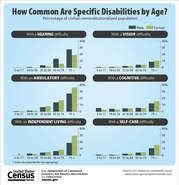
10.8
million
The number of people age 18 and older in 2015 who reported
being deaf or having significant difficulty hearing. Among the population age 65
and older, 6.9 million reported being deaf or having significant difficulty
hearing.
6.8 million
The number of people
age 18 and older in 2015 who had serious difficulty seeing even when wearing
glasses. Among people age 65 and older, 3.0 million had
serious difficulty seeing.
20.6
million
The number of people age 18 and older in 2015 who had serious
difficulty walking or climbing stairs. Among people age 65 and older, 10.5
million had serious difficulty walking or climbing stairs.
12.9
million
The number of people age 18 and older in 2015 who had
serious difficulty concentrating, remembering or making decisions due to a
physical, mental or emotional condition. Among people age 65 and older, 4.2
million had serious difficulty concentrating, remembering or making decisions.
14.2 million
The number of people age 18 and older in 2015
who had difficulty doing errands alone, such as visiting a doctor’s office or
shopping, due to a physical, mental or
emotional condition. Among
people age 65 and older, 6.9 million had difficulty doing errands alone.
7.5
million
The number of people age 18 and older in 2015 who had
difficulty dressing or bathing. Among people age 65 and older, 3.8 million had
difficulty dressing or bathing.
Older
People With a Disability
Note: The source for this section is Older
Americans With a Disability: 2008-2012, which presents
statistics from the 2008-2012 American Community Survey.
25.4%
The percentage of the population age 85 and older with a
disability among the population age 65 and older.
More
Than One-Third
The proportion of people age 85 and older with a disability
who lived alone, is about one-fourth of those aged 65 to 74.
54.4%
The percentage of the older population who had not
graduated from high school and had a disability, twice the rate of those with a
bachelor’s degree or higher (26.0 percent).
12.6%
The percentage of older Americans living in a household
with a disability living in poverty, compared with 7.2 percent of the older
household population without a disability.
Earnings
$21,572
The median earnings in
the past 12 months for people with a disability. This is 69.0 percent of the
median earnings, $31,872, for those without a disability. (Both figures pertain
to the civilian, noninstitutionalized population age 16 and older, with
earnings in the past 12 months.) Source: 2015 American
Community Survey, Table B18140 http://factfinder.census.gov/bkmk/table/1.0/en/ACS/15_1YR/B18140
Mobility
Note: The source for the
statistics in this section is Desire
to Move and Residential Mobility: 2010-2011, which
come from the Survey
of Income and Program Participation.
12.5%
The percentage of
householders with a disability who desired to move to another residence, higher
than the corresponding figure of 8.2 percent for those without a disability.
Those with mental disabilities were the most likely to desire to move (20.6
percent).
17.3%
The percentage of
householders with a disability who desired to move to another residence and
actually did so over a one-year period.
9.3%
The percentage of all
householders with a disability who moved to another residence over a one-year
period.
The following is a list of observances typically covered by
the Census Bureau’s Facts for Features series:
|