NEWS
RELEASE: CB16-54
America’s 65-and-over population is projected to nearly double
over the next three decades, ballooning from 48 million to 88 million by 2050.
However, the U.S. Census Bureau projects the U.S. population will age at a
slower rate compared with other countries.
Worldwide, the 65-and-over population will more than double to 1.6
billion by 2050, according to An
Aging World: 2015. This new report from the Census Bureau examines the
continuing global aging trend and projected growth of the population age 65 and
over, with an emphasis on the differences among world regions.
In 2015, 14.9 percent of the U.S. population was 65 or over.
“The United States was
the 48th oldest country out of 228 countries and areas in the world in 2015,”
said Wan He, a demographer on population aging research at the Census Bureau.
“Baby boomers began reaching age 65 in 2011 and by 2050 the older share of the
U.S. population will increase to 22.1 percent. However, the U.S. will fall to
85th because of the more rapid pace of aging in many Asian and Latin American
countries.”
Japan is the current oldest country in the world
and will retain that position in 2050.
“However, South Korea,
Hong Kong and Taiwan are projected to overtake Germany, Italy and Greece for
second, third and fourth place by 2050,” He said.
Some countries, including China, India, Indonesia,
Brazil, Colombia and Cuba, will experience a quadrupling of their oldest-old
population, those 80 and over, from 2015 to 2050.
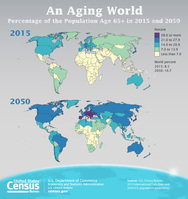
While Europe is still the oldest region today and
is projected to remain so by 2050, aging in Asia and Latin America has
accelerated in recent decades. Asia is also notable for leading the world in
the size of the older population with 341 million people 65 and older. On the
other hand, Africa remained young in 2015, where only 3.5 percent of the total
population was 65 and over.
Other highlights:
Employment
·
Labor
force participation among the older population continues to rise in many
developed countries, yet remains highest in low-income countries.
·
The last recession had a major impact on unemployment rates and
financial assets among many older people in more developed countries. However,
the trend of rising labor force participation rates among the population age 60
and older in these countries was not halted.
Retirement
·
Eligible
ages to receive pension benefits vary widely across countries,
yet tend to lump at particular ages, such as 60 and 65.
·
A number of European countries and the United States are gradually
increasing their age eligible to receive a full public
pension to 67.
·
More
than 90 percent of the older population receives a pension in more developed
countries, such as Japan, the United States, Australia and Italy.
·
In
contrast, public pensions cover less than a third of the older population in
China and a 10th of those in India, the two countries with a total population
of more than a billion each.
·
Public
pensions can drastically lower poverty rates for the older population. In Latin
America and Caribbean countries, for instance, the average poverty rate of
those receiving a pension is 5.3 percent, one-fifth of the average poverty rate
of those not receiving pensions (25.8 percent).
Life
expectancy and health
·
Global
life expectancy at birth was 68.6 years in 2015 and is projected to rise to 76.2 years in 2050.
·
The
population age 80 and over has been growing faster than the population of people
between ages 65 and 79 because of increasing life expectancy at older ages.
·
Among
the older population worldwide, noncommunicable diseases are the main health
concern. In low-income countries, many in Africa, the older population faces a
considerable burden from both noncommunicable and communicable diseases.
- Risk factors, such as tobacco and
alcohol use, insufficient consumption of vegetables and fruit, and low
levels of physical activity, directly or indirectly contribute to the
global burden of disease. Changes in risk factors have been observed, such
as a decline in tobacco use in some high-income countries, with the
majority of smokers worldwide now living in low- and middle-income
countries.
- Increasing obesity, in addition to being
underweight, has been associated with increased mortality at older ages.
Fertility
·
Declining
fertility levels have been the main propeller for population aging, although
rates of fertility decline vary by region and country.
·
Currently,
the global fertility rate is near or below the 2.1 replacement level in all
world regions except Africa.
Long-Term Care
·
Unpaid
caregiving by family members and friends remains the main source of long-term
care for older people worldwide.
·
Informal
care may substitute for formal long-term care in some circumstances in Europe,
particularly when low levels of unskilled care are needed.
The report contains statistics from the Census Bureau’s
International Data Base and other data sources, such as Census Bureau
population projections, World Bank, International Labour Organization and the
Organisation for Economic Co-Operation and Development.
It looks at health and economic characteristics of the older population
throughout the world in addition to its growth and demographic dynamics.
This is
the fifth edition in the An Aging World
series by the Census Bureau, the first published in 1987. All five editions
were commissioned and supported by the Division of Behavioral and Social
Research at the National Institute on Aging.
-X-
Graphic | JPG
| PDF
|
Public Information
Office census.gov
301-763-3030 / pio@census.gov Connect
with us on Social media
|