Wives’ Earnings Make Gains Relative to Husbands’, Census Bureau Reports
New Statistics Reveal a Variety of
Characteristics About U.S. Families
NOV. 23,
2015— Between 2000 and
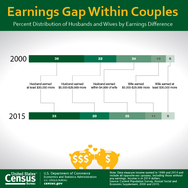
2015, the share of married couples where the wife earned at least $30,000 more
than the husband increased from 6 to 9 percent, according to statistics released today by the U.S. Census
Bureau.
Married
couples where the husband earned at least $30,000 more than the wife decreased from
38 to 35 percent. Conversely, husbands and wives whose earnings were within
$4,999 of each other grew slightly from 24 percent in 2000 to 25 percent in
2015.
“This
is a noteworthy development, given a broader context of an enduring gender earnings gap,” said Jamie Lewis, a statistician in the Fertility
and Family Statistics Branch, referencing page 10 of the 2014 Income and
Poverty in the United States report.
The
statistics released today come from the Census Bureau’s annual Families and Living
Arrangements table package from the 2015 Current Population Survey’s Annual Social
and Economic Supplement, which has collected statistics on families and living
arrangements for more than 60 years. These data measure income earned in 1999
and 2014, and income is in 2014 dollars. The comparisons provide an overview of
all married couples and do not account for employment status.
Today’s table package delves into many other characteristics of
households, including similarities and differences between married and
unmarried couples. The historical data on America’s families and living
arrangements can be found on census.gov.
Other findings:
Children
·Of the 73.6 million children under 18 in the
United States:
o69
percent live with two parents (51.0 million).
o23
percent live with a mother only (17.0 million).
o4
percent live with a father only (2.8 million).
o4
percent have no parent present (2.9 million).
·The share of children living with two parents
increased slightly from 68 percent in 2012 to 69 percent in 2015. This pattern
holds for single-race white and Hispanic children but not for single-race black
and single-race Asian children.
Households
·The
share of households with a single-race white householder decreased from 82
percent in 2003 to 79 percent in 2015. Households with a single-race black
householder grew from 12 to 13 percent; those with a single-race Asian
householder grew from 4 to 5 percent; and those with a Hispanic householder
increased from 10 to 13 percent.
·Average
household size has declined from 3.3 people in 1960 to 2.5 today.
Marriage
and family
·The median age when adults first marry
continues to rise. In 2015, it was 29 for men and 27 for women, up from 24 and
21, respectively, in 1947.
·In
2015, 55 percent of unmarried women 18 or older were never married, up from 47
percent in 1990. During the same period, the share of unmarried women who were
widowed decreased from 30 to 20 percent.
·The
share of mother-only family groups maintained by a mother under 20 decreased by
half from 2000, dropping from 4 to 2 percent.
·24 percent of married family groups with
children under 15 have a stay-at-home mother and 1 percent have a stay-at-home
father.
Older
adults
·A
greater share of families have at least one member 65 or older living at home, increasing
from 20 percent in 2005 to 25 percent in 2015.
·About 13.3
million older adults live alone, representing 29 percent of adults 65 or older.
Unmarried
couples
·8.3 million opposite-sex unmarried couples
live together.
·39 percent of opposite-sex unmarried couples
have a child under 18 present.