Profile America Facts for Features: American Indian and Alaska Native Heritage Month (resend)
CB15-FF.22
American Indian and Alaska
Native Heritage
Month: November 2015
NOV. 2, 2015 — The
first American Indian Day was celebrated in May 1916 in New York. Red Fox
James, a Blackfeet Indian, rode horseback from state to state, getting
endorsements from 24 state governments, to have a day to honor American
Indians. In 1990, President George H.W. Bush signed a joint congressional
resolution designating November 1990 as “National American Indian Heritage
Month.” Similar proclamations have been issued every year since 1994. This
Facts for Features presents statistics for American Indians and Alaska Natives,
as this is one of the six major race categories classified by the U.S. Office
of Management and Budget.
Population
5.4 million
The nation’s population of American Indians and Alaska Natives,
including those of more than one race. They made up about 2 percent of the total population in
2014. Of this total, about 48 percent were American Indian and Alaska Native only, and about 52percent were American Indian and Alaska Native in combination with one or more other
races.
The projected population of American Indians and Alaska Natives,
alone or in combination, on July 1, 2060. They would constitute 2.4 percent of the total
population.
The number of states with 100,000 or more American Indian and
Alaska Native residents, alone or in combination, in 2014. These states were
California, Oklahoma, Arizona, Texas, New York, New Mexico, Washington, North
Carolina, Florida, Michigan, Alaska, Oregon, Colorado, Pennsylvania and
Minnesota.
The proportion of Alaska’s population identified as American
Indian and Alaska Native, alone or in combination, in 2014, the highest share for this race group of
any state. Alaska was followed by Oklahoma (13.5 percent), New Mexico (10.4
percent), South Dakota (10.1 percent) and Montana (8.0 percent). The estimates
for New Mexico and South Dakota were not significantly different from one
another.
The median age for those who were American Indian and Alaska
Native, alone or in combination, in 2014. This compares with a median age of
37.7 for the U.S. population as a whole.
The number of federally recognized American Indian reservations in
2015. All in all, excluding Hawaiian Home Lands, there are 630 American Indian and Alaska
Native legal and statistical areas for which the Census Bureau provides statistics.
The number of American Indian and Alaska Native households in 2014
(households with a householder who was American Indian and Alaska Native alone or
in combination with another race). Of these, 37.8 percent were married-couple
families, including those with children.
The percentage of American Indians and Alaska Natives, alone or in
combination with other races, age 30 and over, who were grandparents living
with at least one of their grandchildren in 2014.
The percentage of single-race American Indian and Alaska Native
householders who owned their own home in 2014. This is compared with 63.1 percent of the
overall population.
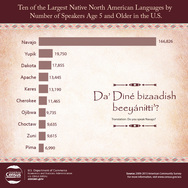
The percentage of single-race American Indians and Alaska Natives,
age 5 and older who spoke a language other than English at home in 2014,
compared with 21.1 percent for the nation as a whole.
The percentage of American Indians and Alaska Natives alone or in
combination, 25 and older, who had at least a high school diploma, GED
certificate or alternative credential in 2014. In addition, 18.5 percent
obtained a bachelor’s degree or higher. In comparison, 86.9 percent of the
overall population, 25 and older, had a high school diploma or higher, and 30.1
percent had a bachelor’s degree or higher.
The percentage of single-race American Indians and Alaska Natives,
25 and older, with a bachelor’s degree or higher whose degree was in science
and engineering, or science and engineering-related fields, in 2014. This
compares with 43.9 percent for all people 25 and older with a bachelor’s degree
or higher.
Note:The preliminary company summary provides
estimates for the number of firms, receipts, employment and
payroll by gender, ethnicity, race and veteran status at the U.S., state
and sector levels. The final businesses and business owners will be released in
December 2015.
Jobs
26.3%
The percentage of civilian-employed, single-race American Indian
and Alaska Native people, 16 and older, who worked in management, business, science and arts
occupations in 2014. In addition, 25.6 percent worked in service occupations and 22.3
percent in sales and office occupations. The percentage in management, business, science and
arts occupations was not significantly different from the percentage in service
occupations.
The percentage of single-race American Indians and Alaska Natives
who were in poverty in 2014, the highest rate of any race group. For the nation
as a whole, the poverty rate was 15.5 percent.
The percentage of single-race American Indians and Alaska Natives
who lacked health insurance coverage in 2014. For the nation as a whole, the corresponding
percentage was 11.7 percent.
St. Patrick’s
Day (March 17)American
Indian/Alaska Native Heritage Month
Earth Day (April 22) (November)
Asian/Pacific American Heritage Month (May)Veterans Day (Nov. 11)
Older Americans Month (May)Thanksgiving
Day
Mother’s DayThe
Holiday Season (December)
Hurricane Season Begins (June 1)
Father’s Day
The Fourth of July (July 4)
Anniversary of Americans with Disabilities Act (July
26)
Back to School (August)
Editor’s note: The preceding data were
collected from a variety of sources and may be subject to sampling variability and other sources of error. Facts for Features are
customarily released about two months before an observance in order to accommodate magazine production timelines.