Census Bureau News: Per Pupil Spending Varies Heavily Across the United States
Per Pupil Spending Varies Heavily Across the United States
Census Bureau Releases New Public Education
Finance Data
June 2, 2015 — Per pupil
spending for the nation was $10,700 during fiscal year 2013, a 0.9 percent
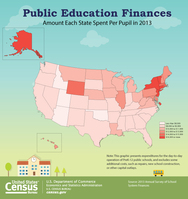
increase from 2012, but varied heavily among states with a high of $19,818 in
New York and a low of $6,555 in Utah.
Today’s findings come from Public Education Finances: 2013, which provides
figures on revenues, expenditures, debt and assets (cash and security holdings)
for the nation’s elementary and secondary public school systems. The report and tables, released annually, include
detailed statistics on spending — such as instruction, student transportation,
salaries and employee benefits — at the national, state and school district levels.
“These statistics provide
researchers, policymakers and the public with a picture of the nation’s public school
system education revenue and spending,” said Stephen Wheeler, an analyst with
the Census Bureau’s Educational Finance Branch. “These data are used in a
variety of important economic measures such as the Department of Education’s
Title I Grants and the Bureau of Economic Analysis’ gross domestic product
measure.”
States and state-equivalents spending
the most per pupil in 2013 were New York ($19,818), Alaska ($18,175), the
District of Columbia ($17,953), New Jersey ($17,572) and Connecticut ($16,631).
States spending the least per pupil included Utah ($6,555), Idaho ($6,791),
Arizona ($7,208), Oklahoma ($7,672) and Mississippi ($8,130).
Of the 100 largest school systems by enrollment,
Maryland had four of the top 10 public school districts with the highest
current spending per pupil. The top-five school districts for per pupil
spending were Boston City Schools ($20,502), New York City School District ($20,331),
Anchorage School District in Alaska ($15,419), Montgomery County Schools in
Maryland ($15,080) and Baltimore City Schools ($15,050).
Public Education
Expenditures
Total expenditure by public school
systems totaled $596.3 billion in fiscal year 2013, up 0.5 percent from the prior year. This
breaks a three-year trend of decreasing total expenditures for elementary and
secondary education. Public education expenditure categories include
instructional spending, support service spending, capital outlay and other
spending. Total school district debt increased by 3.2 percent, from $402.2
billion in fiscal year 2012 to $415.2 billion in 2013.
·Instructional expenditures
oExpenditures
for instruction amounted to $321.3 billion (60.6 percent) of total current
spending.
oInstructional
salaries are the largest expenditure category for public elementary and
secondary education, which accounted for 34.9 percent or $208.0 billion.
·Support services
expenditures
oExpenditures
for support services amounted to $181.7 billion, a 1.0 percent increase from
the prior year.
oExpenditures
on student transportation were $23.4 billion, a 1.2 percent increase from the
prior year.
Public Education
Revenue
Revenue
contributions from all sources to elementary and secondary education revenue
amounted to $597.9 billion, up 0.6 percent from the prior year.
Revenue
contributions
45.6
percent of revenue comes from state
governments at $272.9 billion.
45.3 percent of revenue comes
from local sources (property taxes, student fees, etc.) at $270.6 billion.
9.1 percent of revenue comes
from the federal government at $54.4 billion.
Local
revenue contributions
Of the $270.6 billion schools
received from local sources, $232.8 billion came from taxes and local
government appropriations.
Property taxes accounted for
65.1 percent of revenue from local sources for public school systems at
$176.2 billion.
States
receiving the highest percentage of their revenue from the federal
government: Mississippi (16.0 percent),
Louisiana (15.2 percent), South Dakota (14.8 percent), New Mexico (14.8 percent) and Arizona (14.6 percent).
States
receiving the lowest percentage of their revenue from the federal
government: New Jersey (4.1 percent),
Connecticut (4.3 percent), Massachusetts (5.1 percent), New York (5.6 percent) and New Hampshire (5.7
percent).
-X-
The
data used in the tabulations came from a census of all 15,144 public school
systems. As such, they are not subject to sampling error. Although quality
assurance methods were applied to all phases of data collection and processing,
the data are subject to nonsampling error, including errors of response and
miscoding. For more information, visit the Census Bureau's website at http://www.census.gov/govs/school/.