|
|
The USAID Office of Inspector General (OIG), with criminal investigators and audit personnel posted across the world, continues to conduct rigorous independent oversight of United States foreign assistance across multiple federal agencies.
Our work results in timely recommendations to improve efficiency and effectiveness of U.S. taxpayer-funded foreign assistance, identifying vulnerabilities and risks at the outset of new programs, and holding bad actors accountable for defrauding American taxpayers—no matter where they are located.
To learn more about our past and ongoing oversight of humanitarian, global health, and other foreign assistance programing, please visit oig.usaid.gov.
|
|
Coordination with Bilateral Oversight Partners to Investigate Fraud and Corruption Impacting Humanitarian Assistance
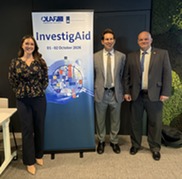
OIG senior leaders attended the annual InvestigAid conference hosted by the Dutch Ministry of Foreign Affairs and the European Anti-Fraud Office (OLAF), alongside 20+ bilateral investigative and oversight counterparts. We welcomed the opportunity to exchange knowledge, share investigative successes, and enhance collaborative approaches to investigating misconduct in humanitarian and development assistance programs. To this end, we currently have information sharing memorandums of understanding (MOUs) with counterparts in the European Union, United Kingdom, Japan, and Ukraine, as well as the Global Fund IG, UNHCR IG, World Bank, and the World Food Programme IG, among others.
|
Convening on the Future of U.S. Leadership Against Malaria
USAID OIG presented at a September forum hosted by Malaria No More, Friends of the Global Fight Against AIDS, Tuberculosis and Malaria, The George W. Bush Institute, and the ONE Campaign, among other sponsors. The convening brought together experts from across the anti-malaria community, including former USAID Chief of Staff William Steiger, current Executive Director of Malaria No More. USAID OIG presented on the critical role of oversight and accountability in the implementation of global health programs, based on lessons learned from our decades of oversight experience.
Atlantic Council Roundtable on Gaza’s Financial Future
OIG senior leader Adam Kaplan joined the Atlantic Council for a discussion focused on the role of cash assistance in Gaza’s recovery and reconstruction. USAID had previously been responsible for hundreds of millions of dollars in multi-purpose cash assistance (MPCA) in the West Bank and Gaza. USAID OIG had identified a number of oversight challenges to utilizing MPCA in non-permissive environments like Gaza, including diversion and exploitation of beneficiaries. Incorporating lessons learned from USAID OIG’s various reviews of USAID’s MPCA programs in WestBank/Gaza can strengthen future U.S.-funded cash assistance programs.
|
|
USAID OIG Receives Seven CIGIE Awards |
|
|
Each year, the Council of the Inspectors General on Integrity and Efficiency (CIGIE) honors outstanding work from the inspector general community that has significantly impacted an agency or the government as a whole. USAID OIG is proud to announce that our organization was the recipient of seven CIGIE awards: six teams and one individual have been recognized for their outstanding contributions.
Award for Excellence, Audit: Global Asset Disposition Team
In recognition of excellence in conducting a series of coordinated audits to provide timely and meaningful oversight of USAID’s disposition of assets across multiple countries during the Agency’s global drawdown. Read the reports here: Haiti, Egypt, Southern Africa, Thailand, Philippines, El Salvador
Award for Excellence, Audit: U.S. Direct Budget Support to Ukraine Team
In recognition of outstanding audit work examining $25.9 billion in U.S. direct budget support to Ukraine following the Russian invasion with recommendations to strengthen the oversight, safeguards, and accountability over those funds. Read the report here: https://oig.usaid.gov/node/8069
Sentner Award for Dedication and Courage: Burkina Faso Investigations Team
In recognition of exceptional investigative efforts that led to a life sentence and a 10-year, government-wide debarment for a former U.S. embassy employee who sexually assaulted minors in Burkina Faso. Read the press release: https://oig.usaid.gov/node/8058
Award for Excellence, Special Act: Bradley Gilmore
In recognition of exceptional efforts to prevent individuals involved in illicit activities related to U.S. foreign assistance from entering the United States and advancing denaturalization actions for unlawfully obtained U.S. citizenships.
Award for Excellence, Investigation: Covert Transnational Diversion Team
In recognition of the team’s efforts to expose a transnational scheme to divert U.S.-funded health commodities from the Kenya Medical Supplies Authority (KEMSA), end reliance on a compromised $650 million supply chain, and advance criminal accountability through covert investigative work. Read the press release: https://oig.usaid.gov/node/7925
Award for Excellence, Investigation: Watson Bribery Team
In recognition of the team’s efforts to expose a $500 million bribery scheme and deliver accountability through investigative skill, perseverance, and the meticulous safeguarding of U.S. taxpayer resources. Read the press release: https://oig.usaid.gov/node/7746
Award for Excellence, Information Technology: Digital Forensics and Investigative Technology Team
In recognition of the team’s efforts to deliver rapid, high-impact digital forensic support across complex investigations; build unique field capabilities; and accelerate and strengthen prosecutions, removals, debarments, and victim-protection efforts.
|
|
A USAID OIG investigation resulted in the conviction of Guyanese national Davendra Rampersaud for illegally selling stolen medical supplies from Kenya via his company, Caribbean Medical Supplies, Inc. (CMS), to the Guyanese government. Rampersaud and CMS also acquired and sold HIV test kits stolen from another separate U.S. program. Based on OIG’s referral, both Rampersaud and his company were debarred from future government-funded programs.
|
USAID OIG Investigation Leads to Debarment of Former Non-Profit President and Affiliates for Sexual Exploitation of Beneficiaries in Colombia
|
USAID OIG's investigation revealed allegations that Luis Meneses, Founder and former President of the Colombian non-profit FUVADIS, engaged in sexual quid-pro-quos with program participants for benefits, and that Meneses committed fraud by diverting free donor-provided HIV medications intended for FUVADIS beneficiaries and selling them for personal financial gain. As a result of USAID OIG’s investigative referral, Meneses, FUVADIS, and the current Legal Representative of FUVADIS were debarred.
|
|
|
USAID OIG Investigation Leads to Debarment of Two Individuals and One Company for Defrauding a Global Health Non-Profit
|
USAID OIG previously announced the conviction and sentencing of two individuals for their roles in defrauding a U.S.-funded non-profit dedicated to global public health. Based on USAID OIG’s findings and the subsequent convictions, both of the individuals and the company involved in the fraud were debarred.
|
USAID OIG Investigation Leads to Debarment of Former Federal Contracting Officer for Misuse of Government Equipment and Appearance of Soliciting Commercial Sex
|
In response to an allegation we received, USAID OIG's Digital Forensics and Investigative Technology Division (DFIT) conducted an analysis of a foreign service contracting officers’ two government furnished iPhones and one government laptop. The review revealed that the individual had viewed and stored sexually explicit material on his government devices. Based on our findings, the subject has been debarred.
|
USAID OIG Investigation Leads to Extradition, Sentencing, and Debarment of Foreign Assistance Contractors in Pakistan
|
USAID OIG's investigation in Pakistan led to debarments of two individuals, Stephen Paul Edmund Sutton, a United Kingdom citizen, and Atif Hussain Gillani, a Pakistani citizen, for their participation in a kickback scheme that defrauded a U.S.-funded power grid project in Pakistan of nearly $100,000. As part of the scheme, Sutton received at least $21,000 in kickbacks. During the investigation, OIG conducted extensive field work throughout Pakistan, submitted multiple requests for overseas bank records, coordinated with foreign law enforcement counterparts, and attempted additional specialized investigative techniques in coordination with the Department of Justice.
|
USAID OIG Investigation Leads to Debarment of Malian Organization and Two of its Officers for Falsifying Records and Payroll Fraud
|
A USAID OIG investigation into Association Subaahi Gumo (ASG), a Mali-based organization involved in a U.S. funded conflict prevention program, revealed that ASG and its senior leadership had likely falsified employee contracts, forged employee signatures, and committed payroll fraud. As a result of our findings, ASG, along with its General Secretary and Finance and Administrative Manager have been debarred.
|
|
|
Audits, Inspections, and Evaluations Updates |
|
Third-Party Monitoring: Lessons for the Future
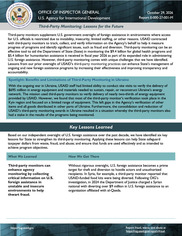
Third-party monitors supplement U.S. government oversight of foreign assistance in environments where access for U.S. officials is restricted due to instability, insecurity, limited staffing, or other reasons. USAID contracted with third-party monitors to track, collect, and verify information on the Agency’s behalf to help it measure progress of programs and identify significant issues, such as fraud and diversion. Third-party monitoring can be an effective tool to aid the Department of State (State) in monitoring the $9.4 billion for global health programs and $5.4 billion for humanitarian assistance it received in fiscal year 2026 as part of its expanded role in administering U.S. foreign assistance. However, third-party monitoring comes with unique challenges that we have identified. Lessons from our prior oversight of USAID’s third-party monitoring practices can enhance State’s management of ongoing and new foreign assistance programs by increasing their effectiveness and improving transparency and accountability.
|
Management Advisory: Severance Payments: USAID Should Find, Preserve, and Share Complete Financial Records and Payment Statements for Terminated Locally Employed Staff With the Department of State
As part of USAID OIG's ongoing evaluation of USAID’s locally employed staff (LES) terminated in 2025, we found that financial records for approximately $10 million in severance payments the Agency made directly to the staff in Mozambique and the Philippines were incomplete and lacked supporting documentation. Given USAID’s operating status, it is unclear whether a) financial records and supporting documentation do not exist or b) are inaccessible to USAID and State officials. Without complete and available payroll records for LES terminated in 2025, USAID lacks reasonable assurance that these transactions were authorized, processed, and disbursed appropriately. Further, USAID might not have the information needed to defend the U.S. government against any employment claims brought by these terminated staff.
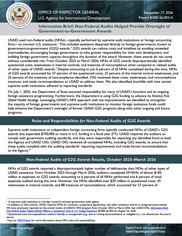
USAID used non-Federal audits (NFAs) to monitor U.S. assistance by assessing implementing partners’ compliance with applicable laws, regulations, and award requirements. USAID OIG's recent report reveals that NFAs of government-to-government (G2G) awards reported a disproportionately higher number of deficiencies than NFAs of other types of U.S. foreign assistance. Deficiencies include over $29 million in costs that auditors identified as not allowed or unsupported, weaknesses in internal controls, or noncompliance with laws and award provisions. The Department of State has announced that it is using G2G funding to advance its America First Global Health Strategy. The Department could leverage USAID’s NFA approach, with the improvements we identified, to help ensure it has sufficient tools in place to monitor the awards and improve foreign governments’ management of U.S. funds. Absent such action, the Department may experience a gap in the oversight of millions of dollars in expenditures on G2G awards, including missed questioned costs, internal control weaknesses, and noncompliance issues.
|
System Review Report on the U.S. Agency for International Development, Office of Inspector General for the Period Ending 30 September 2025
The United States Department of Agriculture, Office of Inspector General, recently concluded their External Peer Review of USAID OIG’s system of quality control for fiscal year 2025. A system of quality control encompasses USAID OIG's organizational structure and the policies adopted and procedures established to provide it with reasonable assurance of conforming in all material respects with Government Auditing Standards and applicable legal and regulatory requirements. Audit organizations can receive a rating of pass, pass with deficiencies, or fail. USAID OIG has received a pass rating.
|
|
Overseas Contingency Operations Reports |
|
|
As required by section 8L of the Inspector General Act of 1978, as amended, the Inspectors General for USAID, the Department of Defense and the Department of State work together to report quarterly to Congress on every operation’s progress and corresponding oversight activities.
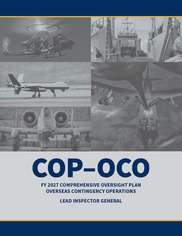
Fiscal Year 2027 Comprehensive Oversight Plan Overseas Contingency Operations
USAID OIG, with our partners at the Department of War and Department of State Offices of Inspector General, produced the “3 IGs” annual comprehensive oversight plan describing planned activities for overseeing overseas contingency operations Operation Inherent Resolve, Operation Enduring Sentinel, Operation Southern Guard, Operation Southern Spear, and Operation Epic Fury.
|
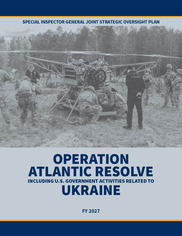
Fiscal Year 2027 Joint Strategic Oversight Plan for Operation Atlantic Resolve
USAID OIG, with our 3 IG partners, published the annual joint strategic oversight plan describing independent oversight activities for Operation Atlantic Resolve and the U.S. Government’s response to Russia’s full-scale invasion of Ukraine.
|
|
|
|
|
|