|
The USAID Office of Inspector General, with criminal investigators and audit personnel posted across the world, continues to provide rigorous independent oversight of United States foreign assistance.
Our work results in timely recommendations to improve efficiency and effectiveness of U.S. taxpayer-funded foreign assistance, identifying vulnerabilities and risks at the outset of new programs, and holding bad actors accountable for defrauding American taxpayers—no matter where they are located.
To learn more about our past and ongoing oversight of humanitarian, global health, and other foreign assistance programing, please visit oig.usaid.gov.
|
|
USAID OIG Testifies at House Foreign Affairs Subcommittee on Oversight and Intelligence Hearing

Alongside GAO, USAID OIG testified before the House Foreign Affairs Subcommittee on Oversight and Intelligence’s March 17 hearing titled "Waste, Fraud, and Abuse in Foreign Assistance: Lessons Learned and Charting the Path Forward."
|
USAID OIG Expands Investigative Oversight of U.S. Global Health Programming via Partnership with the National Association of Boards of Pharmacy
This innovative memorandum of understanding (MOU) enhances coordination between USAID OIG and NABP in protecting the integrity of U.S.-funded global health commodities across U.S. foreign assistance programs. The MOU will allow for the rapid detection of potential diversion, resale, or other corruption that prevents commodities from reaching those in need.
|
USAID OIG Signs Memorandum of Understanding with the Economic Security Bureau of Ukraine

USAID OIG continues to have criminal investigators posted in Kyiv, working daily to respond to allegations of misuse of U.S. funding in Ukraine. This memorandum of understanding will support the work of our criminal investigators and help to ensure accountability of U.S. foreign assistance programming in Ukraine. USAID OIG already has MOUs with the National Anti-Corruption Bureau of Ukraine, the Ukrainian National Police, the Ukrainian State Bureau of Investigation, and the Specialized Anti-Corruption Prosecutor’s Office.
|
USAID OIG is Hiring
With continued oversight jurisdiction for foreign assistance programs implemented across multiple agencies, USAID OIG recently posted hiring announcements for criminal investigators to maintain our rigorous oversight and capacity to respond to emerging issues.
We were encouraged by the number of highly qualified applicants and expect to have new investigators onboarded soon. We will also begin recruiting for auditors and analysts to further enhance our oversight efforts.
|
|
|
USAID OIG FY 26-27 Oversight Plan
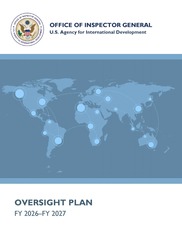
In accordance with the Consolidated Appropriations Act, 2026, USAID OIG published our oversight plan for the next two fiscal years.
Per the Act, USAID OIG has “continued oversight jurisdiction” over ongoing and new foreign assistance programs previously administered by USAID, in addition to existing USAID operations, the Millennium Challenge Corporation, the U.S. African Development Foundation, and the Inter-American Foundation. As reflected by this plan, we remain dedicated to fulfilling this critical mandate and serving as an independent safeguard for U.S. taxpayer dollars spent overseas.
|
|
|
We conducted this audit to determine the extent to which USAID’s partner vetting for selected humanitarian assistance awards in West Bank and Gaza provided assurance that related funding did not support entities associated with terrorism. We found that USAID’s policy exempted United Nations (UN) staff and other groups receiving assistance from the vetting process. In addition, we found that USAID’s partner vetting relied on implementer self-reporting and had information shortfalls. Such weak internal controls limited oversight and data quality in USAID’s partner vetting program. We suggest that the administration consider reviewing exemptions to partner vetting policies and enhancing procedures and other internal controls for vetting partners that receive humanitarian assistance in West Bank and Gaza.
|
USAID OIG Oversight of U.S. Foreign Assistance in West Bank and Gaza
Per the Joint Explanatory Statement accompanying the fiscal year 2026 National Security, Department of State, and Related Programs Appropriations Act, USAID OIG published our plan for “conducting risk-based investigations and related oversight of United States-funded implementing partners, including sub-awards, in the West Bank and Gaza.”
|
USAID OIG’s Ongoing Investigation Leads to Debarment of Former UNRWA Employee for Participation in the October Seventh Terrorist Attacks in Israel
|
An ongoing USAID OIG investigation has led to the 10-year, government-wide debarment of Hafez Mousa Mohammed Mousa, a former employee of the United Nations Relief and Works Agency for Palestine Refugees (UNRWA), for participation in the October 7, 2023, terrorist attacks in Israel. As a result, Mousa is prohibited from participating in all United States contracting and grant activities. This investigative result is unprecedented, representing the first known debarment by the United States of a terrorist affiliated with a UN agency responsible for humanitarian assistance programming.
|
USAID OIG’s Ongoing Investigation Leads to Referral of Four Additional Former UNRWA Staffers Linked to Hamas for Suspension/Debarment
|
USAID OIG found evidence linking four additional current or former staff at UNRWA to participation in the October 7, 2023, terrorist attacks in Israel and/or affiliation with Hamas. These subjects were referred to the U.S. Department of State for consideration of suspension and/or debarment action to exclude them from working across future U.S.-funded aid organizations. The individuals were three UNRWA-employed teachers and a social worker who are alleged to have participated in the holding of civilian hostages kidnapped from Israel and/or the terrorist activities in Israel on October 7, 2023.
|
|
|
USAID OIG Investigative Findings and Implications for U.S. Government-to-Government Award in Kenya
On December 4, 2025, the U.S. Department of State and the Republic of Kenya announced a $2.5 billion bilateral health cooperation framework establishing a G2G partnership for the detection, prevention, and response to emerging and existing infectious disease threats. Under this proposed framework, Kenya intends to utilize the Kenya Medical Supplies Authority (KEMSA), a state-run corporation under the Kenyan Ministry of Health, for procurement, warehousing, and distribution. Past OIG investigations into a $650 million USAID award to KEMSA identified significant vulnerabilities in KEMSA’s core business processes. Given the systemic risks associated with G2G awards and KEMSA’s proposed role in the newly announced health cooperation framework, OIG alerted the Department of State to previously identified vulnerabilities in KEMSA’s capacity to warehouse and distribute U.S.- funded health commodities.
|
USAID OIG Uncovered Evidence of Houthi Seizure of U.S.-funded Assets from an Aid Organization in Yemen
|
OIG’s investigation found evidence that, after the termination of the aid organization’s USAID-funded award, it ceased operations in Yemen and sought to donate its U.S.-government-funded assets, to include vehicles and other physical inventory, in accordance with award requirements. However, Houthi representatives required the awardee to inventory and transfer the assets to the Houthis. The awardee complied due to concerns about the safety of its local and international staff.
|
Former American Embassy Employee Sentenced for Rape of Minors in Burkina Faso
|
A Maryland man was sentenced to life in prison for forcibly sexually assaulting two minor girls in Burkina Faso in 2022 and 2023. After a two-week trial in October 2025, a federal jury in the District of Maryland convicted Fode Sitafa Mara, 41, of four counts of aggravated sexual abuse of a minor, as well as one count each of attempted coercion and enticement of a minor and attempted obstruction of justice. “Protecting children and safeguarding vulnerable populations from sexual exploitation and abuse is a core priority of the USAID OIG and we will continue to pursue those who violate that trust wherever they operate," said Acting Deputy Assistant Inspector General for Investigations Laura Rousseau.
|
|
|
Audits, Inspections, and Evaluations Updates |
|
Management Advisory: USAID’s Interest Payments to Vendors in Calendar Year 2025
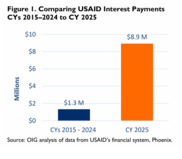
USAID OIG issued a management advisory regarding an increase in the amount of interest payments, or late charges, USAID paid to vendors in calendar year (CY) 2025. According to our analysis of the Agency’s financial data, USAID’s interest payments to vendors accelerated sharply in CY 2025, exceeding $8.9 million.
We urged USAID to take steps to minimize interest payments to vendors as the Agency continues to close out awards and wind down its operations. Further delays will result in the Agency continuing to accrue interest on outstanding payments.
|
USAID OIG published five audits as part of our ongoing series examining the disposition of assets for recently terminated USAID awards:
Terminated USAID Awards in Haiti: USAID Approved Disposition Plans for Selected Assets, but Some Approval Procedures Were Unclear and Disposition Was Incomplete
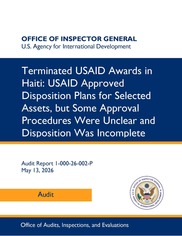
Our audit of the USAID Mission in Haiti found that USAID approved implementers’ disposition plans to donate, transfer, or retain selected assets, but approval procedures for armored vehicles were unclear. USAID implemented expedited procedures to dispose of approximately $4.2 million in priority assets for the eight selected terminated awards. The closure of the USAID Mission for Haiti, lack of clarity on responsibilities transferred to the Department of State, and risks related to unanticipated costs and possible theft, waste, and abuse raise concerns about the delayed final disposition actions for these assets.
|
Terminated USAID Awards in Egypt: USAID Approved Disposition Plans and Implementers Generally Donated Assets, but Some Assets Could Not Be Used as Intended
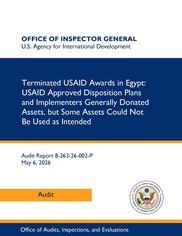
Our audit of the USAID Mission for Egypt (USAID/Egypt) found that USAID/Egypt approved disposition plans and implementers generally donated assets, but because of USAID’s operating status and the subsequent transfer of certain foreign assistance functions to the Department of State, USAID/Egypt was unable to identify factors necessary to ensure assets would be used as intended before the awards were terminated.
|
Terminated USAID Awards in Southern Africa: Unapproved Plans and Limited Controls Over Disposition Leave High Value Assets at Risk
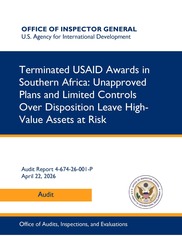
Our audit of the USAID Regional Mission for Southern Africa found that staffing and funding reductions, along with payment delays, led to missing assets in inventory lists and increased the risk of loss, misappropriation, and fraud.
|
Terminated USAID Awards in Thailand: Implementers Have Disposed of Assets by Donating and Selling Them as Approved
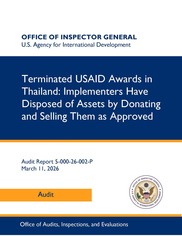
Our audit of the USAID Regional Development Mission for Asia (USAID/RDMA) found that USAID/RDMA approved implementers’ requests to donate 310 of 388 assets (80 percent) for the 7 selected awards we reviewed to local universities and nongovernmental organizations, consisting of $196,542 worth of information technology equipment, and sell the remaining 78 (20 percent) worth $18,517. Proper disposition of federally funded assets is critical to preventing loss, diversion, or misuse of taxpayer funded equipment.
|
Terminated USAID Awards in the Philippines: USAID Approved Disposition Plans and Implementers Started Disposing Assets Largely Through Donations
Our audit of the USAID Mission for the Philippines (USAID/Philippines) found that USAID/Philippines approved asset lists and disposition plans covering assets valued at approximately $1.5 million, including information technology equipment, vehicles, and laboratory equipment. As of May 29, 2025, USAID/Philippines had approved implementers to donate 253 of the 297 assets (85 percent) under the eight awards we reviewed. Proper disposition of federally funded assets is critical to preventing loss, diversion, or misuse of taxpayer funded equipment.
|
Humanitarian Assistance: Actions Needed to Strengthen Inventory Management and Oversight at the Dubai Warehouse
USAID’s humanitarian assistance warehouse in Dubai, the United Arab Emirates, provided humanitarian aid to vulnerable populations in the region, including Afghanistan, Gaza, and Syria, by enabling the quick delivery of prepositioned food commodities and nonfood items. The Dubai warehouse was the Agency’s largest warehouse with nonfood items. Our audit of the Dubai warehouse found that a lack of robust control activities resulted in inconsistent information in USAID’s inventory data, including value discrepancies of approximately $4 million between systems. USAID also did not enforce certain oversight requirements and as a result could not ensure that commodities stored in the Dubai warehouse remained unspoiled and in operable condition. As prepositioning warehouses continue to play a critical role in the U.S. government's humanitarian response efforts, decisionmakers should regularly assess warehouse inventory information, enhance procurement planning, and improve the management of certain nonfood items in the future.
|
Direct Budget Support: Oversight Mechanisms Provided Limited Assurance That U.S. Trust Fund Contributions Supported the Government of Ukraine as Intended
USAID contracted with Deloitte and KPMG to support its programmatic oversight of about $25.9 billion of direct budget support (DBS) to Ukraine financed through a World bank multi-donor trust fund. Our audit found that USAID did not receive some oversight deliverables from Deloitte and KPMG on time or at all. This weakened the United States’ ability to provide oversight of DBS funds. Additionally, we found that USAID’s contributions supported some eligible internally displaced persons (IDPs) but also supported duplicate payments and IDPs living abroad.
|
Mandatory Federal Information Security Evaluations
USAID OIG published two evaluations as required by the Federal Information Security Modernization Act of 2014 (FISMA):
We found that USAID implemented an effective information security program as of April 14, 2025. We could not assess the effectiveness for the full fiscal year.
We did identify certain required actions that USAID failed to take but could not determine the reasons why due to the unavailability of responsible Agency staff.
|
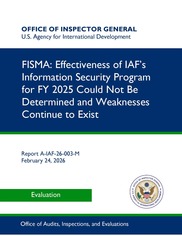
OIG could not determine the overall effectiveness of IAF’s information security program in FY 2025. However, the Agency met requirements for certain areas. For example, the Agency adhered to supply chain policies and procedures, established requirements for monitoring security incidents, and tested contingency plans. IAF also implemented two of our four prior recommendations. However, we identified multiple weaknesses.
|
|
|
Overseas Contingency Operations Reports |
|
Operation Enduring Sentinel (OES)
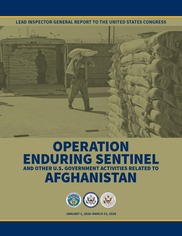
This report describes the activities of the U.S. Government in support of OES, as well as the work of the DoW, the Department of State (State), and the U.S. Agency for International Development (USAID) to further the U.S. Government’s policy goals in Afghanistan. This report also discusses the planned, ongoing, and completed oversight work conducted by the Lead IG agencies—the DoW, State, and USAID OIGs—and our partner oversight agencies. This report covers the quarterly reporting period January 1 through March 31, 2026.
|
|
|
|
|
|