| |
|
Per existing statutory authority, and as reflected in the Consolidated Appropriations Act, 2026, OIG has continued oversight jurisdiction for U.S.-funded foreign assistance programs across multiple agencies.
We continue to inform Congress, the administration, and American taxpayers by publishing timely recommendations to improve efficiency and effectiveness of foreign assistance programs, identifying vulnerabilities and risks at the outset of new programs, and holding bad actors accountable for defrauding the United States—no matter where they are located.
To learn more about our ongoing oversight of humanitarian, global health, and other foreign assistance programming, please visit oig.usaid.gov.
|
|
USAID OIG Welcomes Van Nguyen as Acting Deputy Inspector General Performing the duties of the Inspector General

Previously, Ms. Nguyen served as the Director of the Asia Regional Office, based in Bangkok, Thailand. Ms. Nguyen is a member of the Senior Foreign Service. During her 20-year career at USAID OIG, Ms. Nguyen has held several senior leadership positions, including AIG for Management and Principal Deputy AIG for Audit, both headquartered in Washington, D.C. Her extensive experience also includes service as Director of the Global Strategic Audits Division, Audit Director in Pakistan, and Regional Inspector General in Latin America and the Caribbean.
|
Meeting With Ambassador Jeff Bartos, U.S. Representative for UN Management and Reform

In December, OIG’s investigations and UN accountability leaders met with Ambassador Bartos to discuss OIG’s longstanding work in identifying vulnerabilities within U.S. voluntary contributions to UN agencies. USAID heavily relied on UN agencies to implement its programming, something our office has consistently identified as a Top Management Challenge.
|
|
|
Investigations

We have consistently cautioned Federal agencies, nongovernmental organizations (NGOs), and UN agencies of the risk of aid being diverted to Hamas and other U.S.-designated terrorist organizations. Our investigative work in this space continues and is designed to prevent the circulation of Hamas members across UN agencies and NGOs, as well as identify existing gaps in vetting policies and responses to Hamas interference in the delivery of aid to intended beneficiaries.
|
Audits, Inspections, and Evaluations
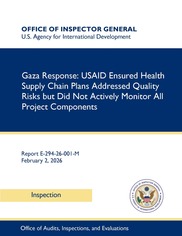
Gaza Response: USAID Ensured Health Supply Chain Plans Addressed Quality Risks but Did Not Actively Monitor All Project Components. Our most recent inspection found gaps in USAID's ability to monitor the procurement, storage, and transportation of pharmaceuticals and other medical commodities into Gaza. Developing clear and explicit oversight and monitoring requirements throughout humanitarian assistance supply chains will help ensure future programming is operating effectively and reaching its intended beneficiaries.
|
|
|
Senior Official at United States African Development Foundation Agrees to Plead Guilty to Accepting Gratuities and Making False Statement
|
OIG’s multi-year investigation resulted in the Director of Financial Management of the United States African Development Foundation (USADF) being charged on January 30, 2026, by criminal information and agreeing to plead guilty to accepting approximately $12,000 in gratuities from a USADF contractor and then lying to federal law enforcement officers about those payments. “The USADF Director of Financial Management’s fraudulent acts betrayed the trust of the American people,” said Acting Assistant Inspector General for Investigations Sean M. Bottary. “As the Inspector General with continued oversight jurisdiction over U.S.-funded foreign assistance, we will utilize our global investigative reach to aggressively detect and disrupt those who defraud taxpayer dollars programmed overseas.”
|
Fraud Alert- Ethiopia: Beneficiaries Solicited for Kickbacks During Humanitarian Registration
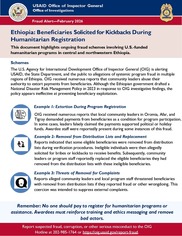
OIG frequently issues “fraud alerts” designed to inform government employees, U.S.-funded award recipients, beneficiaries, and members of the public about fraud schemes we have identified so they do not become victims, and to support detection, prevention, and reporting efforts affecting U.S. taxpayer funds. Our most recent fraud alert highlights ongoing fraud schemes we’ve identified involving U.S.-funded humanitarian programs in central and northwestern Ethiopia.
|
19 Arrested in Four Countries Related to Visa Fraud, Racketeering, Money Laundering and Related Charges
|
We worked in close coordination with multiple U.S. and international law enforcement partners to disrupt a transnational visa fraud, racketeering, and money-laundering scheme that defrauded thousands of Central and South American nationals seeking to work lawfully in the U.S. Victims were defrauded of over $2.5 million dollars.
|
Non-Profit Organization Defrauded Of Over $700,000 In Foreign Assistance
|
Our investigation resulted in the indictment of a former country director of a U.S.- funded NGO operating in Haiti for defrauding over $700,000 in foreign assistance funds by abusing his position of trust as the country director, violating conflict of interest and fraud and corruption policies, and steering procurements to a company he owned or was affiliated with for his own financial benefit.
|
|
|
|
Audits, Inspections, and Evaluations Updates
|
|
Terminated USAID Awards in El Salvador: Assets Were Disposed of According to USAID-Approved Plans
OIG initiated a series of audits examining the disposition of assets for recently terminated USAID awards across eight USAID missions around the world. The first report in this series, on the USAID Mission for El Salvador, is now available. The objective of this audit was to determine the status of the disposition of USAID-funded physical assets procured under selected terminated awards in El Salvador. We found that USAID/El Salvador approved implementers’ expedited disposition plans for selected awards, and implementers donated or retained priority assets in accordance with the plans.
|
Non-Federal Audits: Management Gaps Weaken Stewardship of U.S. Foreign Assistance

Non-Federal audits (NFAs)—also known as single audits—help to mitigate the risk of fraud, waste, and abuse; strengthen internal controls and compliance with award terms and applicable laws and regulations; and identify and recover improper payments. We have over 170 open recommendations for USAID related to NFAs, including $47.4 million in costs that auditors questioned as unreasonable, unsupported, or ineligible as of September 24, 2025. We additionally identified over 350 planned NFAs covering approximately $1.2 billion in foreign entity expenditures that were still outstanding as of August 2025. Addressing open NFA recommendations, incomplete NFAs, and NFA policies and procedures would help USAID administer the responsible closeout of Agency awards, including the recovery of millions in potential improper payments to implementing organizations.
|
MCC Use of Funds: Requirements for Anniversary Events and Promotional Items Were Generally Met, but Gaps Exist in Internal Policy
In response to an allegation received by OIG investigators, we initiated this evaluation to determine whether MCC adhered to applicable Federal requirements and internal policies and procedures when holding events to celebrate MCC’s 20th anniversary and buying promotional items for employees. We found that MCC followed requirements for most anniversary-related purchases but did not always document approvals due to internal policy gaps.
|
Financial Statement Audits
OIG issued four financial statement audits for fiscal year 2025:
U.S. Agency for International Development. OIG contracts for the annual audit of USAID financial statements and ensures effectiveness throughout the audit and reviews the results of the audit for compliance with all applicable standards. The independent certified public accounting firm contracted to perform the financial statement audit concluded that they were unable to obtain sufficient appropriate audit evidence to provide a basis for an audit opinion due to USAID’s failure to maintain adequate processes, controls, and records in support of financial transaction and account balances. For fiscal year 2025, the audit firm noted four material weaknesses in internal control over financial reporting, three significant deficiencies in internal control over financial reporting, and two instances of noncompliance with the Federal Manager’s Financial Integrity Act of 1982 (FMFIA) and the Government Management Reform Act of 1994 (GMRA). We made 20 recommendations to address the material weaknesses, significant deficiencies, and noncompliance identified in the fiscal year 2025 report.
|
Millennium Challenge Corporation. OIG contracts for the annual audit of MCC financial statements and ensures effectiveness throughout the audit process and reviews the results of the audit for compliance with all applicable standards. The independent certified public accounting firm contracted to perform the financial statement audit issued an unmodified opinion and identified no material weaknesses in internal control. In addition, the public accounting firm found no reportable noncompliance with applicable laws, regulations, contracts, and grant agreements.
|
U.S. African Development Foundation. OIG performed the annual audit of USADF’s FY 2025 financial statements in accordance with generally accepted government auditing standards and Office of Management and Budget Bulletin No. 24-02, Audit Requirements for Federal Financial Statements. OIG has issued a disclaimer of opinion. OIG was unable to obtain sufficient appropriate audit evidence to provide a basis for an audit opinion due to USADF’s staff being placed on administrative leave without access to key financial systems. OIG identified three material weaknesses in internal controls over financial reporting. In addition, OIG noted four instances of reportable noncompliance with applicable laws, regulations, contracts, and grant agreements. The report contains 13 recommendations to improve USADF’s management processes for FY 2025. The report also contains three open recommendations from OIG’s FY 2024 audit.
|
Inter-American Foundation. OIG performed the annual audit of IAF’s FY 2025 financial statements in accordance with generally accepted government auditing standards and Office of Management and Budget Bulletin No. 24-02, Audit Requirements for Federal Financial Statements. OIG has issued an unmodified opinion and identified no material weaknesses in internal control. In addition, OIG found no reportable noncompliance with applicable laws, regulations, contracts, and grant agreements.
|
Federal Information Security Modernization Act (FISMA) Reports
We've issued two FISMA reports for fiscal year 2025:
Millennium Challenge Corporation. OIG determined that MCC implemented an effective information security program in FY 2025.
|
U.S. African Development Foundation. OIG could not determine the overall effectiveness of USADF’s information security program. This was because nearly all of USADF’s staff were placed on administrative leave during our fieldwork and thus could not provide the documentation we needed for our evaluation.
|
|
|
Semiannual Report to Congress
On December 30, 2025, OIG issued our Semiannual Report to Congress highlighting our work between April 1, 2025, and September 30, 2025. The report includes information on our work as the lead law enforcement agency in uncovering and investigating a $550 million bribery scheme at USAID; an overseas investigation that led to charges against two foreign nationals for conspiring against the United States to illegally divert U.S.-funded global health commodities intended for vulnerable populations in Kenya; challenges in programming to counter violent extremism in West Africa; efforts to prevent Taliban interference within U.S.-programming in Afghanistan and al-Shahaab influence in Somalia; and adequacy of controls to mitigate the risk of misuse of satellite terminals in Ukraine.
|
Overseas Contingency Operations (OCO) Reports
As required by section 8L of the Inspector General Act of 1978, as amended, we continue to coordinate with the Inspectors General for the Department of Defense and Department of State on a joint strategic plan for comprehensive oversight of each contingency operation. We also report quarterly to Congress on every operation’s progress and corresponding oversight activities.
Operation Enduring Sentinel. The quarterly report for Operation Enduring Sentinel is scheduled to be published later this month.
|
|
|
Top Management Challenges Facing U.S. Foreign Assistance in Fiscal Year 2026
|
|
On December 16, 2025, we issued our Top Management Challenges for FY 26, in which we identified two broad challenges:
Challenges Impacting Oversight of U.S. Foreign Assistance. This includes previously flagged concerns regarding oversight of U.S. funding through UN agencies, monitoring gaps in nonpermissive environments, adherence to comprehensive risk-mitigation measures, and ineffective third-party monitoring practices.
Oversight of Billions of Dollars in Foreign Assistance Programs Previously Run by USAID. Challenges ahead include preventing potential theft of equipment in the field and the disposition of program assets; tracking and holding organizations accountable if they submit false or inflated invoices for payment; and guarding against other exposure to the national security, fiscal, and reputational interests of the United States.
|
|
|
|
|
|