|
|
The USAID Office of Inspector General (USAID OIG) continues to provide the rigorous independent oversight of United States foreign assistance that Congress and American taxpayers rely on and deserve.
In this issue, we highlight our:
-
New United Nations Accountability Office
-
USAID OIG Fiscal Year 2026 Oversight Plan
-
Oversight of USAID’s Realignment to the Department of State
-
Semiannual Report to Congress
-
Criminal Investigations Involving U.S.-Funded Foreign Assistance
-
Audits, Inspections, and Evaluations of U. S. -Funded Foreign Assistance
-
Overseas Contingency Operations Reports
-
Mechanisms to Report Fraud Waste and Abuse to Our Hotline
|
|

USAID OIG has created a new office focused solely on ensuring transparency, oversight, and accountability over U.S. foreign assistance dollars implemented through United Nations (UN) agencies. Our prior, longstanding work in this space has led to new statutory language, creative solutions for obtaining information from UN agencies related to U.S. funding, partnerships with UN inspectors general, and precedent-setting investigations of UN officials involved in fraud, sexual exploitation and abuse, and diversion of aid to terrorist organizations.
|
|
|
USAID OIG’s FY 2026 Oversight Plan describes our ongoing and planned oversight activities in the coming fiscal year, maintaining aggressive oversight and accountability of billions of dollars in overseas assistance, including USAID-funded-awards transferred to the Department of State.
Our planned work includes audits, inspections, evaluations, and investigative efforts, as well as ongoing outreach and coordination to ensure robust independent oversight, accountability, and transparency over taxpayer-funded foreign assistance.
|
|
|
Oversight of USAID's Realignment to the Department of State |
|
For over 4 decades, USAID OIG has provided independent oversight of USAID’s personnel, programs, and activities. As certain USAID functions transfer to the Department of State, our goal is to ensure the challenges, risks, and vulnerabilities that have led to instances of fraud, corruption, and diversion in the past are addressed.
Our May 13 memorandum identified a number of challenges to oversight and accountability of foreign assistance, including: resistance from UN agencies and foreign-based NGOs to sharing information about potential misconduct with OIG; challenges with monitoring aid in nonpermissive environments; limitations in vetting of aid organizations for ties to designated terrorist organizations and known corrupt actors; and improving transparency in funding to subrecipients.
We also outlined risks and challenges in the transfer of USAID functions to State in our recent written statement for the May 20 hearing before the U.S. Senate Committee on Appropriations Subcommittee on State, Foreign Operations, and Related Programs.
Additionally, we identified key questions, policies, procedures, and statutes implicated by the March 28 congressional notification issued by the Department of State in our May 13 letter to the Senate Appropriation’s Subcommittee on State, Foreign Operations, and Related Programs and the House Appropriations Subcommittee on National Security, Department of State, and Related Programs.
|
|
|
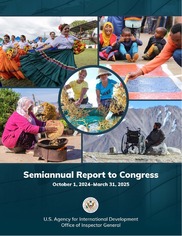
Our recent Semiannual Report to Congress highlights OIG’s comprehensive body of work and unique mission of providing independent oversight of foreign assistance programs. Featured work from October 1, 2024, to March 31, 2025, includes oversight of U.S. foreign assistance programming in Ethiopia, Gaza, and Ukraine.
This report also highlights OIG’s recent investigative work by our special agents, digital forensics specialists, and investigative analysts. This includes an unprecedented 20-year debarment of a USAID mission director who engaged in sexual misconduct, an extradition order for a Syrian national facing a 12- count indictment for diverting humanitarian aid to an Al Qaeda affiliate, and our work toward holding accountable Hamas-associated UNRWA employees who participated in the October 7 terrorist attacks in Israel.
|
|
|
USAID OIG’s criminal investigative casework remains active with approximately 200 ongoing investigative matters relating to the roughly $80 billion in continued active USAID awards, as well as past misconduct by USAID implementers or employees prosecutable under relevant statutes of limitations.
USAID OIG’s Investigative Work to Prevent UNRWA Staff Associated with Hamas from Circulating to Other U.S. Government-Funded Aid Organizations
We continue to investigate UNRWA staff who participated in the terrorist attacks that took place across Israel on October 7, 2023, to ensure they do not recirculate across U.S.-funded aid organizations. We have assigned investigative personnel to the Attorney General’s Joint Task Force October 7, an initiative that will seek justice for the victims of the terrorist attack and disrupt Hamas financing.
|
USAID Official and Three Corporate Executives Plead Guilty to Decade-Long Bribery Scheme Involving Over $550 Million in Contracts; Two Companies Admit Criminal Liability for Bribery Scheme and Securities Fraud
Our investigation led to a government contracting officer for USAID and three owners and presidents of contractors pleading guilty for their roles in a decade-long bribery scheme involving at least 14 prime contracts worth over $550 million in U.S. taxpayer dollars.
“USAID-OIG is firmly committed to rooting out fraud and corruption within U.S. foreign assistance programs. Today’s announcement underscores our unwavering focus on exposing criminal activity, including bribery schemes by those entrusted to faithfully award government contracts. We appreciate our longstanding partnership with the Department of Justice in holding accountable those who defraud American taxpayers.” – USAID OIG Acting Assistant Inspector General for Investigations Sean Bottary.
|
Former Contractor of USAID-Funded Program Extradited to the United States, Convicted and Sentenced for Conspiracy to Obtain Grant Money Through Fraud
USAID OIG’s investigation into a fraud scheme perpetrated by an employee of a USAID awardee resulted in his extradition from the United Kington to the United States, a conviction, and a guilty plea for conspiracy to commit theft from a USAID power distribution program in Pakistan receiving federal funds.
|
USAID Personal Services Contractor Engaged in Compromising Relationships with Local Women at Post
USAID OIG’s investigation resulted in a contract termination of a USAID personal services contractor at a U.S. Embassy in Africa for giving his Department of State issued identification card to two local women and using his government-issued mobile phone to send local women sexually explicit material. The contract termination led to cost savings of approximately $317, 374.
|
Federal Jury Convicts Virginia Man and Maryland Woman for Conspiracy to Defraud a Non-Profit Corporation Through Payments for Work That Wasn’t Performed
A USAID OIG investigation resulted in a federal jury convicting a Virginia man and Maryland woman for conspiracy to defraud a non-profit corporation dedicated to global public health through payments for work that wasn’t performed.
|
Director on USAID Project Arrested for Nine-Year Fraud Scheme
USAID OIG Special Agents arrested a former project director of a North Carolina based non- profit organization, that regularly implements projects funded by USAID, on a federal indictment alleging she defrauded a U.S.-funded organization of approximately $240,000.
|
$1 Million Settlement in USAID Overbilling Case
USAID OIG’s investigation, in partnership with the U.S. Attorney’s Office for DC, resulted in Stax Inc. paying $1 million following allegations it inflated $850,000 in employee salary costs, thus overbilling USAID on a contract for a development project in Sri Lanka.
|
USAID OIG’s Investigation Leads to Sentencing in COVID Relief Fraud Scheme
A USAID OIG investigation into a COVID relief scheme, in partnership with the Department of Justice, led to a guilty plea and sentencing of 1 year and 6 months in federal prison and forfeiture of $370,000 for defrauding the United States.
|
USAID Subawardee Submitted False Claims for Reimbursement
USAID OIG initiated an investigation into an allegation that a USAID subawardee submitted false claims for reimbursement of tax payments to a foreign government. The investigation found evidence that the subawardee overcharged the USAID award $89,000.
|
|
|
Audits, Inspections, and Evaluations of U.S.-Funded Foreign Assistance |
|
Project Announcement: Inspections of BHA Warehouses Storing Food Aid
We are performing a series of inspections of USAID Bureau for Humanitarian Affairs (BHA) warehouses that preposition food aid. As of May, BHA warehouses in Djibouti, Djibouti; Durban, South Africa; and Houston, Texas stored a reported nearly $100 million in prepositioned food aid for use in humanitarian responses worldwide. Ensuring that these goods do not spoil or are otherwise damaged and that plans are in place for their storage and disposition are critical to preventing waste and enabling the U.S. government to continue to be ready to respond to emergency situations.
We are currently inspecting each warehouse and will issue three separate reports. The objectives of the inspections are to (1) determine the status of food stored in BHA’s warehouses and (2) identify plans for the continued storage, transfer, and/or disposal of these goods.
|
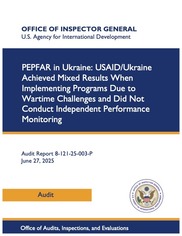
Audit of PEPFAR in Ukraine: USAID/Ukraine Achieved Mixed Results When Implementing Programs Due to Wartime Challenges and Did Not Conduct Independent Performance Monitoring
 |
|
Before Russia’s full-scale invasion in February 2022, an estimated 260,000 people in Ukraine were living with HIV, the second-highest number of cases in Europe. The ongoing war has altered the landscape of the country’s HIV/AIDS epidemic and created significant challenges in providing essential HIV services. We conducted this audit to assess the extent to which USAID/Ukraine implemented and monitored selected PEPFAR programs to achieve its intended results.
What We Found
- USAID/Ukraine did not achieve all its intended results when implementing PEPFAR-funded programs due to wartime challenges.
- USAID/Ukraine did not conduct independent performance monitoring or adapt its monitoring practices in response to the war.
|
Evaluation of USAID/Somalia’s Democracy, Stabilization, and Governance Portfolio: Insufficient System Use, Financial Oversight, and Monitoring Processes Limited Activity Assessments
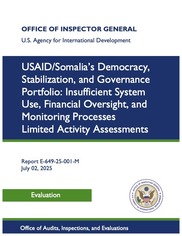
USAID/Somalia’s Democracy, Stabilization, and Governance (DSG) Office was tasked with overseeing a portfolio of five programs, totaling over $120 million, spanning from March 2022 to July 2028. The goal of these programs was to reduce the influence of al-Shabaab, a U.S.- designated terrorist organization, and support areas newly liberated from the group.
We initiated this evaluation to determine the extent to which USAID/Somalia’s Democracy, Stabilization, and Governance Office (1) used the official portfolio management system to measure progress toward intended results, (2) conducted oversight to ensure that spending complied with Federal cost principles, and (3) conducted oversight of the third-party monitor.
What We Found
- USAID/Somalia did not use the official portfolio management system as required, which limited its ability to measure progress toward intended results in the DSG portfolio.
- USAID/Somalia performed required financial oversight of DSG programs but could have improved coordination and instituted discretionary financial oversight tools.
- USAID/Somalia did not have a standardized process for managing recommendations from third-party monitors.
We included several considerations for the administration to enhance performance management and oversight of future foreign assistance programs.
|
Audit of USAID’s Colombia Assistance: USAID Complied With U.S. Laws Limiting Assistance but Could Strengthen Internal Management Activities
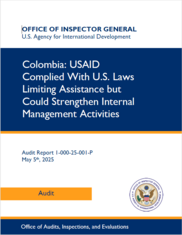
For over two decades, Colombia has been a top recipient of U.S. foreign assistance in the Western Hemisphere.U.S.-Colombia relations have centered around counternarcotics and counterterrorism efforts to advance mutual security interests. U.S. appropriations laws dating back to the signing of the 2016 Peace Accord have included limitations for how foreign assistance funds could be used in Colombia. Congress expressed interest in OIG oversight of the funding limitations in an early version of the fiscal year 2024 appropriations law. Accordingly, OIG initiated this audit to determine the extent to which USAID complied with specific statutory limitations for assistance to Colombia.
What We Found
- USAID complied with statutory limitations for assistance to Colombia for selected awards but risked noncompliance in the future.
We made two recommendations to strengthen management activities for U.S. foreign assistance to Colombia. USAID elected not to provide comments on the recommendations.
|
Taliban Interference in Aid to Afghanistan: USAID Can Strengthen Coordination, Award Requirements, and Guidance to Safeguard Implementers and Manage Taliban Engagement
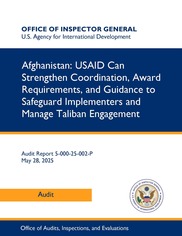
To assess the government’s ability to manage foreign assistance in such a hostile, nonpermissive environment, we initiated this audit of USAID’s efforts in Afghanistan to safeguard implementers and activities by (1) mitigating security and safety risks and (2) managing the impact of Taliban interference.
What We Found
- USAID took effective steps to mitigate security and safety risks for implementers in Afghanistan, but coordination and award requirements were inconsistent between operating units.
- USAID and implementers took effective steps to manage the impact of Taliban interference, but the Agency did not provide clear guidance for implementer engagements with Taliban representatives.
We made four recommendations to better safeguard USAID’s implementers and Agency- funded activities in Afghanistan. The Agency agreed with three recommendations and disagreed with one recommendation.
|
Coming Soon!
-
Evaluation of USADF’s Implementation of Policies and Procedures for Its Strategic Partnerships and Grants Administration
-
Inspection of USAID’s Oversight of Starlink Satellite Terminals Provided to the Government of Ukraine
-
Reviews of Key Lessons from Prior USAID OIG Oversight of Global Health, Humanitarian Assistance, and Public International Organizations
-
Audit of USAID’s Direct Budget Support to Ukraine Through the Public Expenditures for Administrative Capacity Endurance Fund
The OIGs for USAID and the Departments of Defense (DoD) and State jointly oversee three OCOs: Operation Atlantic Resolve, which includes U.S. government activities related to Ukraine; Operation Inherent Resolve, which supports the U.S. government strategy to defeat ISIS in Iraq and Syria; and Operation Enduring Sentinel, which conducts counterterrorism operations against threats emanating from Afghanistan, among other U.S. government activities.
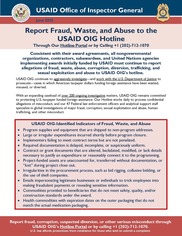
Consistent with their award agreements, all nongovernmental organizations, contractors, subawardees, and United Nations agencies implementing awards initially funded by USAID must continue to report allegations of fraud, waste, abuse, corruption, diversion, trafficking, and sexual exploitation and abuse to USAID OIG’s hotline.
You can report fraud, waste and abuse through our Hotline Portal or by calling +1 (202)-712- 1070.
|
|
Employees of USAID, the Millennium Challenge Corporation, U.S. African Development Foundation, Inter-American Foundation, Development Finance Corporation, and their contractors, subcontractors and grantees can perform an important service by reporting what they reasonably believe to be evidence of wrongdoing, and they should never be subjected to or threatened with reprisal for doing so. Protections and remedies for whistleblowers vary by category. The USAID OIG Whistleblower Protection Coordinator can be reached at: oigombud@oig.usaid.gov
|
|
|
|
|
|