|
|
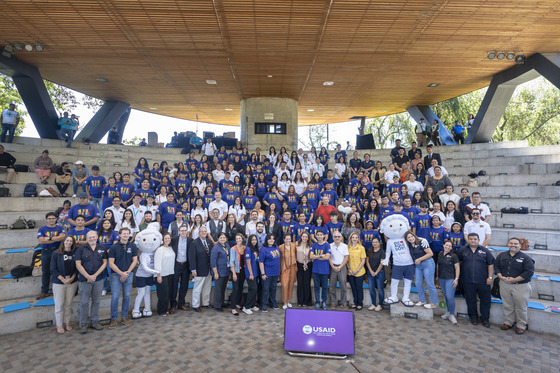
On October 25, in San Salvador, El Salvador, USAID and Glasswing International, in alliance with the Salvador del Mundo Foundation (FUSALMO) and the Salvadoran Association for Rural Health (ASAPROSAR), launched a new project under the Central American Service Corps (CASC) initiative called Jóvenes Unidos.
With a $20.2 million investment ($10 million from USAID and $10.2 million from the private sector), Jóvenes Unidos will help generate leadership potential, an optimistic outlook, and a sense of belonging among youth. Over the course of five years, the project will work directly with 3,700 young people, including those with disabilities, in the Santa Ana, San Salvador, and San Miguel areas to develop the skills to make meaningful contributions to their communities and address the range of challenges they face.
Jóvenes Unidos participants will complete a three-part service year consisting of technical and soft skills training, a six-month community service internship, and support to connect with education, employment, and civic engagement opportunities beyond the life of the project.
Jóvenes Unidos will leverage support services from youth organizations, civil society, the private sector, local government, development banks, and other donors.
|
|
New Alliance to Fight Corruption in Central America
On October 9, during the Central American Donors Forum (CADF 2024), USAID and Cristosal presented the Regional Alliance for Transparency and Anti-Corruption in Antigua Guatemala, Guatemala.
The goal of the new project is to strengthen civil society capacities to monitor transparency and democratic governance, detect corruption, and seek justice and accountability through regional collaboration.
The project will articulate and strengthen the work in the fight against corruption in Guatemala, El Salvador and Honduras, through the investigation of corruption cases, monitoring by communities, accountability exercises and promotion of pro-transparency narratives. In addition, the project will enhance the capacities of the Center Against Corruption and Impunity in Northern Central America (CCINOC) to promote regional anti-corruption initiatives.
During the launch, Michael Camilleri, Deputy Administrator of USAID Bureau for Latin America and the Caribbean, emphasized that the joint action of civil society organizations that are part of the Alliance will enhance the fight against corruption and impunity.
|
|
Encounter of Nations: Union in Diversity
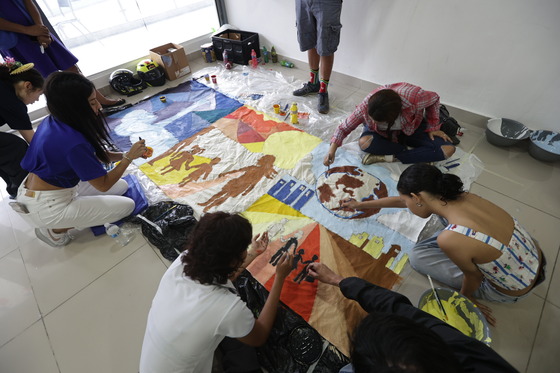
On November 11, the "Encounter of Nations: Unity in Diversity" event took place, bringing together migrants and the local community in Panama to celebrate the national holidays together. The event highlighted values of coexistence and cultural diversity and was supported by the USAID Central America Migration Program and the International Organization for Migration (IOM), in collaboration with the Panama Development Foundation (FUNDESPA).
Activities included dancing, the painting of a collective mural about migration processes, and other recreational exercises to promote well-being and integration. There was also a cultural exchange where participants wore their traditional outfits and proudly shared their customs, enriching the experience for everyone present.
Lastly, participants had access to a legal guidance space where they received answers and practical resources to help with questions and issues related to their migration status in Panama.
|
|
The Bright Future of Salvadoran Youths, Powered by a U.S.-Mexico Partnership
Daniel Vasquez, a young father from San Salvador, once faced an uncertain future. Today, however, he runs his own business, providing camera and lighting equipment services to the film industry. His journey is part of Sembrando Oportunidades, a partnership between the governments of the United States and Mexico that is transforming the lives of hundreds of Salvadoran youths. These youths participated in the Jovenes Construyendo el Futuro project, supported by the Mexican Agency for International Development Cooperation (AMEXCID).
Daniel was among 466 youths who participated in a series of trainings designed to build employability and entrepreneurial skills from November 2023 to October 2024. These trainings in El Salvador, supported by USAID through its Alliance for Root Causes and Opportunities (ARCO) project, helped break down barriers to employment and create economic opportunities for these youths.
Through a specialized course on business models, Daniel learned to sharpen his business skills and build stronger relationships with clients.
“The course helped me understand my clients’ needs and make my services more efficient,” Daniel said. “Now, I can confidently grow my business and provide better support for my family.”
For many, like Katherine Rivas, the journey started with building the foundational skills needed for a professional career. After taking a soft skills course focused on teamwork, emotional intelligence, and time management, Katherine obtained a job in customer service at a local bank branch.
“I’m growing emotionally and professionally,” she said with pride. “I have a stable job with benefits, and I’ve even been offered a chance to advance to a cashier position. Now, my dreams are to keep growing, go to college, and buy a home one day.”
Then, there’s Yazmin Quiñonez, who, before joining the program, was a self-taught programmer learning through YouTube videos. After completing a tech bootcamp where she mastered web design and coding languages like JavaScript and HTML, Yazmin secured a paid internship at a tech company.
“I used to think programming was just a hobby,” Yazmin said. “Now, I see it as a real career. My dream is to become a programming trainer and show people that opportunities exist right here in El Salvador.” She is now a college student and entrepreneur.
These stories reflect broader success. The training programs have equipped participants with the technical and entrepreneurial skills needed to secure jobs or start businesses. To date, 128 of the 466 youths have secured employment, with 91 securing permanent positions, nine taking on temporary roles or internships, and 28 launching entrepreneurial ventures in industries like marketing, technology, and services.
However, the impact goes beyond numbers. “The greatest benefit isn’t just getting jobs or starting businesses,” Daniel reflected. “It’s teaching others, even our families, what we’ve learned. It shows that, no matter how tough things seem, we can move forward together.”
From March 2023 to September 2024, USAID has supported technical and vocational training for 1,276 participants from El Salvador and Honduras. This initiative is part of the United States government’s investments to address the root causes of irregular migration from Central America to support its citizens in building prosperous futures in their home communities.
|
|
|
Guatemala is implementing a new regulatory air quality network to monitor PM2.5 particulate matter and improve air pollution surveillance.
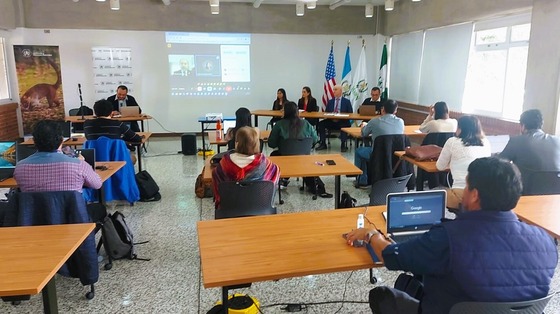
USAID and NASA, in collaboration with Guatemala’s Ministry of Environment and Natural Resources (MARN), conducted an intensive three-day workshop centered on air quality monitoring. The final goal is to improve climate resilience by utilizing satellite-based monitoring tools.
The workshop, held from November 19 to 21, was supported by NASA’s Scientific Coordination Office and included specialists from SERVIR-Central America, a project powered by USAID, NASA, and the Tropical Agricultural Research and Higher Education Center (CATIE).
Experts from the World Meteorological Organization (WMO) also collaborated, bringing their expertise in air quality monitoring practices and their adaptation to specific contexts. Representatives from Guatemala’s National Meteorological Service (INSIVUMEH), Universidad del Valle and other universities in the country also participated, promoting a multisectoral approach to environmental management in Guatemala.
The training included familiarizing participants with freely accessible Earth observation data and tools, understanding the current state of air quality monitoring in Guatemala and its link to climate resilience, and exploring successful monitoring practices implemented in other regions of the world.
|
|
|
|
|