|
Center for Faith-Based and Neighborhood Partnerships |
|
A Message from
USAID's Senior Advisor for Faith Engagement
|
|
|
Colleagues,
This June, the Center for Faith-Based and Neighborhood Partnerships marked important progress in its effort to advance strategic religious engagement (SRE) at USAID and in the broader development community.
At the beginning of the month, FBNP Initiative Lead Amanda Vigneaud and I traveled to Rome where we held meetings with a range of key stakeholders, including donor agencies and implementing partners. Our discussions focused on sharing best practices, exploring collaborative opportunities, and identifying ways to scale our religious engagement efforts.
We also made strides internally with the launch of the Bridge Builders’ Collaborative, a new peer-to-peer platform that brings together USAID colleagues from Missions and Washington headquarters to share knowledge, experience, and resources related to SRE. In the weeks and months ahead, I look forward to expanding on these efforts – increasing our direct support to Missions through SRE tools, resources, and assistance; exploring innovative ways to strengthen the capacity of diverse and non-traditional faith-based organizations; and building multilateral networks with donor institutions and partner governments to enhance our collective capacity to partner with faith-based actors.
In this newsletter, you will find more details on our Rome engagements, important updates on USAID’s humanitarian assistance efforts in Gaza, the West Bank, Ukraine, and Sudan, new funding opportunities, and resources for partners.
Finally, in the month of June, USAID celebrated Pride Month, reaffirming our commitment to promoting Inclusive Development in all aspects of our work. I encourage you to check out USAID’s historic LGBTQI+ Inclusive Development Policy that provides a blueprint for integrating LGBTQI+ individuals into USAID policy and programming. By embracing an inclusive development approach, we ensure that our work truly serves all segments of society.
Warm regards,
Peter Mandaville Senior Advisor for Faith Engagement USAID
|
|
Partner Resources:
Agency Updates & Funding Opportunities
|
|
 |
|
Humanitarian Assistance Update: On June 11, Secretary of State Antony Blinken announced $404 million in additional humanitarian assistance for Palestinians in Gaza, the West Bank, and the region. This new funding includes $64 million from USAID to support partners on the ground providing urgently required food assistance to Palestinians in need and critical logistics support to coordinate delivery of humanitarian goods to and across Gaza. This additional funding provided through USAID will support the World Food Program in securing crucial food assistance to people experiencing high levels of food insecurity and supporting treatment for malnutrition in children throughout Gaza and the West Bank. Visit our website for up-to-date information on USAID’s response in the region. |
 |
|
Humanitarian Assistance in Sudan: In response to the growing humanitarian crisis in Sudan, including reports of extreme hunger and malnutrition, Administrator Samantha Power recently announced $315 million in additional humanitarian assistance to support the people of Sudan. This assistance includes urgently needed food aid, malnutrition screening and treatment for young children, safe drinking water, and emergency health care, among other essential relief. USAID is also focused on immediately scaling up and sustaining the capacity of humanitarian partners, including through market-based and in-kind support, to help avoid breaks in delivering life-saving relief for the most vulnerable. Visit www.usaid.gov/sudan to learn more about our humanitarian response efforts in Sudan. |
 |
|
Celebrating Pride Month: USAID is committed to promoting Inclusive Development in all aspects of our work. This means striving towards a vision of equality for all lesbian, gay, bisexual, transgender, queer, and intersex (LGBTQI+) individuals so that they can live with dignity and be free from all forms of violence, discrimination, stigma, and criminalization. Last year, USAID launched the historic LGBTQI+ Inclusive Development Policy, a blueprint for integrating LGBTQI+ individuals into USAID policy and programming. Read the policy and check out this video from USAID’s Senior LGBTQI+ Coordinator, Jay Gilliam, commemorating Pride Month. |
 |
|
Localization Progress Report: Interested in learning more about how USAID defines its targets to shift more funding to local partners and expand local leadership in our programming? Read Committed to Change: USAID Localization Progress Report for an update on USAID’s progress towards increasing the funding local organizations receive, and the Agency’s efforts to increase local leadership in program design, implementation, and measurement. Also, read a new Devex Op-Ed from Administrator Samantha Power that highlights USAID progress and challenges it must overcome. |
|
|
New Blog: USAID’s partners play a pivotal role in directly implementing awarded funds to respond to development and humanitarian needs around the world. Each year, USAID works directly with nearly 4,000 organizations – what we call our “prime” partners. A new blogpost from USAID's Office of Acquisition and Assistance offers a step-by-step guide for organizations interested in working with the Agency. |
 |
|
Funding Opportunity: USAID/Ghana is seeking applications for a cooperative agreement to implement the “Ghana Youth Activity.” Applications for potential awards of up to $15,000,000 are due by July 26, 2024. The Ghana Youth Activity seeks to support a local Ghanaian applicant with a defined youth-led and locally-led program to empower Ghanaian youth to advance their social, economic, and civic development through improved employability, access to essential services, and strengthened civic engagement. USAID seeks to support an applicant whose proposed program reflects the Positive Youth Development (PYD) approach and who can independently identify and address new and impactful interventions. For more information, visit the award page at Grants.gov. |
 |
|
2024 CLA Case Competition: USAID’s 2024 Collaborating, Learning and Adapting (CLA) Case Competition is now open! The competition seeks to capture real-world examples from USAID staff and partners of strategic collaboration, continuous learning, and adaptive management in action. The competition will close on Friday, July 26, 2024 at 5:00 p.m. EDT. Participation is open to all individuals and organizations working with USAID. To learn more about the competition and submit a case, click here. |
 |
|
ICYMI Learning and Evidence Month Webinar: Back in May, USAID’s Local, Faith, and Transformative Partnerships Hub hosted a Agency Learning and Evidence Month webinar, “Nothing About Us Without Us: Advancing USAID’s Localization Agenda through Partnerships with Religious Actors." This session showcased evidence-based research demonstrating the impact of religious actors advancing locally-led development outcomes, highlighted the donor community’s active investments to empower these actors, and invited agency leadership, including Peter Mandaville, Senior Advisor for Faith Engagement, to discuss ways that USAID Missions can apply these lessons in new and ongoing activities. Watch here. |
 |
|
Summer Webinar Series: USAID’s Industry Liaison team is excited to host the Agency’s first Summer Webinar Series, which will explore different approaches to partnering with USAID. Partners will hear from multiple offices, including the Bureau of Humanitarian Assistance (BHA), the Locally Led Development team, the Center for Faith-Based and Neighborhood Partnerships (FBNP), and more! The series is slated to take place July 16-17. Register today. |
|
|
Strategic Religious Engagement in Practice:
Community of Sant'Egidio Trains Volunteer Networks and Provides Decentralized Aid for Communities Impacted by the War in Ukraine
|
|
|
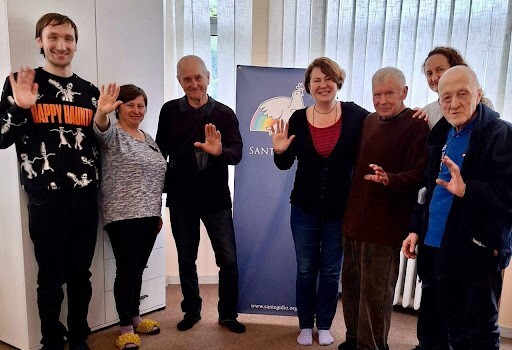
Sant’Egidio opens co-housing facility in Kyiv for previously unhoused individuals. (Photo Credit: Community of Sant'Egidio)
|
|
|
Since February 2022, when the Russian Federation launched a full-scale war against Ukraine, more than 11,000 civilians have been killed and 21,000 injured. In recent months, the Russian Armed Forces have escalated attacks in the southern and eastern regions of the country, further damaging Ukraine’s economic and social infrastructure and exacerbating the humanitarian crisis. Today, 3.4 million Ukrainians remain displaced from their homes and face difficulty accessing essential services like housing, food, healthcare, and psychosocial support. Children, women, people with disabilities, and the elderly are particularly vulnerable as they face additional barriers to accessing essential services or remain in regions most affected by the war.
The Community of Sant’Egidio (CSE), a Catholic organization based in Rome, is working with USAID to strengthen the capacities of its network in Ukraine to address the needs of vulnerable and hard-to-reach groups in Ukraine. With over 30 years of experience working in the country, CSE has long-standing relationships with volunteers, religious communities, NGOs, and local leaders. At the outset of the war, CSE in Ukraine was able to quickly activate this deep network to organize an effective system of storage, transport, and distribution of lifesaving aid. Since the start of the conflict, CSE has sent an estimated 60 tons of humanitarian aid per month to Ukraine.
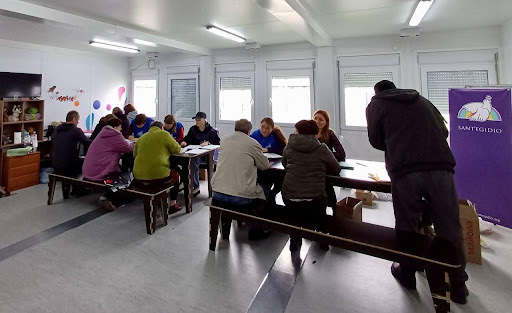
Through USAID’s Local Works program, CSE is expanding its humanitarian aid distribution and working to build the resilience of Ukrainian communities so that they can better respond to the impacts of the protracted crisis. Using their established service centers, CSE delivers meals, non-perishable food, clothing, blankets, mattresses, and hygiene kits to internally displaced persons (IDPs) and unhoused individuals. CSE also employs a decentralized assistance model to meet vulnerable populations which, for different reasons, are unable to access care centers or other channels of aid distribution.
|
|
|
In addition to delivering goods, CSE helps internally displaced and unhoused people find and afford housing, including by helping pay rent and connecting individuals with shelter and cohabitation accommodations.
Through these efforts, CSE has trained and mentored Ukrainian volunteers and aid workers, equipping them with the necessary tools and knowledge to continue and grow interventions in their communities. In March 2024, a cohort of 30 CSE Ukrainian volunteers traveled to Rome to participate in peer-to-peer training activities.
|
|
Sant’Egidio delivers food parcels to 240 displaced elderly residents in Lviv. (Photo Credit: Community of Sant'Egidio)
|
|
The volunteers took part in eight capacity-building sessions under the guidance of Sant’Egidio volunteers with experience working in other conflict zones. Topics of the sessions included history and practice of volunteering, CSE approach and experience, reception and integration of IDPs and war victims, services for unhoused individuals, support to vulnerable minors through the CSE Schools of Peace, food preparation and distribution, and storage of first aid items and medicines. |
|
USAID’s Senior Advisor for Faith Engagement Advances Multilateral Partnership Opportunities in Rome |
|
|
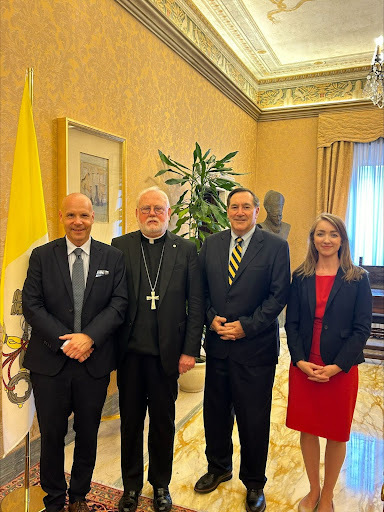
Dr. Peter Mandaville (left) and Amanda Vigneaud (right) meet with Archbishop Paul Gallagher, Vatican Secretary for Relations with States (second from left) and Joe Donnelly, US Ambassador to the Holy See (second from right).
|
|
|
In his first overseas trip as USAID’s Senior Advisor for Faith Engagement, Dr. Peter Mandaville traveled to Rome, Italy, where he convened a range of meetings with key stakeholders and partners, including the Vatican, to discuss the religious dimensions of today's most challenging development and humanitarian issues.
Accompanied by Center for Faith-Based and Neighborhood Partnerships Initiative Lead Amanda Vigneaud, Dr. Mandaville attended and spoke at two conferences with civil society partners - including a gathering highlighting the need for interfaith engagement in peacebuilding and a convening on international religious freedom and integral human development.
|
|
|
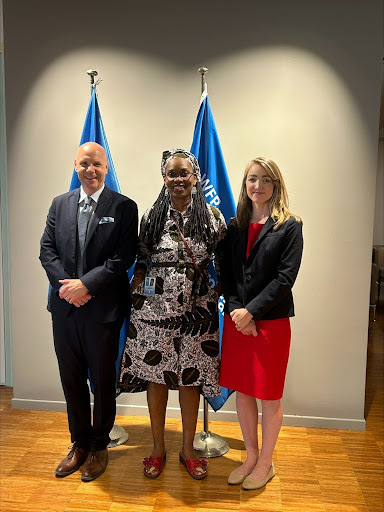
Dr. Peter Mandaville (left) and Amanda Vigneaud (right) meet with Veronique Saint-Luce, Chief of the Operational Partners Unit (center) at the World Food Programme.
|
|
Following these engagements, Dr. Mandaville and Ms. Vigneaud met with leadership from the World Food Programme, as well as the Community of Sant’Egidio and Doctors for Africa CUAMM, to discuss strategic engagement with religious actors and opportunities for mutual learning and cooperation.
To conclude the trip, Dr. Mandaville and Ms. Vigneaud met with Archbishop Paul Gallagher, Vatican Secretary for Relations with States, and presented USAID’s Strategic Religious Engagement Policy. Their discussion covered a range of topics, including the religious dimensions of geopolitical crises and opportunities for engaging faith actors to combat climate change and advance human rights.
|
|
|
The Center for Faith-Based and Neighborhood Partnerships is part of the Local, Faith, and Transformative Partnerships (LFT) Hub, situated within USAID's Bureau for Inclusive Growth, Partnerships, and Innovation (IPI).
The LFT Hub focuses on strengthening USAID’s ability to partner with non-traditional and diverse actors including local, faith-based, and community organizations; schools and hospitals; minority-serving institutions; foundations; diaspora communities; cooperatives; and volunteer organizations. Learn more about how LFT is harnessing the power of partnerships through the following:
|
|
|
|
|