|
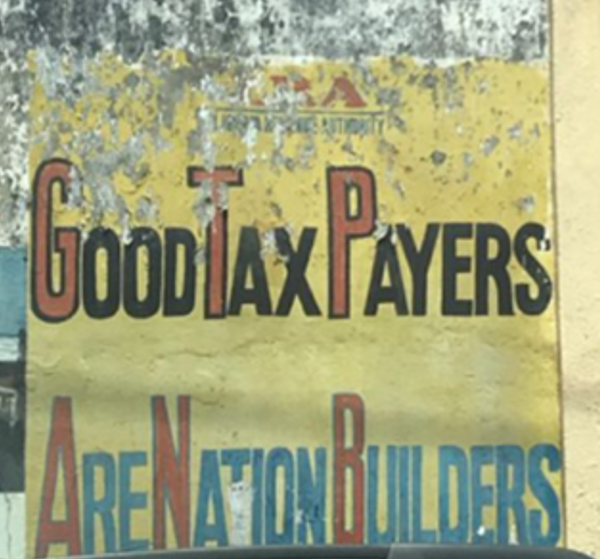
A portion of a taxpayer education mural in Liberia. Photo: Steve Rozner, DDI/DRG
At the second Summit for Democracy, President Biden said, "The great strength of democracy is that it gives us all the tools we need for self-government and self-improvement." Transparent and accountable public financial management (PFM) is a power tool in our democratic toolbox. PFM refers to the national and subnational government policies, procedures, and infrastructure for planning, directing, controlling, monitoring, and reporting on the effective and efficient use of public financial resources.
Critical to democracy promotion, good PFM provides democratic regimes with the resources needed to support state operations, especially those delivering the services that citizens care about (among others: health, education, water and sanitation), thereby strengthening the social contract. Good PFM also helps reduce opportunities for corruption and better detects corruption when it occurs, thus mitigating one of the forces most damaging to democratic resilience.
This month’s Democracy, Human Rights, and Governance (DRG) Learning Digest examines the following ways DRG practitioners can leverage PFM to enhance democracy assistance:
- Good PFM keeps public officials accountable
- Responsible PFM helps democracies deliver better services
- Democracy and PFM can be mutually reinforcing
- The tools you need: practitioner resources for PFM
Please make use of DRG Evidence and Learning Team resources! For a list of resources, refer to the text box at the end.
Good PFM keeps public officials accountable
The Open Contracting Partnership found that public procurement for goods, services, and works is a $13 trillion market globally, with one-third of that going to contracts with companies, but less than three percent of public procurement is published openly. A World Bank study of 34,000 companies in 88 countries found that competition was higher and kickbacks were fewer and smaller in places where transparent procurement, independent complaint procedures, and external auditing are in place. PFM institutions create checks and balances on the use of public funds, limiting vulnerabilities for wasteful spending, mismanagement, and misuse. Similarly, there is evidence that increased tax revenue collection can motivate greater civic participation, creating a citizen check in line with these institutional checks that benefit democratic system performance.
One important institutional check within governments are Supreme Audit Institutions (SAIs). Well-functioning SAIs are independent national agencies with a broad mandate to conduct rigorous reviews of government financial management processes, regulatory compliance, and value for money. When audits are made public, they help citizens decide if politicians should be re-elected. A Brazilian program, Programa de Fiscalização por Sorteios Públicos (Monitoring Program with Public Lotteries), assigned municipalities randomly to be audited, and the published reports informed citizens of cases of mismanagement or corruption. A 2007 study of the program found that for every additional violation in an audit report, a mayor’s likelihood of re-election fell by an average of about 20 percent. This effect was magnified when findings were discussed on local radio stations. Radio coverage of audit findings also helped incumbents without negative findings, increasing the likelihood a well-performing mayor was re-elected by about 20 percentage points. A 2016 study of the program found that municipalities that had been audited previously were less prone to corruption in future audits. Similarly, a recent impact evaluation conducted by USAID/Ghana found that central government audits of subnational governments reduced the incidence of partisan manipulation of public resources by politicians.
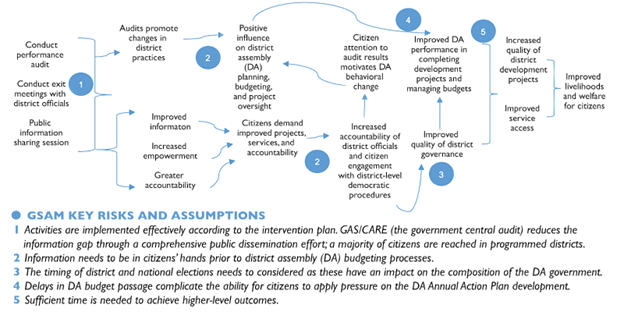 Government central audit causal theory with assumptions numbered in the blue circles, from USAID/Ghana’s impact evaluation, demonstrates how audits should lead to improved citizen livelihood and welfare.
Fiscal councils are independent public agencies that provide accountability around levels of public spending, deficits, and debt by assessing fiscal policy and developing macroeconomic forecasts. A 2022 legal analysis found that fiscal councils enhance the checks and balances between the executive and legislative branches of government when they report to the legislature. Further, the rich literature on fiscal councils has shown that they “improve democratic accountability and discourage opportunistic shifts in fiscal policy, such as pre-electoral spending sprees, by fostering transparency over the political cycle... such bodies can raise public awareness about the consequences of certain policy paths, and thereby contribute to a culture of stability in public finances.”
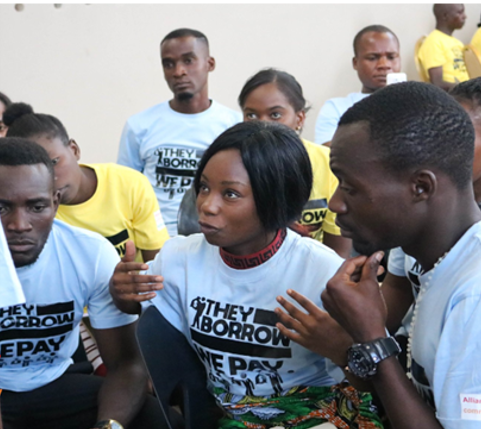
Zambian youth mobilize around debt and fiscal management. Photo: Zambian Alliance for Community Action.
Many researchers have posited that expanding taxation can reinforce democratic tendencies by motivating citizen taxpayers to demand accountability over the use of their taxes — a sort of “no taxation without representation” effect. For example, a 2018 study using a cross-national time-series dataset found that introduction of a value-added tax (VAT) increases the likelihood of democratization, and that civic engagement related to the tax intensifies the effect. Likewise, another 2018 study found that increased reliance of a country on tax revenues (rather than non-tax revenues) has a stabilizing effect in existing democracies; this effect is in part due to the typically damaging effects of natural resource rents on democratic resilience but may also point to a way to reinforce democracy through the tax system. Further, a 2020 study provides evidence from the Democratic Republic of Congo, a fragile state, that citizens demand more of a voice and their political participation increases when the government tries to tax them.
Responsible PFM helps democracies deliver better services
Citizen trust in government is reinforced when that government delivers quality health, education, and public infrastructure services — and PFM plays a vital role in the delivery of these services. The government’s budget is a fiscal translation of a country’s socio-economic and political values, choices, and priorities. Therefore, both budget formulation and delivery of services through the implementation of the budget have the potential to enhance democratic values and trust in government, particularly when done in a transparent, participatory, and accountable manner.
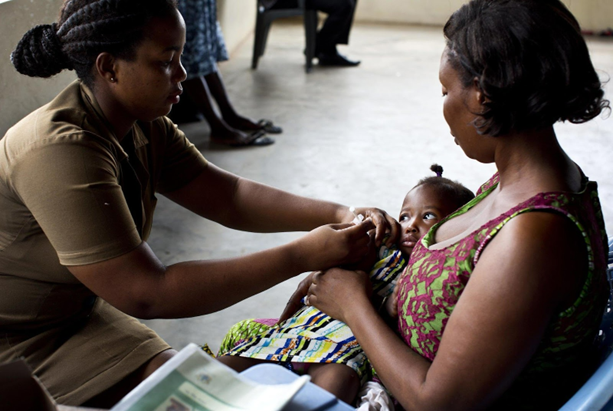 A nurse vaccinates a baby at a clinic in Accra, Ghana. Photo: Kate Holt, MCSP.
Strong PFM reduces opportunities for corruption and increases the efficiency of delivering services — enabling the government to deliver more services with existing resources. A study of Brazil’s municipal auditing program found that audited municipalities experienced greater improvement in performance overall compared to unaudited municipalities, indicating that oversight programs improve not only transparency and accountability but also the provision of public services. A 2019 study that analyzed 134 countries over two decades found that reductions in corruption in a country were associated with more efficient achievement of sectoral service delivery goals such as reducing child and maternal mortality and secondary dropout rates. A similar 2016 study analyzing health and education spending in several African countries found that the quality of budgetary and financial management had a positive and statistically significant impact on the efficiency of delivery of education and health outcomes such as life expectancy, immunization rates, literacy, and enrollment rates.
Public infrastructure like roads, water, sanitation systems, schools, and hospitals are often the most visible representation of the state in people’s lives. PFM systems play a vital role not only in making sure that infrastructure is delivered at a reasonable cost, but that it is of the quality needed. A 2018 study demonstrated that enhanced oversight by Peru’s Office of the Comptroller General resulted in a reduction in costs of about 15 percent, as well as a higher rate of completion and shorter construction duration. A 2021 review examining the link between the strength of a country’s PFM systems and public investment outcomes found that stronger commitment controls, in particular, had a strong influence on infrastructure performance across sectors.
Democracy and PFM can be mutually reinforcing
Recent evidence makes a strong case that improving PFM systems can enhance democracy through a variety of channels, yet there is also evidence that democracy can lead to better PFM. A 2017 World Bank data analysis of 137 countries demonstrated that having a democratic regime and programmatic parties (parties with an identifiable program or policy) had a positive (albeit small) effect on PFM performance. A 2018 study found an empirical basis to indicate that regional waves of democratization contribute to higher levels of direct and indirect tax revenues. With respect to debt, a 2010 International Monetary Fund study found that democratic regimes were less likely to accumulate debt during resource revenue windfalls. When paired, support to enhance democratic processes and PFM system strengthening activities may be mutually reinforcing — supporting a virtuous cycle.
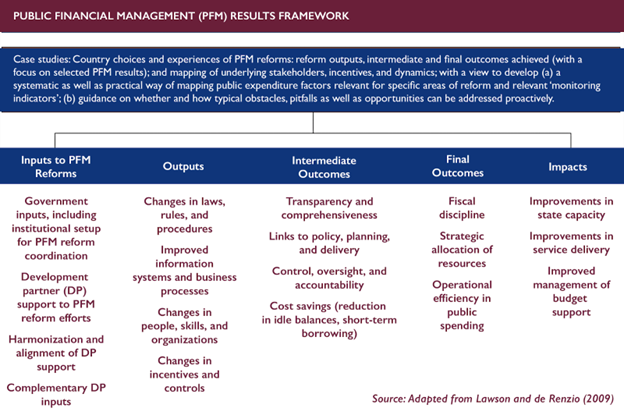 PFM logical framework from a 2017 World Bank Group study. Noting homogeneous approaches to PFM reform with varying results across their case study, the report maps out PFM progress across countries, regions, and income groups to provide guidance on how reformers can better calibrate their approaches to PFM reforms.
The tools you need: practitioner resources for PFM
USAID’s DRG Center provides technical guidance and tools to support the Agency’s PFM work globally, including the newly updated PFM Guide and PFM Primer, as well as recent technical resources on debt management, tax policy, and PFM and political economy analysis.
Further Assistance
To learn more about PFM and how to support PFM programming, contact the DRG Center’s Governance Team at ddi.drg_gov@usaid.gov and Janine Mans at jmans@usaid.gov.
Recent DRG Learning Events
Social and Behavioral Change Community of Practice: Anti-corruption
On Thursday, April 20, the Social and Behavioral Change (SBC) Community of Practice met to discuss recent developments in anti-corruption work and the role of SBC in combating corruption. Julia Rosenbaum of FHI360 and Cheyanne Scharbatke-Church of Besa Global presented on the theoretical space for SBC and lessons on assumptions to look out for. Julia Rosenbaum presented an SBC introduction to anti-corruption work and Cheyanne Scharbatke-Church delivered a fascinating overview of her scholar-practitioner experience on assumptions in anti-corruption programming and their implications for SBC work.
E&L Talk Series: Gender, Deliberation, and Natural Resource Governance: Experimental Evidence from Malawi
Interventions to combat climate change often strive to promote gender balance so that men and women have an equal right to participate in, and benefit from, these programs. Yet, whether and how women's participation affects climate governance is still poorly understood. On April 27, Professor Amanda Clayton, Vanderbilt University, joined the DRG Center to discuss her research examining the causal effect of women's representation in climate-related deliberations using the case of communally managed forests in rural Malawi. Using a lab-in-the-field experiment that randomly varied the gender composition of six-member groups asked to deliberate and then vote on solutions to combat deforestation, her research team found that when women are in the majority, they are more likely to sway group decisions to meet their pre-treatment preferences. These findings suggest that including women in decision-making can shift deliberative processes and outcomes in support of historically marginalized resource users.
E&L Talk Series: Building Fiscal Capacity in the Democratic Republic of Congo
On May 10, Jonathan Weigel, University of California Berkeley, joined the DRG Center to discuss three recent studies about building tax capacity in the Democratic Republic of Congo. The first shows that a door-to-door property taxation campaign increased property tax compliance and political participation. The second compares the effects of tax collection between local elites and state agents, showing that tax collection by local elites increased tax compliance because local elites used local information to efficiently target households with high payment propensities. The third examines the effects of a policy experiment that randomly assigned 38,028 property owners to the status quo tax rate or to a rate reduction. The policy experiment found that reducing tax rates by about one-third would maximize government revenue through increased tax compliance, but substantially increasing revenue may require increasing tax rates in tandem with enforcement to increase compliance.
Tuesday Group: Human Rights Documentation
Documenting human rights violations is a crucial step toward achieving justice and accountability for victims of human rights violations. On May 16, the DRG Center welcomed Videre to discuss their efforts to bridge frontline community knowledge in closed societies and change agents at the local, national, regional and international levels. They highlighted the importance of documentation to shed light on a wide range of abuses, inform advocacy and policy-making efforts, support victims and survivors, and hold perpetrators accountable. They also introduced a forthcoming human rights documentation design guide and shared their insights into challenges and opportunities on the horizon.
Social and Behavioral Change (SBC) Community of Practice
On Thursday, May 18, the SBC Community of Practice met for a unique presentation on decolonial theory and its application to development work and SBC programming. Dr. Natasha Bharj, from Ithaca College, facilitated a discussion about the potential value that decolonial theory can bring to development programs and research. The talk reviewed the central tenants and strategies of decolonial theorists, before moving to a broader discussion of how these strategies have been and can be implemented in development work.
Use Our Resources!
Welcome to the DRG Learning Digest, a newsletter to keep you informed of the latest learning, evaluation, and research in the Democracy, Human Rights, and Governance (DRG) sector. Views expressed in the external (non-USAID) publications linked in this Digest do not necessarily represent the views of the United States Agency for International Development or the United States Government.
Don't forget to check out our DRG Learning Menu of Services! (Link only accessible to USAID personnel.) The Menu provides information on the learning products and services the Evidence and Learning Team offers to help you fulfill your DRG learning needs. We want to help you adopt learning approaches that emphasize best fit and quality.
The Evidence and Learning Team is also excited to share our DRG Learning, Evidence, and Analysis Platform (LEAP) with you. This Platform contains an inventory of programmatic approaches, evidence gap maps, the DRG Learning Harvest, and inventories of indicators and country data portraits - all of which can be very useful in DRG activity design, implementation, evaluation, and adaptation. Some of these resources are still being built, so check back frequently to see what has been newly added.
The DRG Learning Harvest on LEAP is a searchable database of DRG learning products, including summaries of key findings and recommendations, drop-down menus to easily find documents related to a particular country or program area, and links to the full reports on the DEC.
Our friends at the Varieties of Democracy (V-Dem) Institute are also seeking to expand their research partnership with USAID on the complex nature of democracy by inviting research questions from you for V-Dem to work on. If there's a DRG technical question you've been wondering about, please email the Evidence and Learning Team at ddi.drg.elmaillist@usaid.gov.
We welcome your feedback on this newsletter and on our efforts to promote the accessibility, dissemination, and utilization of DRG evidence and research. Please visit the DRG Center's website for additional information or contact us at ddi.drg.elmaillist@usaid.gov.
|